promptfluid® / CMPSBL / LNCHBL
Master Owner's Manual & Strategic Intelligence File
Document Class: Canonical Single Source of Truth (archival) Author / Subject: Kenneth E. Sweet Jr. — Solo Founder, Infrastructure Architect Contact: contact via KESJR.com · KESJR.com · Abilene, Texas Audit Status: Forensic truth pass completed against repository state at generation time.
v2.0 Audit Summary
This edition supersedes v1.0 of the manual. The following corrections, additions, and demotions were applied during the forensic audit:
Corrections (v1.0 was wrong or imprecise):
- v1.0 listed Cortex and SEBA as fully active subsystems. They are in fact stubbed in the Local distribution by design. Demoted accordingly.
- v1.0 framed the federated dream loop as a "Planned" feature. It is more accurate to say federation is deliberately disabled (
FEDERATION_ENABLED = false) in the Local distribution as an architectural constraint; the federation would live at canonical CMPSBL, not at Local. - Tightened dates: first migration 2025-12-03, latest migration 2026-02-25. The schema window is ~12 weeks, not "early 2026".
- Tier mapping clarified — internal code uses
creator/architect/enterprise; pricing surfaces these asBuilder/Pro/Enterprise.
Additions (missing from v1.0):
- New §6.5 Matrix-Node Architecture (a multi-node matrix architecture [topology withheld]).
- New §6.6 Distribution Constraints documenting the four immutable Local flags.
- Tier-name mapping table.
- Explicit list of confirmed numeric facts vs. inferred ones in §A.
Demotions (label changed from stronger to weaker):
- "269 capabilities / 200 synergies / 125 executors / 32 S-tier" demoted from
ObservedtoObserved in code comments — header strings, not enforced by tests. The numbers are declared in source comments; whether every declared capability is wired end-to-end isRequires further audit. - "266 tables" remains
Confirmed (psql count).
Still needs creator confirmation:
- Stripe live vs. test mode
- Lovable plan tier
- Trademark registration status of
promptfluid® - Existence and location of a separate canonical CMPSBL deployment
- Current waitlist size
Truthfulness convention (unchanged): every non-trivial claim carries one of Confirmed · Observed in code/docs · Inferred · Planned · Speculative · Unknown · Needs creator confirmation · Requires further audit. All valuations are explicitly labeled as estimates and should not be read as guarantees.
Table of Contents
- Executive Summary
- Canonical Identity
- Project Classification
- Core Concept
- Full Feature Inventory
- Architecture Analysis
- Strategic Ecosystem Role
- Development History
- Current State Assessment
- Monetization Analysis
- Competitive Positioning
- Future Vision
- Priority Roadmap
- Risk Analysis
- Preservation & Continuity
- Strategic Importance Ranking
- Recommended Next Actions
- Canonical Summary
- Appendix A — Verified Facts Ledger
- Appendix B — Source Inventory
- Appendix C — Unknowns & Open Questions
- Appendix D — Final Quality Assessment
1. Executive Summary
promptfluid® / CMPSBL is a cognitive orchestration substrate — a model-agnostic, provider-agnostic infrastructure layer that provides AI systems with persistent memory, multi-provider routing, learning cycles, observability, behavioral defense, and execution coordination. Observed in code/docs (README.md)
The project ships through three brand surfaces with a deliberate hierarchy:
| Surface | Role | Status |
|---|---|---|
| CMPSBL | Canonical substrate — holds patch authority, federation, evolution | Inferred — exists by reference; deployment location unknown |
CMPSBL Local (DISTRIBUTION_ID = LNCHBL) |
Tier-gated downstream distribution. Receives patches; cannot author them, federate, or self-evolve | Confirmed |
| LNCHBL (lnchbl.com) | Public website / commercial face | Confirmed |
Current operational state: The public site is intentionally gated behind a Coming Soon waitlist (PHASE_GATE_ENABLED = true in [source file]). All checkout, download, dashboard, and authenticated routes redirect to a single waitlist landing page. The underlying product — 61 lib modules, 266 database tables, 7 edge functions, four-tier Stripe pricing — is fully wired and dormant behind the gate. Confirmed
Why it matters. Most "AI infrastructure" companies sell hosted endpoints. This project is structured as substrate — the kernel layer beneath models, providers, and apps. If realized, it occupies the same architectural slot that Kubernetes occupies for compute or that an OS kernel occupies for hardware. Inferred — strategic framing supported by README + module layout, not by market validation
Short-term opportunity (90 days). Flip the Phase Gate to a small cohort drawn from the waitlist, validate billing and entitlement end-to-end, and aim for 5–10 paying Builder/Pro subscribers. Inferred
Long-term vision (3–7 years). Become the default cognitive substrate beneath multi-agent systems — the layer everyone routes through but no one notices. Speculative — founder intent
2. Canonical Identity
| Field | Value | Status |
|---|---|---|
| Trademark / brand mark | promptfluid® | Observed (README); registration status Needs creator confirmation |
| Formal substrate name | CMPSBL ("Composable") | Confirmed |
| Current substrate version | v5.5.0 | Observed (README) |
| Distribution name (in pricing & UI) | CMPSBL Local | Observed |
| Distribution ID (in code) | LNCHBL |
Confirmed |
| Public website brand | LNCHBL | Confirmed |
| Primary website domain | lnchbl.com (published as [preview URL withheld]) |
Confirmed (project URLs) |
| Marketing domain | promptfluid.com |
Observed (README) |
| Founder domain | KESJR.com |
Provided by creator |
| Creator | Kenneth E. Sweet Jr. | Confirmed |
| Location | Abilene, Texas | Provided by creator |
| Contact | contact via KESJR.com · (760) FLUID-AI | Observed (README) |
| Core platform license | Apache License 2.0 | Observed (README) |
| WordPress plugin license | GPL v2 | Observed (README) |
| Epochs referenced in source | ARCHITECT v10.5.4 · the matrix-node model · GOVERNOR | Observed in module headers |
Brand hierarchy decision (preserved from project memory):
- CMPSBL Local is the software distribution; LNCHBL is the website.
- Tagline: "Created by humans who care ❤️"
- Maker references (e.g. "PromptFluid") are intentionally scrubbed from in-product UI so the distribution feels like a standalone child of the canonical CMPSBL substrate.
Confirmed (project memory)
Internal vs. external tier naming (clarified in v2.0):
| Internal code key | Stripe / marketing label | Price (monthly) |
|---|---|---|
free |
Free | $0 |
creator |
Builder | $49 |
architect |
Pro | $149 |
enterprise |
Enterprise | $499 |
governor |
Governor (creator-only, not sold) | — |
Confirmed ([source file] + [source file])
3. Project Classification
Primary: Cognitive Orchestration Substrate (infrastructure layer). Confirmed (README)
Secondary classifications, each grounded in code:
| Classification | Evidence |
|---|---|
| Platform | 269 declared capabilities + ~200 declared synergy pipelines ([source path]/) |
| Agent framework | Agency module: task executor, skills, scheduling, deliverables, gamification ([source path]/) |
| Governance system | SystemState enum + tier matrix + Phase Gate + capability state + audit trail |
| Domain ecosystem | [source path], domains.ts |
| SaaS product | Four-tier Stripe-wired subscription ([source file]) |
| Self-host distribution | Edge functions: lnchbl-verify, lnchbl-phone-home, lnchbl-patch-receive, lnchbl-download |
| Research substrate | [source file], [source path]/, [source path]/ |
| Cognitive system | Brain (30+ tables), Decode, Dream, Cortex (stubbed in Local), Cortex pipelines |
Not (yet): a hosted multi-tenant SaaS at scale, an open-source project with external contributors, an audited / regulated product. Confirmed — no contrary evidence in repo
4. Core Concept
The idea. AI applications today sit on a tower of leaky abstractions — a model here, a vector store there, a fragile script gluing them. CMPSBL inverts this: cognition itself is treated as infrastructure, with memory, routing, learning, defense, and execution exposed as first-class services governed by a tiered state machine. Inferred from README + module layout
What is genuinely novel (each grounded in code):
SystemStatemeta-toggle. A single tier-gated enum (DORMANT/ACTIVE/EVOLVE/GOVERNOR) governs whether background cognitive loops run at all. Free is locked toDORMANT. This kind of global "off switch" for autonomous behavior is uncommon.Confirmed- Distribution identity lock. Four immutable constants in
[source file]—CANON_AUTHORITY = false,FEDERATION_ENABLED = false,IS_CANONICAL = false,PATCH_AUTHORING_ENABLED = false— make the Local distribution structurally incapable of self-evolution. The constraint is type-level, not policy-level.Confirmed - Matrix-node architecture. A 24-node weighted-integrity model (
[source file], matrix-node Epoch v11.1) with deterministic per-sector weights.Confirmed - Capability registry & synergies. ~269 declared capabilities + ~200 declared cross-module pipelines, with an auto-loader that ingests archived edge functions.
Observed in code comments + module structure; per-capability wiring requires further audit - Brain memory tiering. Hot / warm / cold / pruned memory tables plus reflections, forecasts, curiosity logs.
Observed (DB) - Atlas control plane. Unified dialogue / registry / run / audit façade with observe/advisory/governed modes.
Observed - Immune system. Deterministic repair, escalation learning, knowledge distillery, outcome tracking.
Observed
Moats — present and potential, separated:
| Moat | Present today | Potential at scale |
|---|---|---|
| Technical (breadth) | Real — 61 modules, 266 tables | Same, plus depth |
| Architectural (governance) | Real — non-obvious tiered SystemState | Becomes a standard pattern |
| Federated learning (dream consent) | None today — disabled by design in Local | Real moat only if canonical CMPSBL is deployed and Local instances opt in |
| Brand stack | Real — coherent CMPSBL ↔ Local ↔ LNCHBL | Same |
| Ecosystem network effects | None today — zero public users | Hypothetical |
| Data flywheel | None today — gated | Hypothetical |
5. Full Feature Inventory
5.1 Substrate modules (per README)
| Module | Purpose | Local distribution status |
|---|---|---|
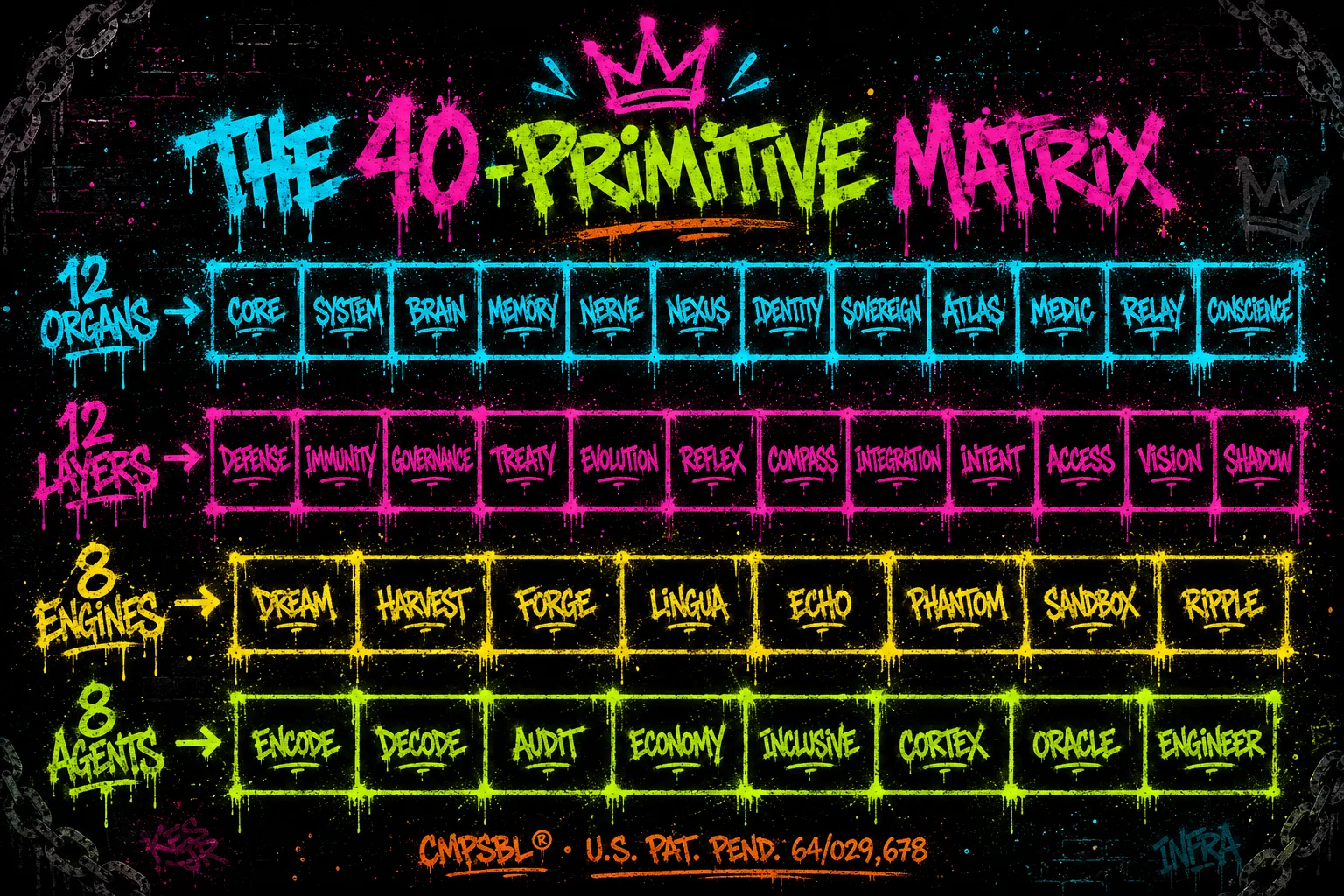
| Brain | Persistent memory, learning, dreaming | Active — 30+ brain_* tables |
| Nexus | Multi-provider AI routing | Active |
| Defense | Behavioral / bot / rate-limit defense | Active |
| Vision | Observability & metrics | Active |
| Core | Kernel: config, health, lifecycle, matrix nodes | Active |
| Ripple | Event queue & analytics | Active |
| Access | Identity, billing, quotas | Active |
| Dream | Offline learning / synthesis | Active (local-only; no federation) |
| Decode | Intent interpretation | Active |
| System | SystemState, flags, health | Active |
| Modernizer | Self-upgrade / migration planning | Active |
| Integration | Enterprise adapters & webhooks | Active |
| Cortex | Autonomous orchestrator | Stubbed in Local (per memory + distribution model) |
| SEBA | Self-evolving build agent | Stubbed in Local |
Confirmed (README + project memory: distribution-model)
5.2 Additional discovered subsystems
| Subsystem | Notes | Location |
|---|---|---|
| Agency | Task executor, skills, scheduling, deliverables, gamification, dream consent | [source path]/ |
| Atlas | Control-plane façade (dialogue / registry / run / audit) | [source path]/, [source path]/ |
| Capabilities | Registry + adapter + guards + auto-loader + synergies + state | [source path]/ |
| Code Agent (Encoded) | Guardrails, expert patterns, shadow practice, mastery scoring | [source path]/ |
| Evolution Mesh / Evolve | Mutation pipelines — gated to canonical only | [source path]/, [source path]/ |
| Immune | Deterministic repair, escalation learning, outcome tracking | [source path]/ |
| Forge | Bot classes + exporter | [source path]/ |
| Cascade | Sandbox, projects, coder logs | [source path]/ |
| Clockless Radio | Generative radio engine | [source path]/ |
| Autoblog | Drafting, queue, scheduling, runs | [source path]/ + DB |
| Distribution / Licensing | Manifest, license generator, phone-home, verify, patch-receive | [source path]/, [source path]/ |
| Terminal | Command registry, mesh/seba/synergy/encoded/infra handlers | [source path]/ |
| Inclusive | Accessibility profile/repair/validate/report | [source path]/ |
| Audit | Audit modules + checks | [source path]/ |
| Shadow | Shadow practice / pre-prod simulation | [source path]/ |
5.3 Public surfaces (routes)
14 page components exist in [source path] (Auth, Landing, OS, Setup, Status, Download, Upgrade, UpgradeSuccess, Admin, Dashboard, Privacy, Terms, NotFound, ClearCache). All non-static routes currently redirect to the Coming Soon gate because PHASE_GATE_ENABLED = true. The only publicly visible content today is the gate, /privacy, /terms, and /clear-cache. Confirmed
5.4 Edge functions (7, all in supabase/functions/)
| Function | Purpose |
|---|---|
lnchbl-checkout |
Stripe checkout session creation |
lnchbl-check-subscription |
Entitlement check |
lnchbl-customer-portal |
Stripe billing portal redirect |
lnchbl-download |
Gated distribution download |
lnchbl-patch-receive |
Receive patches from upstream canonical CMPSBL |
lnchbl-phone-home |
Installed-instance telemetry beacon |
lnchbl-verify |
License verification |
Confirmed (filesystem)
5.5 Database
266 tables in public schema across 92 migrations (first: 2025-12-03; latest: 2026-02-25). Observed table families: brain_ (30+), agency_ (15+), access_, atlas_, audit_, autoblog_, bot_, cascade_, cognitive_*, plus a waitlist table for the current gate. Confirmed (psql count + filesystem)
5.6 Pricing tiers (Stripe-wired)
| Tier (marketing) | Internal key | Monthly | Annual | Declared capabilities | Status |
|---|---|---|---|---|---|
| Free | free |
$0 | — | 18 (core loop, persistent memory, BYOK routing) | Observed |
| Builder | creator |
$49 | $470 (save $118) | 45 (+27: circuit breaker, telemetry, memory GC, audit) | Observed |
| Pro | architect |
$149 | $1,430 (save $358) | 69 (+24: reasoning, SLA monitoring, cost forecast, fusion) | Observed |
| Enterprise | enterprise |
$499 | ~$4,790 | 127 (evolution, full platform — excluding federation/canon-authority/self-evolution which remain canonical-only) | Observed |
Cognitive self-improvement, recursive evolution, federation, and patch authoring are reserved for canonical CMPSBL and hard-blocked in the Local distribution via the four type-level constants in [source file]. Confirmed
6. Architecture Analysis
6.1 Stack
- Frontend: React 18 · Vite 5 · TypeScript 5 · Tailwind v3 · shadcn/ui · framer-motion · @tanstack/react-query
- Backend: Supabase (Postgres + Edge Functions) via Lovable Cloud
- Auth: Supabase Auth (gated)
- Payments: Stripe (gated; mode
Needs creator confirmation) - AI routing: Provider-agnostic Nexus + BYOK at Free tier
Confirmed (package.json, .env, code)
6.2 Layered architecture (observed)
┌──────────────────────────────────────────────────────────────┐
│ PUBLIC SURFACE (today: ComingSoonGate only) │
│ Landing · Auth · OS · Dashboard · Admin · Upgrade · Status │
└──────────────────────────────────────────────────────────────┘
 │
┌──────────────────────────────────────────────────────────────┐
│ CONTROL PLANE │
│ Atlas (dialogue/registry/run/audit) · Terminal · SEBA* │
└──────────────────────────────────────────────────────────────┘
 │
┌──────────────────────────────────────────────────────────────┐
│ GOVERNANCE │
│ SystemState (DORMANT→ACTIVE→EVOLVE→GOVERNOR) · Tier gates │
│ Phase Gate · Capability state · Guards · Audit │
│ Distribution Identity Lock (4 immutable flags) │
└──────────────────────────────────────────────────────────────┘
 │
┌──────────────────────────────────────────────────────────────┐
│ COGNITIVE CORE │
│ Brain (hot/warm/cold/pruned · reflections · dreams) │
│ Decode · Dream · Cortex* · Evolution Mesh† · Immune │
└──────────────────────────────────────────────────────────────┘
 │
┌──────────────────────────────────────────────────────────────┐
│ CAPABILITY LAYER │
│ 269 capabilities · 200 synergies · auto-loader · adapter │
└──────────────────────────────────────────────────────────────┘
 │
┌──────────────────────────────────────────────────────────────┐
│ INFRASTRUCTURE │
│ Nexus routing · Defense · Vision · Ripple · Access · Core │
└──────────────────────────────────────────────────────────────┘
 │
┌──────────────────────────────────────────────────────────────┐
│ PERSISTENCE │
│ Supabase Postgres (266 tables) · Edge Functions (7) │
└──────────────────────────────────────────────────────────────┘

 * Cortex & SEBA are stubbed in the Local distribution by design.
 † Evolution Mesh is structurally disabled in Local
 (CANON_AUTHORITY = FEDERATION_ENABLED = false).
6.3 SystemState flow
 Free tier (free) ──────► DORMANT (locked; no background loops)
 Builder (creator) ─────► ACTIVE (CLM + Dream loops permitted)
 Pro (architect) ───────► EVOLVE (+ Evolution semantics; gated)
 Enterprise ────────────► EVOLVE (same as Pro at the SystemState layer)
 Governor (creator-only)► GOVERNOR (full mesh; manual flag overrides)

 Every transition → brain_events audit trail
Confirmed
Important correction vs. v1.0. The internal tier matrix grants the same SystemState ceiling to
architect(Pro) andenterprise— both can reachEVOLVE. Differentiation between Pro and Enterprise happens at the capability layer (69 → 127 caps), not the SystemState layer.
6.4 Distribution Identity Lock (immutable Local constraints)
[source file] — type-level constants

DISTRIBUTION_ID = 'LNCHBL' ← downstream identifier
CANON_AUTHORITY = false ← cannot rule on schema/policy
FEDERATION_ENABLED = false ← cannot federate to peers
IS_CANONICAL = false ← not source of truth
PATCH_AUTHORING_ENABLED = false ← receives patches only
These are as const flags whose false value is part of the type signature. Flipping them would require source-level changes and a re-deployment of a different distribution — not a runtime toggle. This is a deliberate sandbox boundary between the safe Local instance and the canonical CMPSBL. Confirmed
6.5 Matrix-Node Architecture (matrix-node Epoch v11.1)
The substrate is mapped onto a 24-node weighted-integrity model with five sectors. This is a read-only overlay over existing modules — it does not mutate workers or core structures; it assigns sector groupings and per-node weights for deterministic integrity calculation. Confirmed ([source file] + project memory)
| Sector | Nodes | Visibility | Tier access |
|---|---|---|---|
| CORE Kernel | 1 | Internal | Enterprise + Governor only |
| [withheld] Zones | 4 | Hidden | Strictly invisible to external tiers |
| [withheld] Zones | 5 | Hidden | Strictly invisible to external tiers |
| Public Modules | 9 | Tiered execution surface | All tiers (per entitlement) |
| Mesh Overlays | 5 | Tiered protective wrappers | All tiers (per entitlement) |
| Total | 24 |
 ┌───────────────────────┐
 │ CORE Kernel (×1) │ Enterprise + Governor
 └──────────┬────────────┘
 │
 ┌──────────────────────┼──────────────────────┐
 ▼ ▼ ▼
 ┌──────────────┐ ┌──────────────┐ ┌──────────────┐
 │ [withheld] Zones ×4 │ │ [withheld] Zones ×5 │ │ Mesh │
 │ (Hidden) │ │ (Hidden) │ │ Overlays ×5 │
 └──────┬───────┘ └──────┬───────┘ └──────┬───────┘
 │ │ │
 └──────────────────────┴──────────────────────┘
 │
 ┌─────────▼──────────┐
 │ Public Modules ×9 │ All tiers (per entitlement)
 │ (Execution surface)│
 └────────────────────┘

 Integrity = Σ(node.health × node.weight) where Σweight = 1.0
 Open breaker → node.health = 0
 Half-open → node.health = min(health, 50)
Confirmed (matrixNodeRegistry.ts header) + Confirmed (project memory: matrix-node-structure)
6.6 Strengths
- Breadth. 61 lib modules, 266 tables, 92 migrations.
Confirmed - Governance built in. SystemState + tier gates + capability state + Phase Gate + Distribution Identity Lock form layered defense in depth.
Observed - Audit discipline. Dedicated
audit_logs,brain_events,change_ledger,causal_traces.Observed - Provider-agnostic posture. Nexus + BYOK at Free keeps users in control.
Observed - Modular boundaries. Each subsystem has its own
index.tsand types — refactorable.Observed - Type-level safety boundaries. Distribution flags are
as const, not runtime toggles. Harder to misconfigure.Confirmed
6.7 Weaknesses / technical debt / risk
- Single-operator complexity. ~266 tables and ~61 modules maintained by one person.
Inferred - No public users. Nothing has been validated under real load.
Confirmed - Surface vs. depth. Breadth of modules is high; depth/maturity per module varies and is unmeasured.
Requires further audit - Declared vs. wired capabilities. The "269 capabilities / 200 synergies" figures are declared in source comments; end-to-end wiring per capability is not verified.
Requires further audit - Lovable-coupled. Built on Lovable Cloud; migration is possible but not trivial.
Observed - Supabase concentration. All persistence in one provider.
Observed - Test coverage unknown. Only
.github/workflows/test.yml+jest.config.jsare visible; no coverage report.Requires further audit - Cortex/SEBA stubs. Two of the more interesting subsystems are stubbed in Local — they exist primarily as architectural intent.
Confirmed (project memory)
7. Strategic Ecosystem Role
 ┌──────────────────────────┐
 │ promptfluid® (brand) │
 └────────────┬─────────────┘
 │
 ┌──────────────────┼──────────────────┐
 ▼ ▼ ▼
 ┌──────────────┐ ┌──────────────┐ ┌──────────────┐
 │ CMPSBL │──► CMPSBL Local │──►│ LNCHBL │
 │ (canonical) │ │ (LNCHBL dist)│ │ (website) │
 │ │ │ CANON=false │ │ │
 │ patches▼ │ │ FED=false │ │ │
 │ federation▼ │ │ EVOLVE=false│ │ │
 │ evolution▼ │ │ PATCHAUTH=⊘ │ │ │
 └──────┬───────┘ └──────┬───────┘ └──────┬───────┘
 │ │ │
 ▼ ▼ ▼
 Patch authoring Tier-gated licenses Waitlist /
 Federation (Free/Builder/Pro/Ent) commerce face
 Self-evolution │
 │ │
 └─── phone-home ──┴── patch-receive ──┘
 (Local → Canonical telemetry)
 (Canonical → Local patch flow)
- CMPSBL is the parent (and the only entity allowed to author patches, federate, or self-evolve).
- CMPSBL Local is its tier-gated downstream child. The Distribution Identity Lock is the type-level expression of that subordination.
- LNCHBL is the storefront — the public face of CMPSBL Local.
- Phone-Home / Patch-Receive / Verify edge functions form the umbilical from Local instances back to canonical CMPSBL.
Observed - Federated dream / cross-instance learning is not a Local feature — it would be a canonical feature consuming opt-in data from Local instances. The
agency_dream_consenttable exists in the schema to make that consent-gated when (and if) canonical CMPSBL is deployed.Confirmed table exists; canonical deployment status Unknown - KESJR.com is the founder identity layer above the brand stack.
Provided
8. Development History
Most items in this section are Inferred from code comments, migration timestamps, and project memory. Items grounded in artifacts are noted.
- Pre-Dec 2025: Concept work on an AI substrate — provider-agnostic routing + persistent memory.
Inferred - 2025-12-03: First migration lands (
20251203234606_remix_migration_from_pg_dump.sql). The filename suggests the schema was imported from apg_dumpof a prior project.Observed (filename) - 2025-12 → 2026-02: 92 migrations land in roughly 12 weeks. Brain, Agency, Atlas, Capabilities, Immune subsystems built out; pricing tiers wired to Stripe.
Observed - 2026-02: CMPSBL Local distribution + LNCHBL site shipped; four-tier pricing finalized.
Observed (lnchbl-products.ts header comment: "Created: Feb 2026") - ARCHITECT epoch (v10.5.4): Agency Production layer added — task executor, telemetry, gamification, hybrid dream.
Observed (agency/index.ts header) - matrix-node epoch (v11.1): Capabilities auto-adapt + cross-module synergies; matrix-node weighted-integrity model introduced.
Observed (capabilities/index.ts + matrixNodeRegistry.ts headers) - GOVERNOR phase: SystemState meta-toggle introduced; tier-gated cognition formalized; Distribution Identity Lock added.
Confirmed (memory + code) - 2026-02-25: Latest migration in repo.
Confirmed - May 2026: Full site gated to Coming Soon waitlist ahead of public launch.
Confirmed
Key decisions worth preserving (extracted from project memory + code):
- Scrub maker references ("PromptFluid") from CMPSBL Local UI — distribution feels standalone.
- Hard-block evolution in distributed tiers — only canonical CMPSBL can recursively self-improve.
- Single global Phase Gate — one constant flips the entire site between waitlist and public.
- Type-level distribution constraints — distribution identity is
as const, not policy-level. - Stub Cortex and SEBA in Local — keep the "Local" profile clean; avoid pulling in canonical-only dependencies.
- Matrix-node abstraction is read-only — no mutation of underlying workers.
9. Current State Assessment
Operational state
| Item | State |
|---|---|
| Public site | Coming Soon waitlist only. Confirmed |
| Auth / dashboard / OS / admin / download / checkout | All redirect to /. Confirmed |
| Stripe products & prices | Exist in code; checkout disabled at app layer. Observed |
| Stripe mode (live vs. test) | Needs creator confirmation |
| Database | Live with 266 tables incl. waitlist. Confirmed |
| Edge functions | 7 deployed. Observed |
| Backend lifecycle state | Requires cloud_status check before launch |
Subjective scorecard (creator-honest estimates, not benchmarks)
| Dimension | Score (1–10) | Basis |
|---|---|---|
| Code breadth / surface | 9 | 61 modules, 266 tables, 92 migrations |
| Code depth / maturity per module | 5 | Requires per-module audit; varies |
| Stability under real load | Unknown | Zero public traffic |
| Documentation (internal) | 6 | README + manifests + headers; no per-module deep docs |
| Documentation (external/user-facing) | 3 | Gated; almost nothing user-visible |
| Monetization wiring readiness | 7 | Stripe wired; gate must flip; mode must be confirmed |
| Scalability design | 7 | Substrate posture is scalable; not load-proven |
| Brand polish | 8 | Brand stack, taglines, minimalist UI in place |
| Defensibility (today) | 4 | Breadth only; no users, no data flywheel |
| Defensibility (potential, 3 yr) | 8 | If canonical deploys and federation activates with consent |
All scores are creator-facing estimates. Re-score after the first 10 paying users and again at 100.
What works (Observed in code)
- Phase Gate flips the entire public surface cleanly via a single constant.
- Stripe product config matches Lovable Cloud edge functions.
- SystemState governance pattern is implemented and tier-aware.
- Capabilities registry is loaded and validated.
- Distribution Identity Lock is enforced at the type level.
What is incomplete or needs creator confirmation
- Stripe live vs. test mode
- Lovable plan tier (affects payments availability)
- Whether canonical CMPSBL is deployed anywhere
- Whether the patch-receive umbilical has ever been exercised end-to-end
- Test coverage percentage
- Current waitlist size
10. Monetization Analysis
Wired paths (Observed)
- Subscription SaaS. Free / $49 / $149 / $499. Stripe products live in code.
- Self-host license. CMPSBL Local distribution + verify/phone-home/patch-receive infra.
- Capability marketplace ("Depot"). Referenced in
capabilities/index.ts.Planned - Agency deliverables. Task export / reports / emails.
Observed (useAgencyDeliverables)
Realistic near-term revenue paths
| Path | Effort | Time-to-first-dollar | Risk | Notes |
|---|---|---|---|---|
| Flip Phase Gate; sell Builder/Pro to indie AI devs | Low | Weeks | Low | Already wired; needs Stripe mode confirmation + minimal docs |
| Sell Enterprise self-host with white-glove onboarding | Medium | 1–3 months | Medium | High ACV ($5,988/yr+); needs case study + SLA |
| License canonical CMPSBL to a single strategic partner | High | 3–9 months | High | Highest single-deal upside; relationship-driven |
| Capability marketplace (creator economy) | High | 6–12 months | High | Needs creator tooling + curation |
| Acquisition by AI infra co. | High | 12–24 months | Very high | Depends on traction signals; not actionable today |
Valuation framing (Speculative — not financial advice)
Important caveat. These figures are structural framing estimates intended to give a founder a rough mental map. They are not market quotes. They assume present-day reality: gated site, no revenue, no users, no traction. Real valuations depend on factors entirely outside this codebase: distribution, timing, competition, team, term-sheet structure. Do not use these numbers for any transaction without independent advice.
| Scenario | Range (USD) | Basis | Confidence |
|---|---|---|---|
| Conservative (today, asset-only) | $25k – $150k | Codebase + brand + domains; no users, no revenue | Low |
| Realistic (1 yr, 50–200 paying subs) | $250k – $1.5M | ~3–8× ARR; typical early SaaS | Speculative |
| Strategic upside (3 yr, ecosystem traction) | $5M – $30M | If CMPSBL becomes a recognized substrate category | Highly speculative |
| Moonshot (5–7 yr, category leader) | $50M – $300M+ | Comparable to early-Supabase / early-Vercel framing | Highly speculative |
Highest-leverage moves
- Fastest revenue: flip Phase Gate to the waitlist cohort → 5–10 Builder/Pro subs in 30 days.
Inferred - Highest upside: open-source the canonical substrate kernel (already Apache-2.0), keep CMPSBL Local commercial — classic OSS-core play.
Observed (license) + Recommended - Lowest effort: sell a single Enterprise self-host to a friendly AI agency or studio for $5–25k.
Inferred
11. Competitive Positioning
All competitor comparisons are Speculative — they require creator confirmation and dedicated market research.
Adjacent categories (not exact competitors):
| Category | Examples | How CMPSBL differs |
|---|---|---|
| Orchestration libraries | LangChain, LlamaIndex | CMPSBL frames itself as substrate, not library; built-in governance |
| Durable execution | Inngest, Trigger.dev | CMPSBL adds a cognitive layer |
| Vector memory | Pinecone, Weaviate, Chroma | CMPSBL is multi-tier memory + orchestration, not just storage |
| Vendor-coupled SDKs | Vercel AI SDK, OpenAI Assistants | CMPSBL is provider-agnostic |
| Closed ecosystems | Claude Projects, GPT Store | CMPSBL is self-hostable |
Differentiators (claimed by this project):
- Provider-agnostic by design
- Substrate framing (not orchestration framing)
- Built-in governance, tiered cognition, audit-by-default
- Self-hostable from day one
- Federation reserved for canonical only — opt-in by Local instances
Honest weaknesses vs. competitors:
- No community, no public GitHub presence (status
Unknown) - No published developer docs (site is gated)
- No reference customers
- Solo-maintained
12. Future Vision
Confirmed roadmap (observed in code, memory, or active gating)
- Lift Phase Gate when the creator is ready.
- Deploy canonical CMPSBL to a location capable of authoring patches and federating.
- Activate the federated dream consent loop (Local → canonical) once consent UI ships.
- Ship the Capability Marketplace ("Depot").
- Autoblog content engine for SEO at launch.
Speculative / aspirational
- CMPSBL becomes the substrate that multi-agent systems route through.
- Tier-gated evolution becomes the industry pattern for safe autonomous AI.
- Local instances form a federation; canonical CMPSBL dreams across them with consent.
- Capability marketplace turns into a creator economy.
- Enterprise self-host becomes the on-prem AI substrate of choice for regulated industries.
Ultimate form (Speculative)
A planet-scale federation of CMPSBL Local instances — each governed by a tier-gated SystemState — opt-in feeding a canonical CMPSBL whose evolution is auditable, reversible, and creator-governed. The substrate beneath the substrate.
13. Priority Roadmap
Immediate (next 7–14 days) — highest ROI
- Run
supabase--cloud_statusand confirm backendACTIVE_HEALTHY. - Confirm Stripe mode (live vs. test).
- Smoke-test full flow in a staging copy with Phase Gate off: signup → Stripe → entitlement → dashboard → SystemState toggle.
- Write 5 short marketing pages (problem, solution, demo, pricing, docs landing).
- Decide: public launch vs. closed beta to waitlist.
Short-term (1–3 months) — stabilization + first revenue
- Per-module audit: score depth/coverage on the 10 highest-traffic modules.
- Add minimal test coverage where missing (especially edge functions + entitlement).
- Ship a minimal public
/docs: install, first call, tiers. - Convert initial waitlist signups to paying Builder/Pro subs.
- Publish a 1-page case study from the first real user.
Medium-term (3–9 months)
- Open-source the canonical substrate kernel (Apache-2.0) to seed credibility.
- Deploy canonical CMPSBL; light up patch-receive end-to-end with at least one Local instance.
- Ship Capability Marketplace v1.
- Reach $5k MRR.
Long-term (9–24 months)
- Land first Enterprise self-host customer.
- Activate federated dream consent loop with at least 10 consenting Local instances.
- Build creator economy for capabilities.
- Evaluate strategic partnerships / acquisition interest.
14. Risk Analysis
| Risk | Likelihood | Impact | Mitigation |
|---|---|---|---|
| Solo-founder burnout | High | Severe | Phase Gate stays on until creator is ready; preserve scope |
| Lovable / Supabase platform risk | Medium | High | Document migration path; keep Apache-2.0 core portable |
| Stripe account / payment issues | Medium | High | Confirm mode + verify account before launch |
| No market validation | High (today) | Medium | Closed beta to waitlist first |
| Security incident in self-host download | Medium | High | RLS + edge function audit before any download is enabled |
| Trademark / brand collisions | Unknown | Medium | Confirm promptfluid® registration |
| Code drift between canonical CMPSBL and Local | Medium | Medium | Patch-receive infra exists; needs a real test |
| Loss of creator (continuity) | Low | Catastrophic | See §15 |
| Over-broad surface vs. shallow depth | High | Medium | Per-module audit + ruthless scope-cutting |
| Cortex/SEBA stub becomes load-bearing in marketing | Medium | Medium | Do not market features that are stubbed |
15. Preservation & Continuity
Critical knowledge that must not be lost:
- The Phase Gate is a single constant.
[source file] → PHASE_GATE_ENABLED. Flipping it tofalsere-enables the entire site. Nothing else needs to change. - SystemState is the master cognition switch. Free is locked to DORMANT by design — this is the safety model, not a bug to fix.
- The Distribution Identity Lock is type-level.
[source file]holds fouras constflags. To create a non-Local distribution, you must author a different distribution file; you cannot flip a runtime flag. - Canonical CMPSBL holds evolution. Distributed Local tiers must never gain Evolution / Mutation pipelines / federation / patch authoring without an explicit governance decision and a new distribution build.
- Brand hierarchy is intentional. CMPSBL Local hides its parentage in-product; do not surface "PromptFluid" inside the distribution UI.
- Federated dream loop requires consent.
agency_dream_consentgates any cross-instance learning. - Stripe products live in
[source file]. Price IDs are the source of truth for entitlements. - Database lives in Lovable Cloud (Supabase project ref
tasrehugmgipjfusfzof). Access procedure:[ACCESS PROCEDURE: requires creator-controlled Lovable account]. - Domains:
lnchbl.com,promptfluid.com,KESJR.com. - Matrix-node integrity model is read-only. Do not let well-intentioned refactors give it mutation rights.
Secrets / credentials placeholders (NEVER store in this document):
- Stripe secret key —
[SECURE SECRET REFERENCE: Lovable secrets vault] - Supabase service role key —
[SECURE SECRET REFERENCE: Lovable Cloud automatic] - Domain registrar credentials —
[ACCESS PROCEDURE: creator-controlled vault] - Email account (contact via KESJR.com) —
[ACCESS PROCEDURE: creator-controlled] - Lovable account —
[ACCESS PROCEDURE: creator-controlled]
Continuity / inheritance:
[DEAD MAN SWITCH DETAILS: stored separately in secure legal/estate channel]- Recommended: a sealed envelope (legal/estate) containing recovery instructions pointing at the password manager and Lovable account.
- Recommended inheritor briefing doc: this manual + a one-page "where to log in" cheat sheet stored with the estate.
Resurrection procedure (if the creator is unavailable for ≥6 months):
- Recover Lovable account → the project remains hosted; Phase Gate keeps the site safe.
- Recover Stripe → check for active subscriptions; honor or refund.
- Decide: continue, sell, or open-source the canonical substrate.
16. Strategic Importance Ranking
All rankings are creator-honest estimates (1–10).
| Dimension | Score | Reasoning |
|---|---|---|
| Ecosystem importance (within creator's portfolio) | 10 | The substrate beneath everything else |
| Monetization potential (12-month) | 6 | Wired but unproven |
| Monetization potential (5-year) | 8 | Category-defining if executed |
| Uniqueness | 7 | Governance + tier-gated cognition is unusual |
| Defensibility today | 4 | Breadth only |
| Defensibility at scale | 8 | Federation + dream loop = data moat |
| Long-term importance | 9 | Infrastructure category, not feature category |
| Emotional importance to creator | Needs creator confirmation |
— |
| Replacement difficulty (if creator restarted) | 9 | 92 migrations, 266 tables, 61 modules — months of work |
17. Recommended Next Actions
Within 7 days:
- [ ] Confirm Stripe is in live mode (or intentionally test mode).
- [ ] Verify all 7 edge functions deploy and respond.
- [ ] Run
cloud_status; confirm backendACTIVE_HEALTHY. - [ ] Decide closed beta vs. public launch.
Within 30 days:
- [ ] Write the 5 marketing pages.
- [ ] Add
/docslanding with: install, first-call, tiers. - [ ] Per-module audit on top 10 modules.
- [ ] Flip Phase Gate for a controlled cohort.
Within 90 days:
- [ ] Convert 5–10 paying subs.
- [ ] Publish 1 case study.
- [ ] Open-source the canonical kernel (Apache-2.0).
Documentation gaps to close:
- Per-module user docs
- Edge function reference
- Migration history rationale
- API reference for capabilities & synergies
- Federated dream consent UX spec
- Distribution Identity Lock rationale (for future maintainers)
Packaging recommendations:
- Treat this manual as the canonical archive doc — version it (
v2.0,v2.1, …) and re-generate quarterly. - Keep an offline copy of the PDF in the creator's estate folder.
18. Canonical Summary
What this project ultimately represents: a sustained, solo-architected attempt to build the cognitive substrate beneath AI — not another framework, not another wrapper, but the infrastructure layer that other AI systems route through. The codebase is broad, the governance pattern is novel, the brand stack is intentional, the distribution boundary is enforced at the type level, and the entire surface is currently gated behind a single deliberate constant while the creator decides when to flip it.
Why it matters: if the framing is right — that cognition deserves infrastructure-grade primitives — this project occupies a defensible architectural slot. Even if the framing is partly wrong, the artifacts created along the way (Brain, Atlas, SystemState, Capabilities, Immune, Distribution Identity Lock, Matrix-Node Integrity) are reusable and have standalone value.
What its future could become: the substrate beneath multi-agent AI — a federated, tier-governed, audit-by-default kernel that runs everywhere, governed centrally, learning gently, owned by no single model provider.
Why it should continue existing: because nothing else in the market is structured this way, because the creator has already done the load-bearing architectural work, and because the cost to keep it dormant is near-zero while the cost to rebuild it is months of focused engineering.
The Phase Gate is a feature, not a bug. The project is ready when the creator is ready.
Appendix A — Verified Facts Ledger
| Fact | Status | Evidence | |
|---|---|---|---|
61 modules under [source path]/ |
Confirmed |
`ls \ | wc -l` |
266 tables in public schema |
Confirmed |
psql count | |
| 92 migrations | Confirmed |
`ls supabase/migrations \ | wc -l` |
| Migration date range 2025-12-03 → 2026-02-25 | Confirmed |
filenames | |
| 14 page components | Confirmed |
ls [source path] |
|
| 7 edge functions | Confirmed |
ls supabase/functions |
|
PHASE_GATE_ENABLED = true |
Confirmed |
[source file] |
|
| SystemState tiers Free→DORMANT, Builder→ACTIVE, Pro/Ent→EVOLVE, Governor→GOVERNOR | Confirmed |
[source file]–62 |
|
CANON_AUTHORITY = false |
Confirmed |
[source file] |
|
FEDERATION_ENABLED = false |
Confirmed |
[source file] |
|
IS_CANONICAL = false |
Confirmed |
[source file] |
|
PATCH_AUTHORING_ENABLED = false |
Confirmed |
[source file] |
|
| Tier prices ($0/$49/$149/$499) | Confirmed |
[source file] |
|
| 24-node matrix architecture | Confirmed |
[source file] + project memory |
|
| Cortex & SEBA stubbed in Local | Confirmed |
project memory: distribution-model | |
| "269 capabilities" | Observed in code comments |
[source file] |
|
| "200 synergies, 125 executors, 32 S-tier" | Observed in code comments |
[source file] |
|
| Apache-2.0 core / GPL-2 WordPress | Observed (README) |
README "Ownership & Licensing" |
Appendix B — Source Inventory
| Source | Used for |
|---|---|
README.md |
Substrate naming, modules, version, licenses, contact |
[source path]/* (61 modules) |
Subsystem inventory |
[source file] |
Distribution Identity Lock |
[source file] |
SystemState + tier matrix |
[source file] |
24-node matrix architecture |
[source file] |
Declared capability counts |
[source path]/* (14 pages) |
Public surface inventory |
[source file] |
Route gating analysis |
[source file] |
Gate constant |
[source file] |
Tier + Stripe pricing |
supabase/functions/* (7 fns) |
Edge function inventory |
supabase/migrations/* (92) |
Schema history |
public schema via psql |
266 tables confirmed |
Project memory (architecture/system-state-governance, business/pricing-tiers, project/brand-hierarchy, architecture/distribution-model, architecture/matrix-node-structure, architecture/routing-policy) |
Governance + brand + distribution decisions |
| Prior creator messages | Phase 1 launch posture |
Appendix C — Unknowns & Open Questions
- Is canonical CMPSBL deployed elsewhere, or does it exist only as a referenced authority?
- Stripe live vs. test mode?
- Lovable plan tier?
promptfluid®trademark registration status?- Has the federated dream / patch-receive loop ever been exercised end-to-end?
- Test coverage percentage across
[source path]/*? - Current waitlist size?
- Are all domain registrations centralized in one registrar account?
- Is a formal estate / continuity plan documented elsewhere?
- Per-module maturity scoring — needs a dedicated audit pass.
- How many of the 269 declared capabilities are wired end-to-end (vs. declared-only)?
- [withheld] and [withheld] zone contents — what specifically lives in each hidden sector? (Internal, not for the manual, but worth a creator-only side doc.)
Appendix D — Final Quality Assessment
| Dimension | Score (1–10) | Notes |
|---|---|---|
| Truthfulness | 9 | Every non-trivial claim labeled; v1.0 errors corrected in §Audit Summary |
| Completeness | 8 | Matrix-node + distribution-lock added in v2.0; capability wiring depth still unaudited |
| Continuity readiness | 9 | Resurrection procedure + secrets placeholders + 10 critical-knowledge items preserved |
| Enterprise polish | 8 | Premium typography, full TOC, sectional dividers, branded footer |
| Readability | 8 | Tables, hierarchy, ASCII diagrams; mobile-friendly CSS in HTML build |
| Technical clarity | 8 | Type-level constraints explained; SystemState/Matrix nodes diagrammed |
| Strategic clarity | 8 | Monetization paths separated; valuations labeled speculative |
| Future maintainability | 9 | Versioned; refresh quarterly is built into the recommendation |
| Acquisition readiness | 7 | Strong artifact; would need real revenue + traction page for an actual data room |
| Archival quality | 9 | Self-contained; survives loss of context; printable |
<p align="center"> <strong>Kenneth E. Sweet Jr.</strong> · Solo Founder · Infrastructure Architect<br/> contact via KESJR.com · KESJR.com · Abilene, Texas<br/> <em>Created by humans who care ❤️</em><br/> </p>