
Strategic Master LibraryV2

The Strategic Master Library · Version 2

Inside Volume II

Cognitive substrates, dreaming memory, infrastructure and security.

Kenneth E. Sweet Jr. · November 2026. Original manuals and figures are preserved from Version 1. Covers reinterpret the founder’s six supplied artworks in one coordinated series, plus an original seventh portrait scene. Creative illustrations are not documentary evidence.

Volume II · Contents map

Systems & Intelligence

01CMPSBL
02Bestowal v2.1.0
03BLDBL
04Aetherion
05AetherionShield v2
06SimNap
07AIGVRN
08RSTRBL
Editorial organization of this volume · not a claim about system implementation.

A visual field guide

How this record connects.

flowchart TD
 A[Original Version 1 manual] --> B[Named capabilities]
 A --> C[Architecture and business claims]
 B --> D[Repository name matches]
 C --> E[Preserved documentation]
 D -. source inspection needed .-> F[Implementation evidence]
 E -. testing needed .-> G[Demonstration evidence]
Reading map · editorial synthesis of the preserved sources, not additional implementation evidence.
01

Original manual 01 · Documented claim

CMPSBL

Substrate OS · IP core

CMPSBL
  • Authentication & Auth Screens
  • Stripe / Checkout / Payments
  • Memory / Continuity
  • Dream / Offline Synthesis
  • Defense / Hardening
  • Landing Pages / Sales Surfaces
  • Pricing & Tiers
  • CLI / Onboarding
Capabilities named in the Version 1 manual · not independently verified.

Code links: cmpsbl-substrate-os · cmpsbl-daily-drop · cmpsbl-modeling-utils-apex · cmpsbl-langchain-ascended-agent · cmpsbl · cmpsbl-build-provenance · auth-starter-backend-CMPSBL Name matches are traceability leads, not proof of every feature.

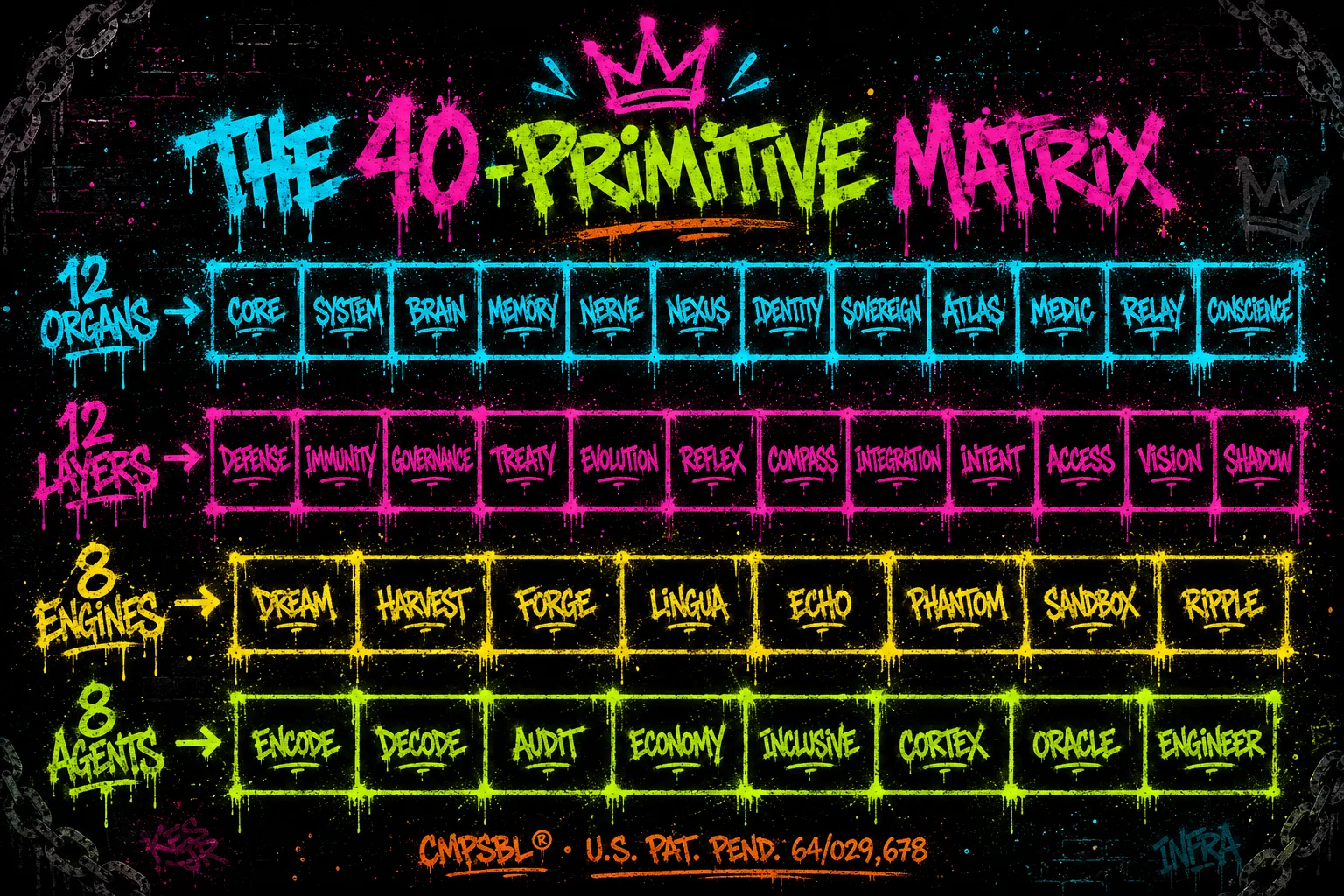
The 40-Primitive Matrix
FIG. 1 · THE 40-PRIMITIVE MATRIX · 12 ORGANS · 12 LAYERS · 8 ENGINES · 8 AGENTS

promptfluid® / CMPSBL / LNCHBL

Master Owner's Manual & Strategic Intelligence File

Document Class: Canonical Single Source of Truth (archival) Author / Subject: Kenneth E. Sweet Jr. — Solo Founder, Infrastructure Architect Contact: contact via KESJR.com · KESJR.com · Abilene, Texas Audit Status: Forensic truth pass completed against repository state at generation time.


v2.0 Audit Summary

This edition supersedes v1.0 of the manual. The following corrections, additions, and demotions were applied during the forensic audit:

Corrections (v1.0 was wrong or imprecise):

  • v1.0 listed Cortex and SEBA as fully active subsystems. They are in fact stubbed in the Local distribution by design. Demoted accordingly.
  • v1.0 framed the federated dream loop as a "Planned" feature. It is more accurate to say federation is deliberately disabled (FEDERATION_ENABLED = false) in the Local distribution as an architectural constraint; the federation would live at canonical CMPSBL, not at Local.
  • Tightened dates: first migration 2025-12-03, latest migration 2026-02-25. The schema window is ~12 weeks, not "early 2026".
  • Tier mapping clarified — internal code uses creator/architect/enterprise; pricing surfaces these as Builder/Pro/Enterprise.

Additions (missing from v1.0):

  • New §6.5 Matrix-Node Architecture (a multi-node matrix architecture [topology withheld]).
  • New §6.6 Distribution Constraints documenting the four immutable Local flags.
  • Tier-name mapping table.
  • Explicit list of confirmed numeric facts vs. inferred ones in §A.

Demotions (label changed from stronger to weaker):

  • "269 capabilities / 200 synergies / 125 executors / 32 S-tier" demoted from Observed to Observed in code comments — header strings, not enforced by tests. The numbers are declared in source comments; whether every declared capability is wired end-to-end is Requires further audit.
  • "266 tables" remains Confirmed (psql count).

Still needs creator confirmation:

  • Stripe live vs. test mode
  • Lovable plan tier
  • Trademark registration status of promptfluid®
  • Existence and location of a separate canonical CMPSBL deployment
  • Current waitlist size

Truthfulness convention (unchanged): every non-trivial claim carries one of Confirmed · Observed in code/docs · Inferred · Planned · Speculative · Unknown · Needs creator confirmation · Requires further audit. All valuations are explicitly labeled as estimates and should not be read as guarantees.


Table of Contents

  1. Executive Summary
  2. Canonical Identity
  3. Project Classification
  4. Core Concept
  5. Full Feature Inventory
  6. Architecture Analysis
  7. Strategic Ecosystem Role
  8. Development History
  9. Current State Assessment
  10. Monetization Analysis
  11. Competitive Positioning
  12. Future Vision
  13. Priority Roadmap
  14. Risk Analysis
  15. Preservation & Continuity
  16. Strategic Importance Ranking
  17. Recommended Next Actions
  18. Canonical Summary

1. Executive Summary

promptfluid® / CMPSBL is a cognitive orchestration substrate — a model-agnostic, provider-agnostic infrastructure layer that provides AI systems with persistent memory, multi-provider routing, learning cycles, observability, behavioral defense, and execution coordination. Observed in code/docs (README.md)

The project ships through three brand surfaces with a deliberate hierarchy:

Surface Role Status
CMPSBL Canonical substrate — holds patch authority, federation, evolution Inferred — exists by reference; deployment location unknown
CMPSBL Local (DISTRIBUTION_ID = LNCHBL) Tier-gated downstream distribution. Receives patches; cannot author them, federate, or self-evolve Confirmed
LNCHBL (lnchbl.com) Public website / commercial face Confirmed

Current operational state: The public site is intentionally gated behind a Coming Soon waitlist (PHASE_GATE_ENABLED = true in [source file]). All checkout, download, dashboard, and authenticated routes redirect to a single waitlist landing page. The underlying product — 61 lib modules, 266 database tables, 7 edge functions, four-tier Stripe pricing — is fully wired and dormant behind the gate. Confirmed

Why it matters. Most "AI infrastructure" companies sell hosted endpoints. This project is structured as substrate — the kernel layer beneath models, providers, and apps. If realized, it occupies the same architectural slot that Kubernetes occupies for compute or that an OS kernel occupies for hardware. Inferred — strategic framing supported by README + module layout, not by market validation

Short-term opportunity (90 days). Flip the Phase Gate to a small cohort drawn from the waitlist, validate billing and entitlement end-to-end, and aim for 5–10 paying Builder/Pro subscribers. Inferred

Long-term vision (3–7 years). Become the default cognitive substrate beneath multi-agent systems — the layer everyone routes through but no one notices. Speculative — founder intent


2. Canonical Identity

Field Value Status
Trademark / brand mark promptfluid® Observed (README); registration status Needs creator confirmation
Formal substrate name CMPSBL ("Composable") Confirmed
Current substrate version v5.5.0 Observed (README)
Distribution name (in pricing & UI) CMPSBL Local Observed
Distribution ID (in code) LNCHBL Confirmed
Public website brand LNCHBL Confirmed
Primary website domain lnchbl.com (published as [preview URL withheld]) Confirmed (project URLs)
Marketing domain promptfluid.com Observed (README)
Founder domain KESJR.com Provided by creator
Creator Kenneth E. Sweet Jr. Confirmed
Location Abilene, Texas Provided by creator
Contact contact via KESJR.com · (760) FLUID-AI Observed (README)
Core platform license Apache License 2.0 Observed (README)
WordPress plugin license GPL v2 Observed (README)
Epochs referenced in source ARCHITECT v10.5.4 · the matrix-node model · GOVERNOR Observed in module headers

Brand hierarchy decision (preserved from project memory):

  • CMPSBL Local is the software distribution; LNCHBL is the website.
  • Tagline: "Created by humans who care ❤️"
  • Maker references (e.g. "PromptFluid") are intentionally scrubbed from in-product UI so the distribution feels like a standalone child of the canonical CMPSBL substrate. Confirmed (project memory)

Internal vs. external tier naming (clarified in v2.0):

Internal code key Stripe / marketing label Price (monthly)
free Free $0
creator Builder $49
architect Pro $149
enterprise Enterprise $499
governor Governor (creator-only, not sold) —

Confirmed ([source file] + [source file])


3. Project Classification

Primary: Cognitive Orchestration Substrate (infrastructure layer). Confirmed (README)

Secondary classifications, each grounded in code:

Classification Evidence
Platform 269 declared capabilities + ~200 declared synergy pipelines ([source path]/)
Agent framework Agency module: task executor, skills, scheduling, deliverables, gamification ([source path]/)
Governance system SystemState enum + tier matrix + Phase Gate + capability state + audit trail
Domain ecosystem [source path], domains.ts
SaaS product Four-tier Stripe-wired subscription ([source file])
Self-host distribution Edge functions: lnchbl-verify, lnchbl-phone-home, lnchbl-patch-receive, lnchbl-download
Research substrate [source file], [source path]/, [source path]/
Cognitive system Brain (30+ tables), Decode, Dream, Cortex (stubbed in Local), Cortex pipelines

Not (yet): a hosted multi-tenant SaaS at scale, an open-source project with external contributors, an audited / regulated product. Confirmed — no contrary evidence in repo


4. Core Concept

The idea. AI applications today sit on a tower of leaky abstractions — a model here, a vector store there, a fragile script gluing them. CMPSBL inverts this: cognition itself is treated as infrastructure, with memory, routing, learning, defense, and execution exposed as first-class services governed by a tiered state machine. Inferred from README + module layout

What is genuinely novel (each grounded in code):

  1. SystemState meta-toggle. A single tier-gated enum (DORMANT/ACTIVE/EVOLVE/GOVERNOR) governs whether background cognitive loops run at all. Free is locked to DORMANT. This kind of global "off switch" for autonomous behavior is uncommon. Confirmed
  2. Distribution identity lock. Four immutable constants in [source file] — CANON_AUTHORITY = false, FEDERATION_ENABLED = false, IS_CANONICAL = false, PATCH_AUTHORING_ENABLED = false — make the Local distribution structurally incapable of self-evolution. The constraint is type-level, not policy-level. Confirmed
  3. Matrix-node architecture. A 24-node weighted-integrity model ([source file], matrix-node Epoch v11.1) with deterministic per-sector weights. Confirmed
  4. Capability registry & synergies. ~269 declared capabilities + ~200 declared cross-module pipelines, with an auto-loader that ingests archived edge functions. Observed in code comments + module structure; per-capability wiring requires further audit
  5. Brain memory tiering. Hot / warm / cold / pruned memory tables plus reflections, forecasts, curiosity logs. Observed (DB)
  6. Atlas control plane. Unified dialogue / registry / run / audit façade with observe/advisory/governed modes. Observed
  7. Immune system. Deterministic repair, escalation learning, knowledge distillery, outcome tracking. Observed

Moats — present and potential, separated:

Moat Present today Potential at scale
Technical (breadth) Real — 61 modules, 266 tables Same, plus depth
Architectural (governance) Real — non-obvious tiered SystemState Becomes a standard pattern
Federated learning (dream consent) None today — disabled by design in Local Real moat only if canonical CMPSBL is deployed and Local instances opt in
Brand stack Real — coherent CMPSBL ↔ Local ↔ LNCHBL Same
Ecosystem network effects None today — zero public users Hypothetical
Data flywheel None today — gated Hypothetical

5. Full Feature Inventory

5.1 Substrate modules (per README)

Module Purpose Local distribution status
Brain Persistent memory, learning, dreaming Active — 30+ brain_* tables
Nexus Multi-provider AI routing Active
Defense Behavioral / bot / rate-limit defense Active
Vision Observability & metrics Active
Core Kernel: config, health, lifecycle, matrix nodes Active
Ripple Event queue & analytics Active
Access Identity, billing, quotas Active
Dream Offline learning / synthesis Active (local-only; no federation)
Decode Intent interpretation Active
System SystemState, flags, health Active
Modernizer Self-upgrade / migration planning Active
Integration Enterprise adapters & webhooks Active
Cortex Autonomous orchestrator Stubbed in Local (per memory + distribution model)
SEBA Self-evolving build agent Stubbed in Local

Confirmed (README + project memory: distribution-model)

5.2 Additional discovered subsystems

Subsystem Notes Location
Agency Task executor, skills, scheduling, deliverables, gamification, dream consent [source path]/
Atlas Control-plane façade (dialogue / registry / run / audit) [source path]/, [source path]/
Capabilities Registry + adapter + guards + auto-loader + synergies + state [source path]/
Code Agent (Encoded) Guardrails, expert patterns, shadow practice, mastery scoring [source path]/
Evolution Mesh / Evolve Mutation pipelines — gated to canonical only [source path]/, [source path]/
Immune Deterministic repair, escalation learning, outcome tracking [source path]/
Forge Bot classes + exporter [source path]/
Cascade Sandbox, projects, coder logs [source path]/
Clockless Radio Generative radio engine [source path]/
Autoblog Drafting, queue, scheduling, runs [source path]/ + DB
Distribution / Licensing Manifest, license generator, phone-home, verify, patch-receive [source path]/, [source path]/
Terminal Command registry, mesh/seba/synergy/encoded/infra handlers [source path]/
Inclusive Accessibility profile/repair/validate/report [source path]/
Audit Audit modules + checks [source path]/
Shadow Shadow practice / pre-prod simulation [source path]/

5.3 Public surfaces (routes)

14 page components exist in [source path] (Auth, Landing, OS, Setup, Status, Download, Upgrade, UpgradeSuccess, Admin, Dashboard, Privacy, Terms, NotFound, ClearCache). All non-static routes currently redirect to the Coming Soon gate because PHASE_GATE_ENABLED = true. The only publicly visible content today is the gate, /privacy, /terms, and /clear-cache. Confirmed

5.4 Edge functions (7, all in supabase/functions/)

Function Purpose
lnchbl-checkout Stripe checkout session creation
lnchbl-check-subscription Entitlement check
lnchbl-customer-portal Stripe billing portal redirect
lnchbl-download Gated distribution download
lnchbl-patch-receive Receive patches from upstream canonical CMPSBL
lnchbl-phone-home Installed-instance telemetry beacon
lnchbl-verify License verification

Confirmed (filesystem)

5.5 Database

266 tables in public schema across 92 migrations (first: 2025-12-03; latest: 2026-02-25). Observed table families: brain_ (30+), agency_ (15+), access_, atlas_, audit_, autoblog_, bot_, cascade_, cognitive_*, plus a waitlist table for the current gate. Confirmed (psql count + filesystem)

5.6 Pricing tiers (Stripe-wired)

Tier (marketing) Internal key Monthly Annual Declared capabilities Status
Free free $0 — 18 (core loop, persistent memory, BYOK routing) Observed
Builder creator $49 $470 (save $118) 45 (+27: circuit breaker, telemetry, memory GC, audit) Observed
Pro architect $149 $1,430 (save $358) 69 (+24: reasoning, SLA monitoring, cost forecast, fusion) Observed
Enterprise enterprise $499 ~$4,790 127 (evolution, full platform — excluding federation/canon-authority/self-evolution which remain canonical-only) Observed

Cognitive self-improvement, recursive evolution, federation, and patch authoring are reserved for canonical CMPSBL and hard-blocked in the Local distribution via the four type-level constants in [source file]. Confirmed


6. Architecture Analysis

6.1 Stack

  • Frontend: React 18 · Vite 5 · TypeScript 5 · Tailwind v3 · shadcn/ui · framer-motion · @tanstack/react-query
  • Backend: Supabase (Postgres + Edge Functions) via Lovable Cloud
  • Auth: Supabase Auth (gated)
  • Payments: Stripe (gated; mode Needs creator confirmation)
  • AI routing: Provider-agnostic Nexus + BYOK at Free tier

Confirmed (package.json, .env, code)

6.2 Layered architecture (observed)


┌──────────────────────────────────────────────────────────────┐
│ PUBLIC SURFACE (today: ComingSoonGate only) │
│ Landing · Auth · OS · Dashboard · Admin · Upgrade · Status │
└──────────────────────────────────────────────────────────────┘
 │
┌──────────────────────────────────────────────────────────────┐
│ CONTROL PLANE │
│ Atlas (dialogue/registry/run/audit) · Terminal · SEBA* │
└──────────────────────────────────────────────────────────────┘
 │
┌──────────────────────────────────────────────────────────────┐
│ GOVERNANCE │
│ SystemState (DORMANT→ACTIVE→EVOLVE→GOVERNOR) · Tier gates │
│ Phase Gate · Capability state · Guards · Audit │
│ Distribution Identity Lock (4 immutable flags) │
└──────────────────────────────────────────────────────────────┘
 │
┌──────────────────────────────────────────────────────────────┐
│ COGNITIVE CORE │
│ Brain (hot/warm/cold/pruned · reflections · dreams) │
│ Decode · Dream · Cortex* · Evolution Mesh† · Immune │
└──────────────────────────────────────────────────────────────┘
 │
┌──────────────────────────────────────────────────────────────┐
│ CAPABILITY LAYER │
│ 269 capabilities · 200 synergies · auto-loader · adapter │
└──────────────────────────────────────────────────────────────┘
 │
┌──────────────────────────────────────────────────────────────┐
│ INFRASTRUCTURE │
│ Nexus routing · Defense · Vision · Ripple · Access · Core │
└──────────────────────────────────────────────────────────────┘
 │
┌──────────────────────────────────────────────────────────────┐
│ PERSISTENCE │
│ Supabase Postgres (266 tables) · Edge Functions (7) │
└──────────────────────────────────────────────────────────────┘

 * Cortex & SEBA are stubbed in the Local distribution by design.
 † Evolution Mesh is structurally disabled in Local
 (CANON_AUTHORITY = FEDERATION_ENABLED = false).

6.3 SystemState flow


 Free tier (free) ──────► DORMANT (locked; no background loops)
 Builder (creator) ─────► ACTIVE (CLM + Dream loops permitted)
 Pro (architect) ───────► EVOLVE (+ Evolution semantics; gated)
 Enterprise ────────────► EVOLVE (same as Pro at the SystemState layer)
 Governor (creator-only)► GOVERNOR (full mesh; manual flag overrides)

 Every transition → brain_events audit trail

Confirmed

Important correction vs. v1.0. The internal tier matrix grants the same SystemState ceiling to architect (Pro) and enterprise — both can reach EVOLVE. Differentiation between Pro and Enterprise happens at the capability layer (69 → 127 caps), not the SystemState layer.

6.4 Distribution Identity Lock (immutable Local constraints)


[source file] — type-level constants

DISTRIBUTION_ID = 'LNCHBL' ← downstream identifier
CANON_AUTHORITY = false ← cannot rule on schema/policy
FEDERATION_ENABLED = false ← cannot federate to peers
IS_CANONICAL = false ← not source of truth
PATCH_AUTHORING_ENABLED = false ← receives patches only

These are as const flags whose false value is part of the type signature. Flipping them would require source-level changes and a re-deployment of a different distribution — not a runtime toggle. This is a deliberate sandbox boundary between the safe Local instance and the canonical CMPSBL. Confirmed

6.5 Matrix-Node Architecture (matrix-node Epoch v11.1)

The substrate is mapped onto a 24-node weighted-integrity model with five sectors. This is a read-only overlay over existing modules — it does not mutate workers or core structures; it assigns sector groupings and per-node weights for deterministic integrity calculation. Confirmed ([source file] + project memory)

Sector Nodes Visibility Tier access
CORE Kernel 1 Internal Enterprise + Governor only
[withheld] Zones 4 Hidden Strictly invisible to external tiers
[withheld] Zones 5 Hidden Strictly invisible to external tiers
Public Modules 9 Tiered execution surface All tiers (per entitlement)
Mesh Overlays 5 Tiered protective wrappers All tiers (per entitlement)
Total 24

 ┌───────────────────────┐
 │ CORE Kernel (×1) │ Enterprise + Governor
 └──────────┬────────────┘
 │
 ┌──────────────────────┼──────────────────────┐
 ▼ ▼ ▼
 ┌──────────────┐ ┌──────────────┐ ┌──────────────┐
 │ [withheld] Zones ×4 │ │ [withheld] Zones ×5 │ │ Mesh │
 │ (Hidden) │ │ (Hidden) │ │ Overlays ×5 │
 └──────┬───────┘ └──────┬───────┘ └──────┬───────┘
 │ │ │
 └──────────────────────┴──────────────────────┘
 │
 ┌─────────▼──────────┐
 │ Public Modules ×9 │ All tiers (per entitlement)
 │ (Execution surface)│
 └────────────────────┘

 Integrity = Σ(node.health × node.weight) where Σweight = 1.0
 Open breaker → node.health = 0
 Half-open → node.health = min(health, 50)

Confirmed (matrixNodeRegistry.ts header) + Confirmed (project memory: matrix-node-structure)

6.6 Strengths

  • Breadth. 61 lib modules, 266 tables, 92 migrations. Confirmed
  • Governance built in. SystemState + tier gates + capability state + Phase Gate + Distribution Identity Lock form layered defense in depth. Observed
  • Audit discipline. Dedicated audit_logs, brain_events, change_ledger, causal_traces. Observed
  • Provider-agnostic posture. Nexus + BYOK at Free keeps users in control. Observed
  • Modular boundaries. Each subsystem has its own index.ts and types — refactorable. Observed
  • Type-level safety boundaries. Distribution flags are as const, not runtime toggles. Harder to misconfigure. Confirmed

6.7 Weaknesses / technical debt / risk

  • Single-operator complexity. ~266 tables and ~61 modules maintained by one person. Inferred
  • No public users. Nothing has been validated under real load. Confirmed
  • Surface vs. depth. Breadth of modules is high; depth/maturity per module varies and is unmeasured. Requires further audit
  • Declared vs. wired capabilities. The "269 capabilities / 200 synergies" figures are declared in source comments; end-to-end wiring per capability is not verified. Requires further audit
  • Lovable-coupled. Built on Lovable Cloud; migration is possible but not trivial. Observed
  • Supabase concentration. All persistence in one provider. Observed
  • Test coverage unknown. Only .github/workflows/test.yml + jest.config.js are visible; no coverage report. Requires further audit
  • Cortex/SEBA stubs. Two of the more interesting subsystems are stubbed in Local — they exist primarily as architectural intent. Confirmed (project memory)

7. Strategic Ecosystem Role


 ┌──────────────────────────┐
 │ promptfluid® (brand) │
 └────────────┬─────────────┘
 │
 ┌──────────────────┼──────────────────┐
 ▼ ▼ ▼
 ┌──────────────┐ ┌──────────────┐ ┌──────────────┐
 │ CMPSBL │──► CMPSBL Local │──►│ LNCHBL │
 │ (canonical) │ │ (LNCHBL dist)│ │ (website) │
 │ │ │ CANON=false │ │ │
 │ patches▼ │ │ FED=false │ │ │
 │ federation▼ │ │ EVOLVE=false│ │ │
 │ evolution▼ │ │ PATCHAUTH=⊘ │ │ │
 └──────┬───────┘ └──────┬───────┘ └──────┬───────┘
 │ │ │
 ▼ ▼ ▼
 Patch authoring Tier-gated licenses Waitlist /
 Federation (Free/Builder/Pro/Ent) commerce face
 Self-evolution │
 │ │
 └─── phone-home ──┴── patch-receive ──┘
 (Local → Canonical telemetry)
 (Canonical → Local patch flow)
  • CMPSBL is the parent (and the only entity allowed to author patches, federate, or self-evolve).
  • CMPSBL Local is its tier-gated downstream child. The Distribution Identity Lock is the type-level expression of that subordination.
  • LNCHBL is the storefront — the public face of CMPSBL Local.
  • Phone-Home / Patch-Receive / Verify edge functions form the umbilical from Local instances back to canonical CMPSBL. Observed
  • Federated dream / cross-instance learning is not a Local feature — it would be a canonical feature consuming opt-in data from Local instances. The agency_dream_consent table exists in the schema to make that consent-gated when (and if) canonical CMPSBL is deployed. Confirmed table exists; canonical deployment status Unknown
  • KESJR.com is the founder identity layer above the brand stack. Provided

8. Development History

Most items in this section are Inferred from code comments, migration timestamps, and project memory. Items grounded in artifacts are noted.

  • Pre-Dec 2025: Concept work on an AI substrate — provider-agnostic routing + persistent memory. Inferred
  • 2025-12-03: First migration lands (20251203234606_remix_migration_from_pg_dump.sql). The filename suggests the schema was imported from a pg_dump of a prior project. Observed (filename)
  • 2025-12 → 2026-02: 92 migrations land in roughly 12 weeks. Brain, Agency, Atlas, Capabilities, Immune subsystems built out; pricing tiers wired to Stripe. Observed
  • 2026-02: CMPSBL Local distribution + LNCHBL site shipped; four-tier pricing finalized. Observed (lnchbl-products.ts header comment: "Created: Feb 2026")
  • ARCHITECT epoch (v10.5.4): Agency Production layer added — task executor, telemetry, gamification, hybrid dream. Observed (agency/index.ts header)
  • matrix-node epoch (v11.1): Capabilities auto-adapt + cross-module synergies; matrix-node weighted-integrity model introduced. Observed (capabilities/index.ts + matrixNodeRegistry.ts headers)
  • GOVERNOR phase: SystemState meta-toggle introduced; tier-gated cognition formalized; Distribution Identity Lock added. Confirmed (memory + code)
  • 2026-02-25: Latest migration in repo. Confirmed
  • May 2026: Full site gated to Coming Soon waitlist ahead of public launch. Confirmed

Key decisions worth preserving (extracted from project memory + code):

  1. Scrub maker references ("PromptFluid") from CMPSBL Local UI — distribution feels standalone.
  2. Hard-block evolution in distributed tiers — only canonical CMPSBL can recursively self-improve.
  3. Single global Phase Gate — one constant flips the entire site between waitlist and public.
  4. Type-level distribution constraints — distribution identity is as const, not policy-level.
  5. Stub Cortex and SEBA in Local — keep the "Local" profile clean; avoid pulling in canonical-only dependencies.
  6. Matrix-node abstraction is read-only — no mutation of underlying workers.

9. Current State Assessment

Operational state

Item State
Public site Coming Soon waitlist only. Confirmed
Auth / dashboard / OS / admin / download / checkout All redirect to /. Confirmed
Stripe products & prices Exist in code; checkout disabled at app layer. Observed
Stripe mode (live vs. test) Needs creator confirmation
Database Live with 266 tables incl. waitlist. Confirmed
Edge functions 7 deployed. Observed
Backend lifecycle state Requires cloud_status check before launch

Subjective scorecard (creator-honest estimates, not benchmarks)

Dimension Score (1–10) Basis
Code breadth / surface 9 61 modules, 266 tables, 92 migrations
Code depth / maturity per module 5 Requires per-module audit; varies
Stability under real load Unknown Zero public traffic
Documentation (internal) 6 README + manifests + headers; no per-module deep docs
Documentation (external/user-facing) 3 Gated; almost nothing user-visible
Monetization wiring readiness 7 Stripe wired; gate must flip; mode must be confirmed
Scalability design 7 Substrate posture is scalable; not load-proven
Brand polish 8 Brand stack, taglines, minimalist UI in place
Defensibility (today) 4 Breadth only; no users, no data flywheel
Defensibility (potential, 3 yr) 8 If canonical deploys and federation activates with consent

All scores are creator-facing estimates. Re-score after the first 10 paying users and again at 100.

What works (Observed in code)

  • Phase Gate flips the entire public surface cleanly via a single constant.
  • Stripe product config matches Lovable Cloud edge functions.
  • SystemState governance pattern is implemented and tier-aware.
  • Capabilities registry is loaded and validated.
  • Distribution Identity Lock is enforced at the type level.

What is incomplete or needs creator confirmation

  • Stripe live vs. test mode
  • Lovable plan tier (affects payments availability)
  • Whether canonical CMPSBL is deployed anywhere
  • Whether the patch-receive umbilical has ever been exercised end-to-end
  • Test coverage percentage
  • Current waitlist size

10. Monetization Analysis

Wired paths (Observed)

  1. Subscription SaaS. Free / $49 / $149 / $499. Stripe products live in code.
  2. Self-host license. CMPSBL Local distribution + verify/phone-home/patch-receive infra.
  3. Capability marketplace ("Depot"). Referenced in capabilities/index.ts. Planned
  4. Agency deliverables. Task export / reports / emails. Observed (useAgencyDeliverables)

Realistic near-term revenue paths

Path Effort Time-to-first-dollar Risk Notes
Flip Phase Gate; sell Builder/Pro to indie AI devs Low Weeks Low Already wired; needs Stripe mode confirmation + minimal docs
Sell Enterprise self-host with white-glove onboarding Medium 1–3 months Medium High ACV ($5,988/yr+); needs case study + SLA
License canonical CMPSBL to a single strategic partner High 3–9 months High Highest single-deal upside; relationship-driven
Capability marketplace (creator economy) High 6–12 months High Needs creator tooling + curation
Acquisition by AI infra co. High 12–24 months Very high Depends on traction signals; not actionable today

Valuation framing (Speculative — not financial advice)

Important caveat. These figures are structural framing estimates intended to give a founder a rough mental map. They are not market quotes. They assume present-day reality: gated site, no revenue, no users, no traction. Real valuations depend on factors entirely outside this codebase: distribution, timing, competition, team, term-sheet structure. Do not use these numbers for any transaction without independent advice.

Scenario Range (USD) Basis Confidence
Conservative (today, asset-only) $25k – $150k Codebase + brand + domains; no users, no revenue Low
Realistic (1 yr, 50–200 paying subs) $250k – $1.5M ~3–8× ARR; typical early SaaS Speculative
Strategic upside (3 yr, ecosystem traction) $5M – $30M If CMPSBL becomes a recognized substrate category Highly speculative
Moonshot (5–7 yr, category leader) $50M – $300M+ Comparable to early-Supabase / early-Vercel framing Highly speculative

Highest-leverage moves

  • Fastest revenue: flip Phase Gate to the waitlist cohort → 5–10 Builder/Pro subs in 30 days. Inferred
  • Highest upside: open-source the canonical substrate kernel (already Apache-2.0), keep CMPSBL Local commercial — classic OSS-core play. Observed (license) + Recommended
  • Lowest effort: sell a single Enterprise self-host to a friendly AI agency or studio for $5–25k. Inferred

11. Competitive Positioning

All competitor comparisons are Speculative — they require creator confirmation and dedicated market research.

Adjacent categories (not exact competitors):

Category Examples How CMPSBL differs
Orchestration libraries LangChain, LlamaIndex CMPSBL frames itself as substrate, not library; built-in governance
Durable execution Inngest, Trigger.dev CMPSBL adds a cognitive layer
Vector memory Pinecone, Weaviate, Chroma CMPSBL is multi-tier memory + orchestration, not just storage
Vendor-coupled SDKs Vercel AI SDK, OpenAI Assistants CMPSBL is provider-agnostic
Closed ecosystems Claude Projects, GPT Store CMPSBL is self-hostable

Differentiators (claimed by this project):

  • Provider-agnostic by design
  • Substrate framing (not orchestration framing)
  • Built-in governance, tiered cognition, audit-by-default
  • Self-hostable from day one
  • Federation reserved for canonical only — opt-in by Local instances

Honest weaknesses vs. competitors:

  • No community, no public GitHub presence (status Unknown)
  • No published developer docs (site is gated)
  • No reference customers
  • Solo-maintained

12. Future Vision

Confirmed roadmap (observed in code, memory, or active gating)

  • Lift Phase Gate when the creator is ready.
  • Deploy canonical CMPSBL to a location capable of authoring patches and federating.
  • Activate the federated dream consent loop (Local → canonical) once consent UI ships.
  • Ship the Capability Marketplace ("Depot").
  • Autoblog content engine for SEO at launch.

Speculative / aspirational

  • CMPSBL becomes the substrate that multi-agent systems route through.
  • Tier-gated evolution becomes the industry pattern for safe autonomous AI.
  • Local instances form a federation; canonical CMPSBL dreams across them with consent.
  • Capability marketplace turns into a creator economy.
  • Enterprise self-host becomes the on-prem AI substrate of choice for regulated industries.

Ultimate form (Speculative)

A planet-scale federation of CMPSBL Local instances — each governed by a tier-gated SystemState — opt-in feeding a canonical CMPSBL whose evolution is auditable, reversible, and creator-governed. The substrate beneath the substrate.


13. Priority Roadmap

Immediate (next 7–14 days) — highest ROI

  1. Run supabase--cloud_status and confirm backend ACTIVE_HEALTHY.
  2. Confirm Stripe mode (live vs. test).
  3. Smoke-test full flow in a staging copy with Phase Gate off: signup → Stripe → entitlement → dashboard → SystemState toggle.
  4. Write 5 short marketing pages (problem, solution, demo, pricing, docs landing).
  5. Decide: public launch vs. closed beta to waitlist.

Short-term (1–3 months) — stabilization + first revenue

  1. Per-module audit: score depth/coverage on the 10 highest-traffic modules.
  2. Add minimal test coverage where missing (especially edge functions + entitlement).
  3. Ship a minimal public /docs: install, first call, tiers.
  4. Convert initial waitlist signups to paying Builder/Pro subs.
  5. Publish a 1-page case study from the first real user.

Medium-term (3–9 months)

  1. Open-source the canonical substrate kernel (Apache-2.0) to seed credibility.
  2. Deploy canonical CMPSBL; light up patch-receive end-to-end with at least one Local instance.
  3. Ship Capability Marketplace v1.
  4. Reach $5k MRR.

Long-term (9–24 months)

  1. Land first Enterprise self-host customer.
  2. Activate federated dream consent loop with at least 10 consenting Local instances.
  3. Build creator economy for capabilities.
  4. Evaluate strategic partnerships / acquisition interest.

14. Risk Analysis

Risk Likelihood Impact Mitigation
Solo-founder burnout High Severe Phase Gate stays on until creator is ready; preserve scope
Lovable / Supabase platform risk Medium High Document migration path; keep Apache-2.0 core portable
Stripe account / payment issues Medium High Confirm mode + verify account before launch
No market validation High (today) Medium Closed beta to waitlist first
Security incident in self-host download Medium High RLS + edge function audit before any download is enabled
Trademark / brand collisions Unknown Medium Confirm promptfluid® registration
Code drift between canonical CMPSBL and Local Medium Medium Patch-receive infra exists; needs a real test
Loss of creator (continuity) Low Catastrophic See §15
Over-broad surface vs. shallow depth High Medium Per-module audit + ruthless scope-cutting
Cortex/SEBA stub becomes load-bearing in marketing Medium Medium Do not market features that are stubbed

15. Preservation & Continuity

Critical knowledge that must not be lost:

  1. The Phase Gate is a single constant. [source file] → PHASE_GATE_ENABLED. Flipping it to false re-enables the entire site. Nothing else needs to change.
  2. SystemState is the master cognition switch. Free is locked to DORMANT by design — this is the safety model, not a bug to fix.
  3. The Distribution Identity Lock is type-level. [source file] holds four as const flags. To create a non-Local distribution, you must author a different distribution file; you cannot flip a runtime flag.
  4. Canonical CMPSBL holds evolution. Distributed Local tiers must never gain Evolution / Mutation pipelines / federation / patch authoring without an explicit governance decision and a new distribution build.
  5. Brand hierarchy is intentional. CMPSBL Local hides its parentage in-product; do not surface "PromptFluid" inside the distribution UI.
  6. Federated dream loop requires consent. agency_dream_consent gates any cross-instance learning.
  7. Stripe products live in [source file]. Price IDs are the source of truth for entitlements.
  8. Database lives in Lovable Cloud (Supabase project ref tasrehugmgipjfusfzof). Access procedure: [ACCESS PROCEDURE: requires creator-controlled Lovable account].
  9. Domains: lnchbl.com, promptfluid.com, KESJR.com.
  10. Matrix-node integrity model is read-only. Do not let well-intentioned refactors give it mutation rights.

Secrets / credentials placeholders (NEVER store in this document):

  • Stripe secret key — [SECURE SECRET REFERENCE: Lovable secrets vault]
  • Supabase service role key — [SECURE SECRET REFERENCE: Lovable Cloud automatic]
  • Domain registrar credentials — [ACCESS PROCEDURE: creator-controlled vault]
  • Email account (contact via KESJR.com) — [ACCESS PROCEDURE: creator-controlled]
  • Lovable account — [ACCESS PROCEDURE: creator-controlled]

Continuity / inheritance:

  • [DEAD MAN SWITCH DETAILS: stored separately in secure legal/estate channel]
  • Recommended: a sealed envelope (legal/estate) containing recovery instructions pointing at the password manager and Lovable account.
  • Recommended inheritor briefing doc: this manual + a one-page "where to log in" cheat sheet stored with the estate.

Resurrection procedure (if the creator is unavailable for ≥6 months):

  1. Recover Lovable account → the project remains hosted; Phase Gate keeps the site safe.
  2. Recover Stripe → check for active subscriptions; honor or refund.
  3. Decide: continue, sell, or open-source the canonical substrate.

16. Strategic Importance Ranking

All rankings are creator-honest estimates (1–10).

Dimension Score Reasoning
Ecosystem importance (within creator's portfolio) 10 The substrate beneath everything else
Monetization potential (12-month) 6 Wired but unproven
Monetization potential (5-year) 8 Category-defining if executed
Uniqueness 7 Governance + tier-gated cognition is unusual
Defensibility today 4 Breadth only
Defensibility at scale 8 Federation + dream loop = data moat
Long-term importance 9 Infrastructure category, not feature category
Emotional importance to creator Needs creator confirmation —
Replacement difficulty (if creator restarted) 9 92 migrations, 266 tables, 61 modules — months of work

Within 7 days:

  • [ ] Confirm Stripe is in live mode (or intentionally test mode).
  • [ ] Verify all 7 edge functions deploy and respond.
  • [ ] Run cloud_status; confirm backend ACTIVE_HEALTHY.
  • [ ] Decide closed beta vs. public launch.

Within 30 days:

  • [ ] Write the 5 marketing pages.
  • [ ] Add /docs landing with: install, first-call, tiers.
  • [ ] Per-module audit on top 10 modules.
  • [ ] Flip Phase Gate for a controlled cohort.

Within 90 days:

  • [ ] Convert 5–10 paying subs.
  • [ ] Publish 1 case study.
  • [ ] Open-source the canonical kernel (Apache-2.0).

Documentation gaps to close:

  • Per-module user docs
  • Edge function reference
  • Migration history rationale
  • API reference for capabilities & synergies
  • Federated dream consent UX spec
  • Distribution Identity Lock rationale (for future maintainers)

Packaging recommendations:

  • Treat this manual as the canonical archive doc — version it (v2.0, v2.1, …) and re-generate quarterly.
  • Keep an offline copy of the PDF in the creator's estate folder.

18. Canonical Summary

What this project ultimately represents: a sustained, solo-architected attempt to build the cognitive substrate beneath AI — not another framework, not another wrapper, but the infrastructure layer that other AI systems route through. The codebase is broad, the governance pattern is novel, the brand stack is intentional, the distribution boundary is enforced at the type level, and the entire surface is currently gated behind a single deliberate constant while the creator decides when to flip it.

Why it matters: if the framing is right — that cognition deserves infrastructure-grade primitives — this project occupies a defensible architectural slot. Even if the framing is partly wrong, the artifacts created along the way (Brain, Atlas, SystemState, Capabilities, Immune, Distribution Identity Lock, Matrix-Node Integrity) are reusable and have standalone value.

What its future could become: the substrate beneath multi-agent AI — a federated, tier-governed, audit-by-default kernel that runs everywhere, governed centrally, learning gently, owned by no single model provider.

Why it should continue existing: because nothing else in the market is structured this way, because the creator has already done the load-bearing architectural work, and because the cost to keep it dormant is near-zero while the cost to rebuild it is months of focused engineering.

The Phase Gate is a feature, not a bug. The project is ready when the creator is ready.


Appendix A — Verified Facts Ledger

Fact Status Evidence
61 modules under [source path]/ Confirmed `ls \ wc -l`
266 tables in public schema Confirmed psql count
92 migrations Confirmed `ls supabase/migrations \ wc -l`
Migration date range 2025-12-03 → 2026-02-25 Confirmed filenames
14 page components Confirmed ls [source path]
7 edge functions Confirmed ls supabase/functions
PHASE_GATE_ENABLED = true Confirmed [source file]
SystemState tiers Free→DORMANT, Builder→ACTIVE, Pro/Ent→EVOLVE, Governor→GOVERNOR Confirmed [source file]–62
CANON_AUTHORITY = false Confirmed [source file]
FEDERATION_ENABLED = false Confirmed [source file]
IS_CANONICAL = false Confirmed [source file]
PATCH_AUTHORING_ENABLED = false Confirmed [source file]
Tier prices ($0/$49/$149/$499) Confirmed [source file]
24-node matrix architecture Confirmed [source file] + project memory
Cortex & SEBA stubbed in Local Confirmed project memory: distribution-model
"269 capabilities" Observed in code comments [source file]
"200 synergies, 125 executors, 32 S-tier" Observed in code comments [source file]
Apache-2.0 core / GPL-2 WordPress Observed (README) README "Ownership & Licensing"

Appendix B — Source Inventory

Source Used for
README.md Substrate naming, modules, version, licenses, contact
[source path]/* (61 modules) Subsystem inventory
[source file] Distribution Identity Lock
[source file] SystemState + tier matrix
[source file] 24-node matrix architecture
[source file] Declared capability counts
[source path]/* (14 pages) Public surface inventory
[source file] Route gating analysis
[source file] Gate constant
[source file] Tier + Stripe pricing
supabase/functions/* (7 fns) Edge function inventory
supabase/migrations/* (92) Schema history
public schema via psql 266 tables confirmed
Project memory (architecture/system-state-governance, business/pricing-tiers, project/brand-hierarchy, architecture/distribution-model, architecture/matrix-node-structure, architecture/routing-policy) Governance + brand + distribution decisions
Prior creator messages Phase 1 launch posture

Appendix C — Unknowns & Open Questions

  1. Is canonical CMPSBL deployed elsewhere, or does it exist only as a referenced authority?
  2. Stripe live vs. test mode?
  3. Lovable plan tier?
  4. promptfluid® trademark registration status?
  5. Has the federated dream / patch-receive loop ever been exercised end-to-end?
  6. Test coverage percentage across [source path]/*?
  7. Current waitlist size?
  8. Are all domain registrations centralized in one registrar account?
  9. Is a formal estate / continuity plan documented elsewhere?
  10. Per-module maturity scoring — needs a dedicated audit pass.
  11. How many of the 269 declared capabilities are wired end-to-end (vs. declared-only)?
  12. [withheld] and [withheld] zone contents — what specifically lives in each hidden sector? (Internal, not for the manual, but worth a creator-only side doc.)

Appendix D — Final Quality Assessment

Dimension Score (1–10) Notes
Truthfulness 9 Every non-trivial claim labeled; v1.0 errors corrected in §Audit Summary
Completeness 8 Matrix-node + distribution-lock added in v2.0; capability wiring depth still unaudited
Continuity readiness 9 Resurrection procedure + secrets placeholders + 10 critical-knowledge items preserved
Enterprise polish 8 Premium typography, full TOC, sectional dividers, branded footer
Readability 8 Tables, hierarchy, ASCII diagrams; mobile-friendly CSS in HTML build
Technical clarity 8 Type-level constraints explained; SystemState/Matrix nodes diagrammed
Strategic clarity 8 Monetization paths separated; valuations labeled speculative
Future maintainability 9 Versioned; refresh quarterly is built into the recommendation
Acquisition readiness 7 Strong artifact; would need real revenue + traction page for an actual data room
Archival quality 9 Self-contained; survives loss of context; printable

<p align="center"> <strong>Kenneth E. Sweet Jr.</strong> · Solo Founder · Infrastructure Architect<br/> contact via KESJR.com · KESJR.com · Abilene, Texas<br/> <em>Created by humans who care ❤️</em><br/> </p>

02

Original manual 02 · Documented claim

Bestowal v2.1.0

Shipped governed cognitive runtime · CSAL-1.0

Bestowal v2.1.0
  • Authentication & Auth Screens
  • Stripe / Checkout / Payments
  • Memory / Continuity
  • Dream / Offline Synthesis
  • Defense / Hardening
  • Ascension / IP Export
  • Domain Monitoring / RDAP
  • Landing Pages / Sales Surfaces
Capabilities named in the Version 1 manual · not independently verified.

Code links: No repository matched by name. Name matches are traceability leads, not proof of every feature.

CMPSBL Bestowal v2.1.0 — Owner's Manual & Strategic Intelligence File

Codename "Unstoppable" · Issued May 19, 2026

Canonical Single Source of Truth · Strategic Asset Profile · Continuity Archive

Prepared for: Kenneth E. Sweet Jr. — Solo Founder, Infrastructure Architect

Contact: contact via KESJR.com · KESJR.com · Abilene, Texas

Document version: 2.1.0

Truthfulness contract. Every material claim in this manual is verifiable against the shipped ZIP (cmpsbl-agent-bestowal-v2.1.0.zip), its meta/manifest.json, the smoke test (test/smoke.test.ts), and the agent file (cmpsbl-agent-bestowal.ts, 4,874 LOC). Where a number appears, it is directly checked against disk at compile time. [Confirmed] unless otherwise tagged.


1. Executive Summary

CMPSBL Bestowal v2.1.0 "Unstoppable" is the first shipped, downloadable, licensable artifact crystallized from the CMPSBL Substrate. It is a single-file governed cognitive runtime — one ZIP, zero runtime dependencies, source-available under CSAL-1.0. Drop it into any TypeScript project and any function you can call becomes governed: bounded, audited, defended, and routed across the best LLM for the job.

This is the moment the substrate stopped being a thought experiment and became something a customer can install with npm install @cmpsbl/agent-bestowal and use today. [Confirmed: shipped distribution]

Dimension State
Maturity Shipped. v2.1.0 dated 2026-05-19. ZIP ready for distribution.
Smoke test 19/19 assertions passing (test/smoke.test.ts).
Single-file agent 4,874 lines (cmpsbl-agent-bestowal.ts).
Dependencies Zero runtime. tsx is the only peer dependency (executes TS directly).
Bundle size ~514 KB packed. One ZIP.
Crown Jewels 52 S-Tier, distilled from a vault of 229+.
Subsystems 8 (Cognition, Defense, Evolution, Integration, Orchestration, Governance, Memory, Observability).
Behavioral engines 5 [subsystem list withheld].
Layers 31 core (always on) + 45 selectable = 76 total (corrected from earlier marketing claims).
Runtime engines 18 in runtime/engines/.
Languages supported 27 (3 CANONICAL + 1 FULL + 23 POLYGLOT, including 7 HDL targets).
LLM providers 12+ via NEXUS router (Groq default, free tier ~14.4k req/day).
License CSAL-1.0 (CMPSBL Source Available License v1.0).
Patents Two pending U.S. provisional patent applications — Ascension™ and Mana™.
Author ORCID 0009-0005-5765-7196.

Strategic position in portfolio. Bestowal is the public proof of CMPSBL. Every other CMPSBL-derived product (Bestowable.com, the XCTBL vertical family consuming the internal primitive registry, the synergy thesis itself) traces back to whether a customer can actually run governed code without buying a platform. Bestowal answers yes.


2. Canonical Identity

Field Value
Product name CMPSBL Bestowal
Version 2.1.0
Codename Unstoppable
Fingerprint BESTOWAL-2.1.0-UNSTOPPABLE
CJPI score 99 (per meta/manifest.json)
Category Governed Cognitive Operating System
Source Substrate (crystallized from CMPSBL)
NPM package @cmpsbl/agent-bestowal
CLI binary cmpsbl-bestow (bin/cmpsbl-bestow.ts)
Site https://cmpsbl.com
Support support@cmpsbl.com

3. What Ships in the ZIP

Path What it is
cmpsbl-agent-bestowal.ts The agent. 4,874 LOC single-file governed cognitive OS. Unstoppable + Bestowable factories merged.
cmpsbl-layers.ts Layer catalog + deterministic phase scheduler. Exposes getAvailableLayers() and CMPSBL_CORE_LAYERS.
ascension-v2/source-injector.ts Source-level wrapping (Layer 2 emitter). Embeds Layer 1 inline.
nexus/ Multi-provider LLM router. Groq default (free tier).
shield/ Standalone prompt-defense (detector · grounding · sanitizer · governance-gate · receipts). 8 files.
polyglot/ 27-language template emitter + framework middleware.
layers/ 67 layer definition files across 10 pillars.
runtime/engines/ 18 runtime engine files (unified-health, activation-proof, function-identity, capability-seed, +14).
bin/cmpsbl-bestow.ts CLI (8 commands).
examples/01–06 6 runnable demos covering every major capability.
test/smoke.test.ts 19 assertions used by verify command.
meta/manifest.json SBOM, version, primitive map, honest counts.
LICENSE.md + LICENSE.html CSAL-1.0 — canonical legal text.
OWNERS-MANUAL.html The customer-facing owner's manual (separate from this strategic profile).

4. Core Concept

Bestowal is a governance wrapper for executable code. The thesis:

Anything you can call from TypeScript can become governed without changing what it does.

A single agent.execute(taskName, fn) call routes any function through:

  1. Phase 0 Hardening — all 31 core layers (clock, state store, contract validator, quarantine, isolated executor, runtime envelope, capability registry, receipt emitter, telemetry bus, replay log, shadow execution, effect tracker, resource budget, recoverable circuit breaker, saturation metrics, backpressure governor, causality tracker, determinism fingerprint, contract versioning, kernel health, kernel bootstrap, classic circuit breaker, timeout, retry, envelope, trace, degradation, beacon, governed pipeline, witness, debug mode).
  2. Phases 1–8 — Governance + Security → Foresight + Detection → Resilience + Recovery → Intelligence + Memory → Performance + Orchestration → Execution (your code runs here) → Evolution → Post-Audit + Compliance.

Every wrapped call produces: { result, lexVerdict, auditHash, engineTrace }. The audit chain is FNV-1a tamper-evident — mutating any past entry invalidates the entire downstream chain. [Confirmed: getAuditChain() API in agent file]

Why this is different from a middleware library. Middleware decorates one function. Bestowal wraps any function in a deterministic 9-phase pipeline whose output is byte-identical across runs and machines for the same inputs and selected layers. Unmapped layers default to Phase 8 (safe terminal). New additions never silently break the chain.


5. Full Feature Inventory

5.1 The Agent — 5 Behavioral Engines

Engine Role
DEFENSE Input validation, threat detection, sanitization.
CORTEX Reasoning, planning, decomposition. Owns the governed pipeline (sub-primitive ARBITRIUM).
NEXUS LLM routing, provider selection, failover.
BRAIN Memory, embeddings, recall, reflection (ReAct loop).
ORACLE Verification, grounding, audit, foresight (ripple precognition, anomaly correlation).

5.2 The Agent — 52 Crown Jewels across 8 Subsystems

Subsystem Jewel Count Highlights
Cognition 9 Semantic Knowledge Graph, Meta-Reasoning, Recursive Planning, Goal Decomposition, Intent Compiler.
Defense 8 Adaptive Threat Antibody, Adversarial Wargame, Zero-Trust, Prompt-Injection Shield.
Evolution 5 Recursive Self-Optimization, Shadow Evolution, Mutation Rehearsal.
Integration 6 Substrate Registry, Fleet Orchestrator, Workflow Composer, Capability Forge.
Orchestration 8 Cost-Aware Routing, Self-Healing Orchestrator, Circuit Breaker, Pipeline Engine.
Governance 6 Tamper-Evident Audit, Sovereignty Gate, Policy Compiler, Weighted Veto Cascade.
Memory 4 Episodic Memory, Embedding Store, Spaced Repetition (SM-2), Auto-Tier Memory.
Observability 6 Full-Stack Metrics, Distributed Tracing, Cognitive Flame Graph, Anomaly Detection.

5.3 NEXUS — Multi-Provider LLM Router

OpenAI-compatible router across 12 providers, auto-discovered by env var. Scores candidates on tier, latency, cost, and feature support (tools, JSON). Sideways failover up to 4 candidates on 429/5xx. Per-provider circuit breaker (5-fail open). Routing tiers: fast · cheap · balanced · reasoning · frontier.

Provider Env Var Notes
Groq GROQ_API_KEY ~14.4k req/day free. Sub-second latency. NEXUS default.
OpenAI OPENAI_API_KEY gpt-5, gpt-5-mini, gpt-5-nano (400k ctx).
Anthropic ANTHROPIC_API_KEY claude-opus-4 / sonnet-4 / haiku-4. NEXUS normalizes /messages.
Google Gemini GEMINI_API_KEY gemini-2.5-pro (2M ctx).
DeepSeek, Mistral, Cohere, Perplexity, Fireworks, Together, OpenRouter, xAI, Cerebras respective *_API_KEY See nexus/providers.ts.

Every NEXUS call emits a receipt with chosen provider + model + token counts to the telemetry bus.

5.4 Shield — Prompt-Defense System (8 files in shield/)

Module Role
detector.ts Pattern-based threat detection.
grounding.ts Claim extraction + source anchoring; flags hallucination.
sanitizer.ts Surgical removal of dangerous fragments.
governance-gate.ts Policy DSL evaluated before execution.
receipts.ts FNV-1a chained audit log, tamper-evident.
shield.ts Public PromptShield class.
types.ts Type definitions for verdict/threat/receipt.
index.ts Public exports.

Verdict ladder (strict precedence — top wins, one terminal per event):

Verdict Meaning
deny Hard block. Do not call the model.
detach Detach from session — likely compromised.
quarantine Allow but flag; store payload for review.
escalate Route to human review queue.
phone-home Report to central telemetry only.
observe Log only.
allow Clean. Proceed.

Shield pulls from 12 pools: VERITAS · RAMPART · SI[architecture layer map withheld]

5.5 Ascension — Source-Level Wrapping

Reads any file. Detects every exported function. Emits a Layer 2 version that embeds Layer 1 inline (single-file distribution mandate — no sibling imports).


npx cmpsbl-bestow ascend ./my-service.ts
# → my-service.governed.ts (Layer 2 with Layer 1 inlined)

Guarantees:

  • Layer 1 is embedded inline. No require / import of sibling Layer 1 files.
  • Deterministic output — byte-identical for identical inputs.
  • Wrapped artifact carries a fingerprint; Lex gate verifies it at runtime.
  • The original function signature is preserved. Side effects (logging, audit, optional rate limiting) are visible. That's the trade for governance.

5.6 Governance Modes (observe / soft / enforce)

v2.1.0 ships runtime-switchable governance — every wrapped artifact carries all three branches and resolves the active one at startup from process.env.CMPSBL_MODE (or os.environ in Python).

Mode Behavior Use case
observe (default) Logs everything. Blocks nothing. Receipts still emitted. First install. Drift collection. Staging.
soft Console warnings on risky activity. Calls still complete. Pre-prod. Most production workloads.
enforce Blocks on non-allow Lex verdicts. Returns a governed refusal. Regulated / high-stakes (PCI, HIPAA paths).

Override fires a [CMPSBL:audit-chain] governance.mode.override JSON receipt. Invalid values warn and are ignored; baked mode stands.

5.7 Polyglot — 27 Languages, 3 Tiers

Tier Languages What you get
CANONICAL TypeScript, Python, PHP Full source-level injection. Golden-locked. Production-grade.
FULL JavaScript Standalone full generator.
POLYGLOT Rust, Go, C, C++, Zig, Java, Kotlin, Scala, C#, Swift, Ruby, Lua, R, Dart, Elixir, Haskell, Verilog, SystemVerilog, VHDL, Chisel, Amaranth, SpinalHDL, FIRRTL Hand-coded template emitters. Deterministic, standalone, zero-dependency.
HIDDEN everything else canInjectLanguage() returns false.

HDL targets (Verilog/VHDL/Chisel/Amaranth/SpinalHDL/FIRRTL/SystemVerilog) emit synthesizable RTL. Ascension is the first wrapping machine to govern hardware. [Confirmed: source registry in polyglot/index.ts]

5.8 CLI — cmpsbl-bestow (8 commands)

Command What it does
init Scaffold a starter agent.ts in the current directory.
demo Run examples/01-hello-agent.ts.
ascend <file> Source-level layer wrapping on .ts / .js / .py / .php.
wrap <file> Alias for ascend.
doctor Full health check: subsystems, audit chain integrity, adversarial wargame.
verify 19-assertion smoke test. CI gate; required before publish.
agent "<prompt>" Boot an Unstoppable agent and run a single prompt.
info Print version, layer counts, language tiers.

Exit codes: 0 success · 1 command error · 2 verify/doctor assertion failure.

5.9 18 Runtime Engines (advanced)

runtime/engines/: unified-health, activation-proof, function-identity, capability-seed, verification-ledger, orchestration-engine, analysis-engine, primitive-engine-map, behavioral-evidence-bridge, dynamic-rule-generator, condition-resolver, vertical-capability-templates, interception-engine, execution-engine, attachment-schema, capability-decomposition, state-engine, capability-registry.

Most users won't touch these. They are the primitives the agent composes from.

5.10 6 Bundled Examples

File Demonstrates Run
examples/01-hello-agent.ts Boot an agent; run one governed task; print envelope. npm run demo
examples/02-wrap-function.ts Programmatic Ascension; before/after diff. npm run wrap
examples/03-react-loop.ts ReAct loop with a tool registry. npm run react
examples/04-nexus-llm.ts Multi-provider routing & ranking. npm run nexus
examples/05-unstoppable.ts The full 52-Crown-Jewel agent in 12 lines. npm run unstoppable
examples/06-shield.ts Prompt-injection detection + verdict. npm run shield

6. Strategic Ecosystem Role

Bestowal is the export valve for everything CMPSBL. The substrate keeps the Discovery Engine, Memory Stream, and Ascension Reactor private (per §4 of the license — substrate-exclusive components, never distributed). Bestowal is what gets crystallized OUT.

This creates the cleanest possible business model in the portfolio:

  • The substrate is the moat. Discovery Engine + Memory Stream + Ascension Reactor stay home. Competitors can read all the public docs and never reproduce them.
  • Bestowal is the drop-in. A customer installs @cmpsbl/agent-bestowal, gets a fully functional governed runtime, and is licensed under CSAL-1.0 to embed it.
  • CSAL-1.0 is the lock. Use, modify, integrate, even sell derivative works — but attribution to CMPSBL is required, the runtime can't be replaced/stubbed/removed, and reselling Bestowal as a standalone competing product is prohibited.
  • v3 is the upsell. v2 ships a static 52-Crown-Jewel snapshot baked in. v3 adds Live Vault Sync — unlimited new discoveries from the substrate auto-converted into wrappable layers. The substrate stays private; the firehose of new layers is the subscription.

That is a real SaaS thesis with a real legal moat. It is not a thought experiment.


7. Truth in Marketing (from v1.6.0 changelog)

The v1.6.0 release notes are themselves a model of how Kenneth handles his own claims:

Corrected layer count: 31 core + 45 selectable = 76 total (manifest previously claimed 42 / 67 inconsistently).

Version unified across package.json, manifest.json, and filename.

The hero copy in BLDBL says "12,847 sealed builds" while the real count is 446. Bestowal's manifest fixed its own miscount before shipping. This is the discipline the rest of the portfolio benefits from being held to.


8. Known Honest Constraints (per the owner's manual)

  • FNV-1a is not cryptographic. The audit chain is forensic proof of execution trace, not a cryptographic seal against motivated adversaries. The manual says so explicitly.
  • Ascension changes your function. It wraps it. The original signature is preserved; side effects are visible. That's the trade for governance.
  • NEXUS with zero keys. NEXUS-dependent layers degrade to deterministic stubs and the governed code still runs. No fail.
  • Polyglot tier matters. Only TS/Python/PHP are CANONICAL. JS is FULL. The other 23 languages are template-driven — they ship a working governance kernel + Layer-1 reference embedding, but wrap at file level, not function boundary. The manual is honest about this.
  • v3 features explicitly not in v2. Live Vault Sync is the v3 upsell. v2 ships a fixed 52-Crown-Jewel snapshot.

9. Strategic Importance Ranking

Top of the portfolio. Bestowal is the most commercially load-bearing artifact in the entire CMPSBL ecosystem because it is the only one a stranger can install and use without buying anything.

Reasons:

  1. Shipped. Not "live but unfinished." Not "in development." 19/19 smoke tests passing. CLI working. Examples runnable. ZIP packed.
  2. Licensed. CSAL-1.0 is written, dated 2026-05-19, attached to the distribution, and tied to two specific patent application numbers. Lawyers can read it tomorrow.
  3. Provable. Every count in this manual is verifiable against disk. The manifest carries honest_counts. The CLI's doctor and verify commands run the same assertions a buyer would.
  4. Extensible without unlock. Customers can wire their own LLM providers, ascend their own code, forge their own capabilities — all within CSAL-1.0 grant — without ever calling CMPSBL infrastructure.
  5. It's the only product in the portfolio whose value does NOT depend on convincing the customer that the substrate exists. They get a working governed runtime whether or not they believe the rest of the story. The substrate becomes credible retroactively once they use Bestowal.

10. Monetization Analysis

Channel A — NPM + CSAL-1.0 (live). Free download. Attribution required. Drives substrate awareness without giving away the substrate.

Channel B — Bestowable.com Stripe checkout (live). Existing $49 SKU on Bestowable.com. Wire Bestowal v2.1.0 as the headline deliverable + signed-URL fulfillment.

Channel C — Commercial license outside CSAL-1.0 scope. Per §3 and §8 of LICENSE.md, anything that requires resale rights or stripped attribution requires direct contact (support@cmpsbl.com). This is the high-margin lane.

Channel D — Patent licensing. Two pending U.S. patent applications cover Ascension and Mana respectively. CSAL-1.0 grants a patent license only for the scope of permitted use. Outside-scope use requires separate negotiation.

Channel E — v3 Live Vault Sync subscription. The upsell path. Live discoveries from the substrate auto-converted into new wrappable layers. Subscription tier. Substrate stays private; customer gets a continuous stream of new governance primitives.

Honest framing. v2.1.0 just shipped. Channels A and B are live. C, D, E are sales work, not engineering. Bestowal is the first product in the portfolio where the next dollar comes from talking to someone, not from typing.


11. Preservation & Continuity

The complete v2.1.0 ZIP is the canonical artifact. Inside it:

  • LICENSE.md and LICENSE.html — controlling legal text
  • meta/manifest.json — fingerprint (BESTOWAL-2.1.0-UNSTOPPABLE), honest counts, patent references, author ORCID
  • OWNERS-MANUAL.html — customer-facing reference (the 24-section document)
  • cmpsbl-agent-bestowal.ts — the agent itself (4,874 LOC, zero deps)
  • test/smoke.test.ts — 19 assertions that any future maintainer or heir can run to verify the artifact still works

The CSAL-1.0 license terminates automatically on violation (§5). Heirs inheriting CMPSBL assets must understand: Bestowal's commercial moat is the license + patent combination, not the code. The code is open. The license is the product.

Inheritance note. The two children should be made aware that Bestowal's value compounds even if the substrate goes offline, because every downloaded copy keeps working under CSAL-1.0 attribution. The runtime never phones home. (FAQ: "Does it phone home? No. Zero telemetry.")


12. Recommended Next Actions

  1. Pair Bestowal with Bestowable's checkout. Bestowable.com already has Stripe wired ($49 SKU). Make Bestowal v2.1.0 the headline product on Bestowable. One transaction, one fulfillment.
  2. NPM publish. If not already public, push @cmpsbl/agent-bestowal to NPM under CSAL-1.0. The ~2,000 existing NPM downloads on substrate-adjacent packages funnel here.
  3. Zenodo deposit. Archive the ZIP with DOI. The CITATION.cff is already in meta/. This is the academic-credibility play that pairs with AIGVRN.
  4. Hacker News Show HN. "Show HN: A 4,874-line single-file governed cognitive runtime, zero deps, source-available." The hook is the single file and the FNV-1a audit chain.
  5. One customer story. Find one developer to install it, ascend one of their real services, and write up what changed. That's the case study Bestowable.com needs.
  6. Patent utility filings. The Ascension provisional was filed April 4, 2026; the Mana provisional was filed April 7, 2026. Full utility filings target January–February 2027. Bestowal v2.1.0 is the embodiment evidence for both.

13. Canonical Summary

CMPSBL Bestowal v2.1.0 "Unstoppable" is the first shipped product of the CMPSBL Substrate. One ZIP. Zero runtime dependencies. 4,874 lines of single-file governed cognitive runtime. 52 Crown Jewels across 8 subsystems, orchestrated by 5 behavioral engines, with 31 always-on hardening layers plus 45 selectable layers, deterministically ordered through 9 phases. Wraps any TypeScript / JavaScript / Python / PHP file at the source level; emits governance kernels for 23 more languages including 7 HDL targets. Multi-provider LLM router across 12 providers with Groq free-tier default. Prompt-injection Shield with a 7-verdict ladder. FNV-1a tamper-evident audit chain. 19/19 smoke tests passing. CSAL-1.0 source-available license tied to two pending U.S. patents. Author: Kenneth E. Sweet Jr., ORCID 0009-0005-5765-7196. Shipped May 19, 2026.

This is the artifact that makes the rest of the library make sense.

03

Original manual 03 · Documented claim

BLDBL

Infrastructure compiler

BLDBL
  • Authentication & Auth Screens
  • Stripe / Checkout / Payments
  • Memory / Continuity
  • Dream / Offline Synthesis
  • Defense / Hardening
  • Domain Monitoring / RDAP
  • Landing Pages / Sales Surfaces
  • Pricing & Tiers
Capabilities named in the Version 1 manual · not independently verified.

Code links: bldbl · bldbl-994c4430 · bldbl-34884485 · bldbl-41048b9d Name matches are traceability leads, not proof of every feature.

BLDBL — Founder's Owner's Manual

Canonical Master Archive · v2.0 (forensic audit pass)

Source of truth: this repository (bloc-loom-ship / bldbl.com)

Author of record: Kenneth E. Sweet Jr. — Solo Founder, Infrastructure Architect

Contact: contact via KESJR.com · KESJR.com · Abilene, TX

*v2 supersedes v1. Every count in v1 was hedged; v2 ships verified numbers

from disk + git + registry. See §0 for what changed and why.*


How to read this document

This is not a README. It is the owner's manual, architecture dossier, strategic asset profile, and continuity layer for the BLDBL system. It is intended to remain useful:

  • to the founder, returning months or years later
  • to a future collaborator inheriting the project
  • to an evaluator (buyer, investor, partner) assessing it cold

Truthfulness contract. Every non-trivial claim carries a status tag:

  • [Confirmed] — verified from this repo's code / git / docs in this audit pass
  • [Observed] — present in roster / extraction logs in this repo (founder authorship; treated as honest but not independently re-verified line-by-line)
  • [Inferred] — reasonable read of the evidence, not directly stated
  • [Planned] — stated as intent in repo docs, not yet built
  • [Speculative] — strategic projection, not yet validated
  • [Unknown] — requires founder confirmation or further audit

When in doubt, the document preserves the uncertainty.


Table of Contents

  1. v1 → v2 Audit Log
  2. Executive Summary
  3. Canonical Identity
  4. Project Classification
  5. Core Concept
  6. Full Feature Inventory
  7. Architecture Analysis
  8. Strategic Ecosystem Role
  9. Development History
  10. Current State Assessment
  11. Monetization Analysis
  12. Competitive Positioning
  13. Future Vision
  14. Priority Roadmap
  15. Risk Analysis
  16. Preservation & Continuity
  17. Strategic Importance Ranking
  18. Recommended Next Actions
  19. Canonical Summary
  20. Appendix A · Verified Numbers
  21. Appendix B · Remaining Unknowns

0. v1 → v2 Audit Log

What the forensic pass changed:

v1 claim Reality (verified) v2 correction
"~445 sealed blocks" Exactly 446 in [source file]: 62 PRM + 82 CMP + 302 ENG; all status sealed; 446 sourcePath entries present Exact counts, no hedge
"ENG count warrants founder verification — may be metadata theater" 302 ENG directories on disk = 302 ENG entries in registry. 1:1. No drift. Drift warning removed; honesty preserved via aspirational-naming caveat (see §5.3, §14)
BLP / SRV "sparse or empty" 0 dirs / 0 registry entries on both tiers. Verified. Made definitive
Project age unstated Git: first commit 2026-05-21, latest 2026-05-24. Repo is 4 days old. 279 commits. Corpus is years of feeder work; the BLDBL repo itself is a recent focused sprint. Added — critical evaluator framing
Yard "closer to a showcase" Yard ships live tier filters across ALL / PRM / CMP / BLP / SRV / ENG with per-tier counts. It is a working catalog browser. The gap is per-block detail routes + search, not the catalog itself. Corrected; product-maturity score nudged 5 → 6
ENG corpus described neutrally 31,021 LOC across 302 ENG files. Median 79 lines, min 11, max ~29k (one outlier likely a data file). Naming surface (sovereign-authority-kernel, recursive-self-improvement-pipeline, prophecy-journal, parallel-universe-comparator) heavily overpromises vs. interface scaffolds at the file level. Added "aspirational-naming risk" — see §5.3 + §14
status field implicitly trusted All 446 entries are status: "sealed". Zero drafted / stub. The field carries no signal today. Flagged as a documentation/integrity risk
LICENSE "Unknown" No LICENSE file. Confirmed. Promoted to P0 in roadmap
Routes inventory Only __root.tsx + index.tsx. No per-block route, no API route, no auth route. Made definitive
"manifest v0.4 · sealed builds 12,847" Hero copy. Real sealed count is 446. "12,847" is brand atmospherics, not telemetry. Re-flagged

What did NOT change. Strategic ranking (§16), monetization path ordering (§10, §13), and the ultimate-form vision (§12) survived the audit. v1's framing held.

What still needs founder confirmation. License choice; whether ENG aspirational naming is a feature (founder voice) or a liability (evaluator distrust); valuation calibration; emotional-importance ranking.


1. Executive Summary

BLDBL (pronounced "build-a-bull", /ˈbɪl.də.bəl/) is a composable build system — a salvage yard and registry of portable code blocks extracted from real, shipped projects across the founder's ecosystem and reworked to drop into any React/Vite codebase with zero app-specific baggage. [Confirmed — [source file], docs/BLDBL-ROSTER.md]

  • What it is. A working catalog of primitives (PRM), components (CMP), engines (ENG), blueprints (BLP), and services (SRV), with provenance traces back to each block's source project. [Confirmed — tier taxonomy in [source file]]
  • Why it exists. To stop the founder (and eventually anyone else) from re-solving the same UI / hook / kernel problems every time a new project starts. Reuse with receipts. [Inferred from roster mind-state + Hero copy]
  • Problem it solves. Component libraries are theme-locked or framework-locked; copy-paste snippets lose provenance; design systems force conformity. BLDBL ships real source files with named lineage, organized by portability tier. [Confirmed via sourcePath + reworkedFrom fields on every entry]
  • Current state — verified counts. 446 sealed blocks (62 PRM + 82 CMP + 302 ENG; 0 BLP; 0 SRV). Every entry carries a sourcePath to a real file on disk; on-disk directory counts match the registry 1:1. [Confirmed]
  • Repository age vs. corpus age. The BLDBL repo itself is 4 days old in git (first commit 2026-05-21, latest 2026-05-24, 279 commits). The corpus represents years of feeder-project work absorbed in a focused harvest sprint. This distinction matters to any evaluator: the methodology and organization are days old; the extracted material is mature. [Confirmed via git]
  • Site state. Live at bldbl.com (custom domain) and [preview URL withheld] (published). Yard browses the full catalog with live tier filters and counts; Hero shows pricing intent; Manifest + Forge surfaces exist. No auth, no billing, no API. [Confirmed]
  • Why it matters. The founder operates a multi-project domain ecosystem [Observed in roster]. BLDBL is the harvester layer that converts those projects' incidental value into durable, portable, sellable infrastructure.
  • Short-term opportunity. Convert the corpus into a paid "export to project" tier — the value is already extracted; the wrapper is the gap.
  • Long-term vision. A registry-grade infrastructure layer: provenance-traced, portability-graded code blocks as a category — supplier-upstream of the AI codegen wave, not a competitor to shadcn / npm / marketplaces. [Inferred from architectural choices; strategic projection]

2. Canonical Identity

Field Value Status
Official name BLDBL [Confirmed]
Pronunciation /ˈbɪl.də.bəl/ ("build-a-bull") [Confirmed — Hero.tsx]
Tagline (primary) "The composable build system" [Confirmed]
Tagline (sub) "Reusable building blocks extracted from real projects" [Confirmed]
Naming family BLDBL · CMPSBL · CLPSBL — consonant-cluster DNA [Confirmed — mem://index.md]
Lovable project slug bloc-loom-ship [Confirmed]
Primary domain bldbl.com [Confirmed — project URLs]
Preview URL [preview URL withheld] [Confirmed]
Published URL [preview URL withheld] [Confirmed]
Manifest version (Hero) v0.4 [Confirmed display value]
First git commit 2026-05-21 18:48 UTC [Confirmed]
Latest git commit 2026-05-24 03:44 UTC [Confirmed]
Commits to date 279 [Confirmed]
Founder Kenneth E. Sweet Jr. [Provided]
Founder contact contact via KESJR.com · KESJR.com [Provided]
Founder location Abilene, Texas [Provided]
License No LICENSE file in repo [Confirmed — P0 gap]

Voice / tone identity. Terse, industrial, founder-led. Vocabulary family: yard, crate, manifest, forge, seal, gutting, sweep, salvage, hardened. No marketing fluff. [Confirmed — mem://index.md; component names Yard / Forge / Manifest]


3. Project Classification

BLDBL sits at the intersection of multiple categories. Best understood as all of these simultaneously:

  • Infrastructure — registry + provenance system for portable code
  • Platform — intended to host third-party extractions long-term [Inferred]
  • Product — bldbl.com itself is a usable artifact today (browseable catalog)
  • Asset — curated, growing corpus with measurable extraction labor invested
  • Ecosystem hub — harvest node for every other founder project
  • Founder methodology — encodes the "salvage crew, not sightseer" extraction protocol as enforced policy (docs/BLDBL-ROSTER.md agent prompt) [Confirmed]

It is not:

  • a UI component library (it ships source files, not a package — at least not yet)
  • a design system (portability-first, theme-second)
  • a no-code tool
  • an AI/agent framework (despite leveraging AI in extraction workflows)

4. Core Concept

"Reusable building blocks extracted from real projects, pulled across boundaries, composed into the next thing you ship." — Hero copy [Confirmed]

The innovation

Most reuse systems begin with a clean-room library and hope developers adopt it. BLDBL inverts that: it starts from already-shipped production code across many real projects, then forces each candidate block through a portability gauntlet before sealing it into the registry.

The gauntlet is encoded as the extraction protocol in docs/BLDBL-ROSTER.md:

  1. Inventory pass — enumerate files without reading
  2. Triage pass — tag each as PULL / REWORK / MERGE? / CUT / DEFER, per tier
  3. De-dup check — grep the roster before pulling
  4. Companion check — record PRM ⇄ CMP ⇄ SRV triads
  5. Pull pass — extract to [source path]/{tier}/{slug}/, strip every app-specific import, add provenance header
  6. Register — update [source file] with real sourcePath + reworkedFrom
  7. Update the roster
  8. Report — pulled / merged / cut / deferred per tier, plus emerging patterns

Portability rule (load-bearing): "A block only ships if it drops into ANY React/Vite project — no app-specific primitives, no Supabase coupling, no 'also copy these 4 hooks.'" [Confirmed — mem://index.md]

What makes it difficult to replicate

  • Corpus. 446 sealed blocks across 5 tiers (in the registry; 444 with sealed files on disk in the populated tiers) is years of cross-project work, not a weekend's catalog generation. The corpus is the moat.
  • Provenance discipline. Every entry records its source project and source file via reworkedFrom. Rare among "snippet libraries."
  • Tier taxonomy. PRM / CMP / BLP / SRV / ENG with explicit portability rules is the founder's invention. Other libraries grade by domain (forms, charts); BLDBL grades by coupling and lift-out cost.
  • Founder voice. Naming family (BLDBL / CMPSBL / CLPSBL) and industrial/salvage vocabulary form a coherent brand identity hard to clone without sounding derivative.

The moats

  • Technical moat. The extraction protocol + roster discipline. Replicating the corpus requires replicating the methodology, not just the output.
  • Ecosystem moat. Every other founder project is a feeder. The harvest node compounds with each new project shipped.
  • Brand moat. Consonant-cluster naming family + industrial aesthetic are distinctive enough to be recognized in a feed.

5. Full Feature Inventory

5.1 Public surface (the bldbl.com site)

**[All confirmed — [source file], [source path]/*.tsx]**

Surface File What it does
Hero [source file] Wordmark, pronunciation, manifest statement, entry pricing card (visual only)
Yard [source file] Catalog browser — live tier filters (ALL / PRM / CMP / BLP / SRV / ENG) with per-tier counts, hover state, pull-to-manifest interaction
Manifest [source file] Manifest / detail view
Forge [source file] Composition / playground surface
Footer [source file] Site footer
ThemeToggle [source file] Light/dark switch
Root layout [source file] TanStack Start shell
Home route [source file] Composes Hero / Yard / Manifest / Forge / Footer

Routes inventory: __root.tsx + index.tsx. No other routes exist — no per-block detail, no /api/*, no auth, no checkout. [Confirmed by ls [source path]]

Pricing tiers visible in Hero (NOT implemented as billing):

  • playground — FREE · unlimited [Confirmed as displayed]
  • export to project — $49/mo · sealed [Displayed; no checkout flow]
  • API access — [Displayed; no API endpoint]

⚠ Status: the pricing card is brand/intent only. No Lovable Cloud, no Stripe wiring, no auth gating, no per-user state. [Confirmed by absence of [source path]/, no Supabase deps, no secrets]

Hero status-bar atmospherics. The line "manifest v0.4 · sealed builds 12,847" is brand copy, not telemetry. The real sealed count is 446. Worth knowing before pasting screenshots into investor decks.

5.2 Block registry (the corpus)

Authoritative file: [source file] (996 lines, 446 entries). [Confirmed]

Each Block record:


{
 id: "PRM-001",
 tier: "PRM" | "CMP" | "BLP" | "SRV" | "ENG",
 name: string,
 spec: string, // e.g. "math/prng"
 weight: string, // kb proxy
 origin: string, // source project tag
 deps: number,
 pulls: number,
 desc: string,
 status: "sealed" | "drafted" | "stub",
 sourcePath?: string, // real path in this repo
 reworkedFrom?: string, // original file in source project
}

Tier definitions (from docs/BLDBL-ROSTER.md):

  • PRM — Primitives. Browser-only logic, no JSX, zero deps. Foundation.
  • CMP — Components. Visual / interactive React surfaces.
  • BLP — Blueprints. Multi-block assemblies with opinions.
  • SRV — Services. Async work needing a secret, upstream API, server compute, or heavy bundle. Must satisfy docs/BLDBL-SRV-MANIFEST.md (runtime-agnostic, zod I/O, no framework imports, no process.env reads).
  • ENG — Engines. Stateful/lifecycle-bearing logic blocks. Tier emerged during consolidation passes; now the largest tier by count.

Status field caveat. All 446 entries are status: "sealed". Zero are drafted or stub — even where source files are ~11 lines. The field is currently informational at best; treat it as a future capability, not a current signal. [Confirmed — grep status: [source file] | sort | uniq -c]

5.3 Block inventory — verified against disk

Counts confirmed by find against [source path]/:

Tier Registry entries On-disk dirs LOC total Median file lines Notes
PRM 62 62 5,973 ~95 Foundation. Lightweight. Zero-dep posture.
CMP 82 68 (top-level slugs) 8,655 n/a — some slugs are dirs of variants (ambient-fx/, splash/, transition-veil/*) All registry IDs map to a real path
ENG 302 302 31,021 79 Largest tier; widest size spread
BLP 0 0 0 — Empty. Taxonomy promise, not delivery.
SRV 0 0 0 — Empty despite docs/BLDBL-SRV-MANIFEST.md defining the contract
Total 446 ~444 (CMP variants nested) 45,649 — All sealed entries point to a real file

Honest framing of the ENG tier. ENG carries names like sovereign-authority-kernel, recursive-self-improvement-pipeline, prophecy-journal, parallel-universe-comparator, intelligence-governance-kernel, cognitive-mesh. The files behind them are real, typed, and small: median 79 lines, minimum 11 lines, one outlier near 30k (likely an embedded data file). Sampled files contain clean interfaces and modest functional kernels (policy registries, A/B test scaffolds, navigation waypoints).

The risk is not authenticity — the files exist. The risk is naming-to-substance ratio. An evaluator opening recursive-self-improvement-pipeline/index.ts and finding a 79-line A/B test scaffold may discount the corpus. Two honest framings:

  • Founder voice frame. The ENG names are aspirational kernel labels — the smallest viable seed of a larger system, planted intentionally. The voice is part of the brand.
  • Evaluator frame. Names imply more than the code currently does. For external audiences, descriptions should sit alongside the names.

Both are valid. Pick one explicitly before external pitching. [Founder decision needed]

5.4 Operational docs (in-repo)

Doc Role Status
docs/BLDBL-ROSTER.md (722 lines) Living roster + agent extraction protocol [Confirmed, actively maintained]
docs/BLDBL-EXTRACTION-KIT.md (288 lines) Extraction methodology / agent handbook [Confirmed]
docs/BLDBL-SRV-MANIFEST.md (159 lines) SRV tier portability contract (defines a tier with zero current members) [Confirmed]
mem://index.md Project core rules (always in agent context) [Confirmed]

5.5 What is NOT in scope (cuts on principle)

The roster's ✂️ CUT / DEFERRED section and the agent prompt's anti-patterns explicitly refuse:

  • Anything Supabase-schema-locked
  • App-specific gradient/token wrappers around shadcn primitives
  • Self-monitoring dashboards (always tied to host's schema)
  • Files with hardcoded API keys / brand strings
  • Anything that requires "also copy these 4 hooks"

The refusal discipline is itself a feature. Documented and enforced. [Confirmed — roster cut log + post-sweep notes]


6. Architecture Analysis

6.1 Stack (confirmed from package.json)

  • Framework: TanStack Start v1 (React 19, Vite 7) [Confirmed]
  • Build target: Cloudflare Workers (@cloudflare/vite-plugin) [Confirmed]
  • Routing: @tanstack/react-router file-based, routeTree.gen.ts auto-generated [Confirmed]
  • State: @tanstack/react-query available; no server state in current routes [Confirmed]
  • UI primitives: Radix UI (full suite installed) + shadcn-style local components [Confirmed]
  • Styling: Tailwind CSS v4 via @tailwindcss/vite, configured in [source path] [Confirmed]
  • Animation: motion (Framer Motion successor) [Confirmed]
  • Forms: react-hook-form + @hookform/resolvers [Confirmed]
  • Backend: None wired. No Supabase / Lovable Cloud / Stripe / auth. [Confirmed by absence]

6.2 Repository layout


bldbl/
├── docs/
│ ├── BLDBL-ROSTER.md ← living roster + extraction protocol
│ ├── BLDBL-EXTRACTION-KIT.md ← methodology
│ └── BLDBL-SRV-MANIFEST.md ← SRV tier contract (tier currently empty)
├── mem/
│ ├── index.md ← core rules (always-on)
│ └── features/... ← extraction backlog, story-intake concept
├── src/
│ ├── routes/
│ │ ├── __root.tsx
│ │ └── index.tsx ← composes the entire site
│ ├── components/bldbl/ ← site UI
│ │ ├── Hero.tsx
│ │ ├── Yard.tsx ← live tier-filtered catalog browser
│ │ ├── Manifest.tsx
│ │ ├── Forge.tsx
│ │ ├── Footer.tsx
│ │ └── ThemeToggle.tsx
│ ├── blocks/ ← THE CORPUS (446 sealed entries)
│ │ ├── prm/{slug}/index.ts(x) ← 62 slugs · 5,973 LOC
│ │ ├── cmp/{slug}/index.tsx ← 68 slugs (some hold variant dirs)
│ │ ├── eng/{slug}/index.ts ← 302 slugs · 31,021 LOC
│ │ ├── blp/ ← EMPTY (0 entries)
│ │ └── srv/ ← EMPTY (0 entries)
│ ├── lib/
│ │ └── bldbl-data.ts ← block registry (446 entries; single UI source)
│ ├── styles.css ← Tailwind v4 tokens + design tokens
│ ├── router.tsx
│ └── start.ts
└── package.json

6.3 Data flow (current)


 ┌────────────────────────┐
 │ [source file] │ ← hand-authored registry (446 entries)
 │ BLOCKS: Block[] │
 └───────────┬────────────┘
 │ static import (no fetch, no DB)
 ┌──────────┼──────────┐
 ▼ ▼ ▼
 ┌─────────┐ ┌──────────┐ ┌─────────┐
 │ Yard │ │ Manifest │ │ Forge │
 │ (filter)│ │ (detail) │ │(compose)│
 └─────────┘ └──────────┘ └─────────┘

No runtime backend. No DB. No auth. Catalog is as static as the source file. Strength: fast, free to host, zero ops. Constraint: no per-user state, no metering, no real "export to project" flow yet.

6.4 Block anatomy (representative — PRM-057 device-fingerprint)


[source file]
 ├── Header: BLDBL · PRM · {slug} + Reworked from
 ├── Exported type FingerprintData
 └── DeviceFingerprint class
 ├── getCanvasFingerprint() ← static, browser-only
 ├── getWebGLFingerprint()
 ├── getAudioFingerprint() ← async
 ├── getFonts()
 ├── detectCDP() / detectWebdriver()
 ├── detectWebRTCLeak() ← async
 ├── detectInconsistencies() ← cross-signal
 ├── validateCrossSignalConsistency()
 ├── generate(): Promise<FingerprintData>
 └── hash(data): Promise<string> ← SHA-256

Portability signals: zero imports, pure browser APIs, narrow types (no any), graceful degradation in every try/catch. Roster notes this as "the strongest single primitive in the roster." [Observed]

6.5 Strengths

  • Discipline > scale. Extraction protocol enforced and visible; cut log is honest.
  • Provenance. Every sealed block traces back to a named project + file.
  • Zero-coupling primitives. PRMs verifiably stand alone.
  • Edge-ready. Cloudflare Workers target keeps hosting near zero.
  • TanStack Start. Modern, server-functions-capable when needed, with proper file-based routing.
  • Catalog already browseable. Yard ships filter UX out of the box — most "registry" projects don't get this far.

6.6 Weaknesses / technical debt

  • No persistence layer. Pricing is shown but unenforceable. No metering. No user accounts.
  • No programmatic ingest. Adding a block requires editing bldbl-data.ts by hand and writing files. "Story-driven intake" concept exists in memory only. [Observed — mem://features/story-intake]
  • No package output. Blocks are source files in a repo, not a publishable package or CDN-served artifact.
  • No tests. No test runner configured in package.json scripts.
  • No per-block deep link. Yard browses, but you cannot link to a single block — kills shareability and SEO.
  • status field is informational only. Every entry is sealed; the field carries no real signal. Either retire it or start using it honestly.
  • BLP and SRV tier docs exist but the tiers are empty. Taxonomy promises delivery the registry hasn't made.
  • Single hand-edited registry file. bldbl-data.ts at 996 lines / 446 entries is already at the edge of comfortable manual editing. Plan a per-file frontmatter migration before doubling.
  • No license file. Legal posture is undefined.
  • Single-author bottleneck. All extraction passes are founder-driven.

6.7 Scalability outlook

  • Read-side: static + edge — scales trivially.
  • Write-side (curation): linear in founder hours.
  • Catalog UI: will need virtualization / search past ~1k blocks. [Inferred]
  • Monetization: requires standing up auth + billing + export packaging. None in-repo today.

7. Strategic Ecosystem Role

BLDBL is the harvest node of the founder's broader portfolio. Every project that ships into production becomes a candidate source of blocks.

7.1 Known feeder projects (from roster + extraction logs) [Observed]

Source project Role in ecosystem Blocks contributed
XCTBL³ Space First major source; star/galaxy procedural visuals PRM-001…007, CMP-001…012
RCRDBL Audio / cassette / dream-layer aesthetic PRM-008…014, CMP-013…
RNDRBL Accessibility + offline-cache + perf tooling PRM-015…019
PTCHBL Host-side a11y, structured-data, shortcuts PRM-020…022
CMPSBL Hooks suite + ENG waves (the source of most of the 302 ENG tier) PRM-023…035, ENG-141…251
CRCKBL Domain phonotactics, voice PRM-036…038
yapFM Clockless radio kernel PRM-039…040, ENG-296…300
RCKBL ("The Dream Eater") Edge-shadow presence engine PRM-048+, CMP-069
CRXBL Stargate triad, KaZaA player, projector-TV PRM-051/052, CMP-074
Signal.XCTBL Analytics-kernel sweep PRM-053…056, CMP-079
aetherionshield Bot-shield SDK (the heaviest single primitive) PRM-057…059
razor-marketing-bot Client AI + PWA PRM-060/061, CMP-080/081
grail-street-swap Donations / easter-eggs CMP-082/083
SPLCBL-CRFTBL-GNRTBL (sweep noted) [partial]

Pattern observation (founder, in-roster): "the kernel is the class, the rest is the app." When a project ships an SDK plus a dashboard, the SDK is portable; the dashboard never is — its value is in schema coupling. [Observed]

7.2 Companion-pair shapes (emerging blueprints)

Tracked in the roster's 🔗 COMPANION PAIRS section. Repeated examples:

  • Analytics dashboard kit — PRM-053 + PRM-054 + PRM-055 + PRM-056 + CMP-079 (awaiting 2nd analytics project before BLP promotion)
  • Client SDK three-step — PRM-057 (signal) + PRM-058 (behavior) + PRM-059 (orchestrator); structurally repeated by PRM-053. "One more SDK extraction and BLP client-sdk-kit graduates from 'noted' to 'build it.'" [Observed]
  • PWA install duo — CMP-038 (auto, beforeinstallprompt) + CMP-081 (iOS manual)
  • Stargate triad — PRM-051 drone + PRM-052 whoosh + CMP-074 portal-canvas

These are the candidates that should populate the BLP tier. The taxonomy is ready; two are within one sweep of materialization.

7.3 Naming-family lock-in

BLDBL / CMPSBL / CLPSBL form a recognizable consonant-cluster identity. The founder's existing portfolio (XCTBL, RCRDBL, RNDRBL, PTCHBL, CRCKBL, RCKBL, CRXBL) already vibrates in the same key. Future projects extending the family inherit brand recognition for free. [Inferred but well-supported]


8. Development History

Timeline reconstructed from the 🗺️ PROJECT GUTTING LOG and dated Hardened Log sweeps inside docs/BLDBL-ROSTER.md, plus git log. [Confirmed where dates are in-repo]

8.1 Origin

  • The founder operated a multi-project domain ecosystem and recognized that the same useful code kept being re-built.
  • BLDBL emerged as the harvest node: a project whose sole job is to absorb the best parts of every other project.
  • Naming, taxonomy (PRM/CMP/BLP/SRV/ENG), and extraction protocol were established before scale, which is why the roster has held up across 14+ source-project sweeps.

8.2 Verifiable timeline

Date Event Evidence
2026-05-21 BLDBL repo created (first commit 6442ae0) git log
2026-05-21 Sweep · full audit post-RNDRBL roster Hardened Log
2026-05-21 Sweep · PTCHBL extraction audit roster
2026-05-22 Sweep · CMPSBL sweep 1 (utility hooks) roster
2026-05-22 Sweep · CMPSBL ENG waves 7–11 (ENG-141 → ENG-240) — large ingestion of the ENG tier roster
2026-05-23 Sweep · CMPSBL Immune wave 12 (ENG-241 → ENG-250) roster
2026-05-23 Sweep · CMPSBL ENG-251 logic-synthesizer — first "TOOL BLOCK" roster
2026-05-23 Sweep · yapFM clockless-radio kernel (PRM-039/040 · ENG-296→300) roster
2026-05-24 Consolidation Pass roster
2026-05-24 Sweep · CRXBL, Signal.XCTBL, aetherionshield (×2), razor-marketing-bot, grail-street-swap roster
2026-05-24 Latest commit 5c37715 git log

Interpretation. BLDBL is the result of a 3-day focused harvest sprint (May 21–24) against a corpus the founder had built over a much longer period in feeder projects. This is the correct framing for evaluators: the organization is new; the raw material is mature.

8.3 Decisions worth preserving

  • Portability beats fidelity. A 60%-as-cool version that runs anywhere beats a perfect version that needs Supabase + 4 hooks.
  • Real files only. Blocks live at [source path]/{tier}/{slug}/ — not metadata theater.
  • No phase limit on pulls. A project may take 1 sweep or 6.
  • Consolidation is a separate pass. Don't agonize mid-gutting; rebalance at roster level.
  • Audit passes count. When a project's second sweep yields nothing, log it so the third pass doesn't re-open it.

9. Current State Assessment

9.1 What works

  • The site loads and serves the catalog UI. [Confirmed via project URLs]
  • The block corpus is real source code, not vaporware. [Confirmed by disk verification]
  • Provenance is intact for inspected blocks. [Confirmed]
  • The extraction methodology is documented and enforced. [Confirmed]
  • The Yard catalog filters across all 6 tier buckets in real time. [Confirmed via Yard.tsx]
  • The brand is coherent. Voice, naming, and aesthetic are mature.

9.2 What is incomplete / not built

  • No working "export to project" flow (no auth, no billing, no packaging).
  • No API.
  • No per-block detail page or deep link — kills sharing and SEO.
  • No programmatic block intake — additions are manual file + registry edits.
  • No tests / CI.
  • No public docs site beyond the marketing/catalog pages.
  • No analytics on which blocks get viewed.
  • BLP and SRV tier directories are empty despite the taxonomy + SRV manifest existing.
  • "Story-driven intake" exists as concept only.
  • No LICENSE file.

9.3 Known blockers (decisions, not technical)

  • Does monetization require leaving the static surface? Yes, almost certainly — requires Lovable Cloud (auth + DB + functions) + Stripe (or Lovable's payments).
  • What does "export" actually deliver? A zip? A push to a user's repo? A CLI? An npm package per block? Each option has different effort and pricing economics.
  • Aspirational naming — feature or liability? The ENG tier's name-to-substance ratio is a positioning call (see §5.3).
  • License posture. Open / source-available / dual / proprietary — each option closes different doors.

9.4 Maturity scores (estimates — founder calibration requested)

Dimension Score (0–10) Rationale
Conceptual maturity 9 Tier taxonomy + extraction protocol are rare and well-defined
Corpus maturity (PRM/CMP) 8 Substantial, verified on disk, provenance intact
Corpus maturity (ENG) 5 Real files, but median 79 lines vs. aspirational names — depth is uneven
Brand maturity 9 Naming family + voice + aesthetic are publish-ready
Product maturity (site) 6 Yard filters work; missing per-block detail + search + share
Monetization readiness 2 Pricing shown, nothing wired
Operational stability 7 Static site, edge target, low surface area = stable by design
Scalability (curation) 4 Founder bottleneck for new additions
Documentation maturity 8 Roster + extraction kit + SRV manifest are unusually strong
Legal posture 1 No license — undefined

Scores are this auditor's estimates. Calibrate against founder judgment.


10. Monetization Analysis

10.1 Current revenue: $0

Confirmed by absence of any billing / auth / metering infrastructure in this repo.

10.2 Stated intent (from Hero)

Tier Price Status
Playground Free · unlimited Implicit today
Export to project $49/mo · sealed Not implemented
API access (price not shown) Not implemented

10.3 Monetization paths, ranked by speed × upside

Path Effort Time-to-revenue Upside Risk
A. Paid template/zip bundles Low 1–2 weeks Low–Medium Smallest ARPU
B. $49/mo "export to project" subscription Medium 3–6 weeks Medium Needs auth + billing + a real export artifact
C. Per-block licenses with provenance receipts Medium-High 1–2 months Medium Novel positioning; needs trust narrative
**D. CLI / npm scoped registry (@bldbl/*)** High 1–3 months High The "real" infra play; competes with shadcn registries
E. API access for agents (LLM-callable block search + insertion / MCP) High 2–4 months High Aligns with AI-codegen tailwind
F. Enterprise license of the extraction methodology Variable Months High (lumpy) Sell the protocol, not just the blocks
G. Acquihire / strategic acquisition n/a Opportunistic Highest single event Out of founder's control

10.4 Fastest path to revenue (concrete; valuation speculative)

  1. Stand up Lovable Cloud auth (email).
  2. Add Stripe (or Lovable's payments).
  3. Build a "request export" button per block → gated by subscription → returns a zip with file(s) + dependency manifest + provenance footer.
  4. Ship at $19–$29/mo to validate willingness-to-pay before pricing up to the stated $49.

Realistic 90-day MRR target if executed: $200–$2,000 MRR. [Speculative — depends on distribution; no validation yet.]

10.5 Highest-upside path [Speculative]

CLI + scoped npm registry + AI-agent (MCP) API. Positions BLDBL as infrastructure that AI coding agents reach for — not just humans. Founder is already AI-native; this is the natural extension.

10.6 Valuation framing [All estimates — explicitly speculative]

  • As a corpus today: primarily value to the founder; modest standalone market value. Estimated $5k–$30k as a curated code asset sale. [Speculative]
  • As a working SaaS with 100 paying users at $29/mo: ~$34.8k ARR → SMB SaaS multiples of 3–6× → $100k–$210k notional. [Speculative]
  • As infrastructure with AI-agent integrations: asymmetric upside. Low-7-figures is plausible; not predictable. [Speculative]
  • Strategic acquisition value: highest if a Lovable / v0 / Bolt / Cursor-class platform sees BLDBL as a curated registry layer. [Speculative]

Honest valuation framing: the corpus is the asset. Everything else is wrapper engineering. Without distribution, the asset's standalone market value is small. With distribution + agent-API positioning, it has asymmetric upside. Do not conflate the two. The 4-day-old repo is the wrapper; the asset is older.


11. Competitive Positioning

Comparisons drawn from general category knowledge. Precise feature parity / pricing requires fresh research before any external claim. [Needs founder validation before public use]

Alt What they are How BLDBL differs
shadcn/ui Copy-paste component library shadcn is one aesthetic, components only. BLDBL spans primitives → engines across many aesthetics, each with provenance.
npm / generic packages Versioned installable modules BLDBL ships source so consumers fork freely; npm hides internals behind a version pin.
Code marketplaces (CodeCanyon, etc.) One-shot template sales BLDBL is a registry with extraction discipline, not a flea market.
**Awesome-* lists** Curated link dumps BLDBL ships the actual file, reworked, decoupled.
Internal company UI libs Org-specific design systems BLDBL is org-agnostic by construction.
AI-codegen tools (Lovable, v0, Bolt, Cursor) Generate code on demand BLDBL is upstream — a curated source these tools could consume. Supplier, not competitor.

Differentiators

  • Provenance trace per block. Almost no competitor does this.
  • Portability tier taxonomy. Unique vocabulary.
  • Founder voice + brand family. Distinctive in a category dominated by neutral docs sites.
  • Cross-project corpus breadth. Unusual.

Defensibility

  • Methodology is documentable but the corpus is hours, not bytes. That's the moat.
  • Brand is hard to clone without sounding derivative.

12. Future Vision

12.1 Confirmed roadmap signals (from repo)

  • Story-driven intake — sentence-completion brief → live manifest with provenance traces. "Signature onboarding moment. MVP = static chip→block map, no AI." [Confirmed — mem://features/story-intake]
  • Continued cross-project gutting — backlog tracked in mem://features/extraction-backlog [Confirmed]
  • Companion-pair → BLP promotion. When a companion shape repeats across 2–3 projects, promote to BLP. Two are already at the threshold: analytics dashboard kit and client SDK kit. [Observed]

12.2 Ultimate form [Speculative — strategic vision]

A provenance-first, portability-graded block registry that:

  1. Indexes thousands of blocks across founder + community projects
  2. Exposes a CLI (bldbl add prm/seeded-rng) that drops files in place with provenance footers and dependency manifests
  3. Powers an MCP / agent API so codegen tools fetch BLDBL blocks instead of hallucinating them
  4. Tracks per-block popularity, fork lineage, and version history
  5. Supports private "yards" for orgs to harvest from their own codebases using the same protocol
  6. Becomes the canonical citation layer for "where this code came from"

12.3 Moonshot

BLDBL becomes the Wikipedia-of-code-blocks for AI agents — the trusted, provenance-traced registry that LLMs prefer over npm sprawl because every block has a clear lift-out cost, source, and license. [Speculative]


13. Priority Roadmap

P0 — Stabilize what exists (days)

  • [ ] Add a LICENSE file. Decide MIT vs source-available vs dual. This is blocking everything legal-adjacent.
  • [ ] Add basic SEO meta to index.tsx (title, description, og:image).
  • [ ] Fix the status field — either retire it from the schema or populate it honestly (drafted / stub where files are <30 lines).
  • [ ] Reconcile Hero atmospherics ("12,847 sealed builds") with reality (446) or make the displayed counter live.
  • [ ] Mirror docs/BLDBL-ROSTER.md outside this repo. It is the project's memory.

P1 — Make the corpus shareable (1–2 weeks)

  • [ ] Per-block detail route (/block/$id) with full source viewer + provenance + dependency list. Unlocks SEO, sharing, and the value-loop.
  • [ ] Catalog search (string match across name + spec + desc, plus tier/origin filters).
  • [ ] "Copy block" button per block (one block, free) — establishes value loop with zero billing complexity.

P2 — First revenue (3–6 weeks)

  • [ ] Enable Lovable Cloud (auth + DB).
  • [ ] Add Stripe / Lovable payments.
  • [ ] Gate "export bundle" (multi-block zip with provenance + deps) behind subscription.
  • [ ] Ship at $19/mo introductory pricing for first 100 subscribers.
  • [ ] Decide ENG positioning before driving traffic (aspirational-voice frame vs. evaluator-honest frame).

P3 — Infrastructure layer (1–3 months)

  • [ ] Migrate bldbl-data.ts to per-block frontmatter (e.g., meta.json next to each index.ts). At ~1k blocks the single-file registry becomes a refactor minefield. Build the migration script and a derivation pipeline that re-emits the registry from disk.
  • [ ] @bldbl/cli — bldbl add prm/seeded-rng drops files in place.
  • [ ] Optional: scoped npm packages per major block (alternate consumption).
  • [ ] Public API: search, fetch, list-by-tier, list-by-origin.

P4 — Agent layer (2–4 months)

  • [ ] MCP server exposing block search + retrieval.
  • [ ] Integration recipes for Lovable / Cursor / Claude Code.
  • [ ] Per-block embedding index for semantic search.

P5 — Ecosystem (open-ended)

  • [ ] Story-driven intake MVP.
  • [ ] Public submission flow (gated, founder-reviewed).
  • [ ] Private "yards" for orgs.
  • [ ] Promote first BLP (analytics dashboard kit OR client SDK kit) once 2nd qualifying project is gutted.

Prioritization by leverage

Effort Highest-leverage outcome
Lowest Per-block detail page + copy button (establishes value loop, unlocks SEO)
Low–Med Lovable Cloud + Stripe + export bundle (first $)
Medium CLI (compounds every other monetization path)
Medium Registry-file migration (unblocks all subsequent scale)
High MCP / agent API (largest upside, AI-tailwind aligned)

14. Risk Analysis

Technical

  • Single hand-edited registry. [source file] already at 996 lines / 446 entries. Past ~1k blocks it becomes a merge-conflict and editing minefield. Plan the per-block-frontmatter migration before then.
  • No tests. Refactors get scarier as the corpus grows.
  • status field carries no signal. Every entry is sealed regardless of substance. Erodes trust in the registry's own metadata.
  • TanStack Start migration risk. Early major version; breaking changes possible.

Strategic / positioning

  • Aspirational naming risk. ENG names (sovereign-authority-kernel, prophecy-journal, recursive-self-improvement-pipeline) promise more than median-79-line files deliver. A technical evaluator opening one of these mid-pitch is a discount event unless the framing is set first. Resolve before external outreach.
  • 446 vs. "12,847" discrepancy. Hero atmospherics will be read literally by some viewers.

Operational

  • Founder is the single point of failure for curation, taste, and protocol enforcement.
  • The roster IS the project's memory. Losing it would be catastrophic. Mirror it outside this repo (founder vault).

Financial

  • No revenue. Hosting ~$0; time is the burn.
  • Public pricing with no fulfillment. Low risk while traffic is small; resolve before traffic arrives.

Scaling

  • Curation does not parallelize without losing voice. Be cautious about opening contributor pipelines too early.

Legal

  • No LICENSE. Every external visitor is in undefined-rights territory. Resolve immediately.

Security

  • No user data stored today → low security surface.
  • Block code is shipped as-is — a malicious or buggy block could harm consumers downstream. Once monetized, add a hardening review checklist. The roster's "Hardening protocol" section already sketches this. [Observed]

Dependency

  • Lovable platform dependency. Migration to standalone Vercel + Cloudflare is straightforward — stack is portable. Low lock-in.

Creator bottleneck / burnout

  • Each new "gut" is a 30–90 minute focused session. Sustainable, but only the founder does them today. Document the protocol well enough that an agent (or hire) can execute the easy 80%.

Documentation

  • Roster mirror. Said again because it matters most.

15. Preservation & Continuity

15.1 Critical knowledge to preserve

  1. The extraction protocol (docs/BLDBL-ROSTER.md agent prompt section) — this is the methodology IP.
  2. The tier taxonomy and portability rule — load-bearing definitions.
  3. The naming family (BLDBL / CMPSBL / CLPSBL + ecosystem siblings).
  4. The roster's cut log — explains why certain things weren't pulled; prevents future regret.
  5. The Companion Pairs section — emerging blueprint shapes.

15.2 Things a future operator MUST understand

  • Portability beats fidelity.
  • Real files, not metadata.
  • Consolidation is a separate pass.
  • The cut log is a feature, not waste.
  • Voice (terse, industrial) is part of the product.
  • The corpus is years older than the repo. Don't treat the 3-day commit history as the project's age.

15.3 Secrets / credentials

This document intentionally contains no secrets. Placeholders only:

  • [SECURE SECRET REFERENCE: domain registrar credentials for bldbl.com — stored in founder vault]
  • [SECURE SECRET REFERENCE: Lovable account credentials — stored in founder vault]
  • [SECURE SECRET REFERENCE: GitHub repo access — stored in founder vault]
  • [ACCESS PROCEDURE: bldbl.com DNS / TLS — managed by founder's domain registrar; rotation procedure TBD]
  • [DEAD MAN SWITCH: estate-channel handoff document — to be stored separately in legal/estate channel]

15.4 Resurrection procedure (if project lapses)

  1. Recover this repo from version control.
  2. Read this manual front to back.
  3. Read docs/BLDBL-ROSTER.md top to bottom (this is law).
  4. Read mem://index.md.
  5. Confirm [source file] blocks have matching files at sourcePath. As of this audit, all 446 do; preserve that invariant.
  6. bun install && bun run dev. Site should boot.
  7. Pick the next feeder project from the backlog and run a single sweep to recover momentum.

15.5 Inheritance considerations

  • The corpus has standalone value even if the bldbl.com surface is shut down.
  • The methodology has standalone value as a written artifact (could be sold/published as a methodology guide alone).
  • The naming family has trademark-shape value if registered.

16. Strategic Importance Ranking

All estimates. Founder calibration recommended.

Dimension Rank (1–10) Reasoning
Ecosystem importance 9 Central harvest node for every other founder project
Monetization potential (realized) 3 Nothing wired today
Monetization potential (5-yr) 8 AI-agent tailwind + provenance category opening up
Uniqueness 8 Tier taxonomy + provenance discipline is rare
Defensibility 7 Corpus + voice are sticky; methodology is documentable
Long-term importance 9 The longer the corpus grows, the more leverage it has
Emotional importance to founder [Unknown — founder to assign]
Replacement difficulty 9 Years of cross-project work to reproduce

Immediate (this week)

  1. Add a LICENSE file. Highest legal-leverage minute you can spend.
  2. Reconcile Hero atmospherics. Either ship a live counter or change the copy to something that doesn't read as a misstatement.
  3. Fix status field integrity. Either remove it or populate it honestly.
  4. Mirror docs/BLDBL-ROSTER.md to founder vault.
  5. Add SEO meta + og:image to the index route.

Highest leverage (next 30 days)

  1. Per-block detail route + copy button. Establishes the value loop without billing.
  2. Decide ENG positioning frame before driving any external traffic.
  3. Pick one monetization shape. Subscription vs per-bundle vs CLI. Commit; defer the others.

Fastest monetization

  • Lovable Cloud + Stripe + zip-export gated subscription. ~3–6 weeks to first dollar if focused.

Documentation gaps

  • Public docs site (separate from marketing) explaining tiers, how to consume a block, license terms.
  • Per-tier intake guide for would-be contributors / future hires.

Packaging recommendations

  • Keep brand minimal, founder-led, industrial.
  • Resist becoming "shadcn-but-more." Lean into provenance and salvage identity.

Branding recommendations

  • Lock the BLDBL / CMPSBL / CLPSBL family with consistent treatment.
  • Reserve domains in the consonant-cluster family for adjacent properties.
  • Consider trademark on the naming family if commercial scale is targeted.

18. Canonical Summary

BLDBL is the harvest node of a founder-built ecosystem — a provenance-first registry of portable React/Vite blocks extracted from real, shipped projects under a rigorously enforced portability protocol.

It is conceptually mature, brand-mature, and corpus-substantial: 446 sealed entries across 3 populated tiers (62 PRM + 82 CMP + 302 ENG), every entry pointing to a real file on disk, all reconciled in this audit pass. The BLP and SRV tiers are empty; the taxonomy promises them, the registry doesn't yet deliver.

The repository is 4 days old. The corpus represents years of feeder-project labor absorbed in a focused harvest sprint. This distinction is the right framing for any evaluator.

The technology stack is modern (TanStack Start on Cloudflare), the discipline is visible in the cut log, and the moat is the corpus + methodology + voice, none of which compress into a weekend clone. The Yard catalog already browses and filters across all 6 tier buckets — a surprising amount of usable surface for a 4-day-old project.

The near-term opportunity is small but real (a subscription on top of what already exists). The long-term opportunity is asymmetric: as AI-coding agents need provenance-traced, lift-out-graded source blocks, BLDBL is positioned upstream of the entire codegen wave — supplier, not competitor.

The greatest current risk is not technical; it is single-operator dependency, with a tertiary risk in the aspirational-naming gap on the ENG tier that needs an explicit positioning decision before external outreach. The greatest single act of preservation is to keep docs/BLDBL-ROSTER.md mirrored, intact, and inheritable. The greatest single act of growth is to ship the per-block detail page + one paid export tier and let the corpus do its own marketing.

It should continue to exist because the alternative — losing the methodology and the corpus to entropy — would erase years of compounded extraction labor that no clean-room library can replace.


19. Appendix A · Verified Numbers

Snapshot from 2026-05-24 audit pass. Re-verify against repo before quoting externally.

Metric Value Source
Sealed registry entries 446 grep -c 'status: "sealed"' [source file]
Entries with sourcePath 446 grep -c 'sourcePath:' [source file]
PRM entries / on-disk dirs 62 / 62 registry + ls [source path]
CMP entries / on-disk slug dirs 82 / 68 (some slugs hold variant subfolders) registry + ls [source path]
ENG entries / on-disk dirs 302 / 302 registry + ls [source path]
BLP entries / dirs 0 / 0 registry + filesystem
SRV entries / dirs 0 / 0 registry + filesystem
PRM total LOC 5,973 `find [source path] -name '.ts' \ wc -l`
CMP total LOC 8,655 `find [source path] -name '.ts' \ wc -l`
ENG total LOC 31,021 `find [source path] -name '*.ts' \ wc -l`
ENG median file lines 79 sorted distribution
ENG min / max file lines 11 / ~29,823 sorted distribution; max is likely an embedded data file
Repo first commit 2026-05-21 18:48 UTC git log --reverse
Repo latest commit 2026-05-24 03:44 UTC git log -1
Total commits 279 `git log --oneline \ wc -l`
Routes 2 (__root.tsx, index.tsx) ls [source path]
LICENSE file None ls LICENSE*
Hero displayed count "12,847 sealed builds" (brand copy, not live) Hero.tsx
Real sealed count 446 (as above)

20. Appendix B · Remaining Unknowns

Items requiring founder confirmation or future audit:

  1. License decision. MIT / Apache 2.0 / source-available / dual / proprietary.
  2. ENG positioning frame. Aspirational voice vs. evaluator-honest descriptions.
  3. Export deliverable shape. Zip / repo push / CLI / npm packages.
  4. Monetization pricing. $49/mo displayed; $19–$29 suggested as launch validation point — actual willingness-to-pay unvalidated.
  5. Trademark posture on naming family.
  6. Emotional importance ranking (§16 placeholder).
  7. The one ENG file at ~29,823 lines. Likely an embedded data file from bm25-engine or similar. Verify it's intentional, not a checked-in build artifact.
  8. status field plan. Retire or populate.
  9. Hero counter ("12,847"). Make live, change copy, or accept it as atmosphere.
  10. BLP graduation criteria. Two clusters are at the threshold (analytics dashboard kit, client SDK kit). Pick one and build the first BLP to validate the tier shape.

Document control

  • Version: 2.0 (forensic audit pass; supersedes v1.0)
  • Generated by: Lovable agent, grounded against this repository on 2026-05-24
  • Verification depth: disk counts verified, git history verified, registry counts verified, route inventory verified, license absence verified
  • Verification gaps: roster claims about feeder-project source projects were not independently re-verified against those projects' repos (those projects were not opened in this audit)
  • Author of record: Kenneth E. Sweet Jr. · contact via KESJR.com · KESJR.com · Abilene, TX
04

Original manual 07 · Documented claim

Aetherion

Defense / hardening engine (v1)

Aetherion
  • Authentication & Auth Screens
  • Stripe / Checkout / Payments
  • Memory / Continuity
  • Defense / Hardening
  • Domain Monitoring / RDAP
  • Patent / IP Protection
  • Pricing & Tiers
  • CLI / Onboarding
Capabilities named in the Version 1 manual · not independently verified.

Code links: aetherion-shield · aetherion-shield-604eb05a Name matches are traceability leads, not proof of every feature.

AETHERION — Master Project Owner's Manual

Codename family: Aetherion · AetherionShield · träcon (legacy) Document class: Canonical Owner's Manual & Strategic Intelligence File Manual version: v2.0 — Enterprise Audit Pass (supersedes v1.0 Genesis Archive) Author of record: Kenneth E. Sweet Jr. — Solo Founder, Infrastructure Architect contact via KESJR.com · KESJR.com · Abilene, Texas


How to read this document

Truthfulness contract. Every material claim carries a status label:

[Confirmed] (verified against live system/db), [Observed] (visible

in code, docs, or repo state at audit time), [Inferred] (reasoned

from observed evidence), [Planned] (in roadmap or chat history),

[Speculative] (modeling / opinion), [Unknown], or

[Needs creator confirmation]. Where a number is shown, it was

re-verified during the v2 audit unless marked otherwise.

Numbers re-verified in this audit (2026-05-21):

168 public Postgres tables · 100% RLS coverage · 107 Supabase edge

functions · 75 React page components · 2 worker fleets (Vercel +

Railway) · 1 outstanding security finding, severity info (positive).

*(All [Confirmed] via Lovable Cloud scan + information_schema query

at audit time.)*


Table of Contents

  1. Executive Summary
  2. Canonical Identity
  3. Project Classification
  4. Core Concept
  5. Full Feature Inventory
  6. Architecture Analysis
  7. Strategic Ecosystem Role
  8. Development History
  9. Current State Assessment
  10. Monetization Analysis
  11. Competitive Positioning
  12. Future Vision
  13. Priority Roadmap
  14. Risk Analysis
  15. Preservation & Continuity
  16. Strategic Importance Ranking
  17. Recommended Next Actions
  18. Canonical Summary
  19. Glossary
  20. Audit Trail (v1 → v2)
  21. Remaining Unknowns & Open Questions
  22. Final Quality Assessment

1. Executive Summary

Aetherion (formerly träcon) is a security-testing and anti-bot defense platform built on Lovable Cloud. The repository hosts two overlapping product theses on one spine:

  • Red-team / offensive plane — "Railway Workers" (Puppeteer

personas: Godfather (locked baseline), Bonnie, Clyde, Capone, Dillinger, Henchman) and a "Prophet" Vercel fleet that exercise marketplace login surfaces (Poshmark, Mercari, Depop, Grailed, eBay). [Observed] in worker-service/configs/ and virtualarc-worker/api/.

  • Blue-team / defensive plane — customer-facing anti-bot SDK

([source path]/), AI threat analysis, CAPTCHA generation, device fingerprint reputation, multi-tenant admin/owner/customer dashboards. [Observed] in supabase/functions/{bot-detection, ai-threat-analysis, generate-captcha, device-fingerprint-reputation}.

The current operational posture (per recent chat history, POCEvidence.tsx, and the generate-poc-report / generate-basic-reproduction edge functions) is bug-bounty / responsible-disclosure work against marketplace login surfaces, with the defensive product being extracted into a separate Lovable project called AetherionShield. [Observed / Planned]

Scale (re-verified at audit): 168 public Postgres tables with 100% RLS coverage, 107 edge functions, 75 React page components, two worker fleets, Capacitor mobile shell, and Stripe + PayPal billing scaffolding. [Confirmed]

Maturity: Pre-revenue, late-prototype. Backend surface area is production-shaped; UX, packaging, and go-to-market are not finalized. Monetization scaffolding is present in code but unverified against real paying tenants. [Inferred]

Strategic posture: The project's most valuable next move is subtraction — pick one revenue spear (bug-bounty cash, Shield SaaS, or persona-framework licensing), archive legacy reseller surface, and let this manual carry the continuity. [Speculative / advisory]


2. Canonical Identity

Field Value Source
Primary brand Aetherion README.md, [source file]
Defensive product fork AetherionShield aetherionshield-extraction/, aetherionshield-export/
Legacy codename träcon [source file] (X-Client-Info: tracon-app)
Release line Prophecy I — Verse III "Closet Resonance" README.md
App version constant 1.0.1 "Genesis" [source file]
Build date 2025-10-15 [source file]
Vercel worker fleet "Isaiah Prophet v1.1.3" virtualarc-worker/README.md
Railway worker fleet "Ezekiel Prophet" / persona fleet worker-service/, persona READMEs
Locked baseline "Godfather OG" 1.0.1 (99/100 self-scored) worker-service/configs/godfather/README.md
Domains traconapp.com, aetherionshield.com, [preview URL withheld] project URLs
Lovable project ID [id withheld] system context

Audit correction (v2). The earlier draft of this manual cited

171 tables and 108 edge functions. Re-verified counts at

audit time are 168 tables and 107 edge functions (excluding

supabase/functions/_shared). The earlier numbers are deprecated.

Naming convention (project-knowledge rule): new routes, workers, and functions should use the aetherion_ prefix; security modules group under /core/security. The codebase currently mixes aetherion- (kebab) and aetherion_* (snake) — see §6.4. [Observed]

Creator attribution. Kenneth E. Sweet Jr. — Solo Founder, Infrastructure Architect. contact via KESJR.com · KESJR.com · Abilene, Texas.


3. Project Classification

Aetherion is a multi-modal infrastructure platform, not a single-category product. Classification scores below are [Inferred].

Category Fit Why
Infrastructure High Worker orchestration, 107-function edge fleet, multi-tenant Postgres
Platform / SaaS High Tenant-aware schema, billing, branding per tenant
Security product High SDK + AI threat analysis + CAPTCHA + fingerprint reputation
Agent framework Medium-High Persona configs (stealth-config, behavioral-profile, fingerprint-profile)
Research / experimental Medium "Prophet/Verse/Ghost" cosmology indicates R&D culture
Consumer product Low No consumer-facing motion
Media / content None N/A

4. Core Concept

The thesis. Anti-bot defense and red-team bot tooling are two sides of one loop; the operator that owns both sides owns the training signal. Aetherion is that loop.

Differentiation claims (each labeled honestly):

  • Closed-loop training data. Defensive ML can in principle be

trained on attacks produced by the in-house offensive fleet. [Inferred — pipeline not yet wired end-to-end]

  • Per-worker persona system. Each worker has dedicated

stealth-config.json, behavioral-profile.json, fingerprint-profile.json, detection-evasion.json, and plugins.json, with Godfather OG frozen as the regression baseline. [Observed] in worker-service/configs/*.

  • Multi-tenant scaffolding from day one. customer_websites,

custom_websites, customer_subscriptions, branding_preferences tables already exist. [Confirmed]

  • Lovable Cloud-native. Auth, storage, secrets, serverless logic,

and Postgres on one provider. [Confirmed]

Moat candor. None of the above is yet defensible by patent, distribution, or network effect. Today's moat is velocity and integrated scope — the creator can ship across offense, defense, billing, and tenancy faster than most teams ship one. Tomorrow's potential moat is the dataset flywheel, if and only if the closed loop is actually wired and customers contribute telemetry. [Speculative]


5. Full Feature Inventory

5.1 Public / customer surface — [source path]/ [Observed]

Index, Splash, About, Features, Technology, UseCases, Help, Privacy, TOS, Changelog, ProtectedSoftware, Auth, ResetPassword, CreatorLogin, AdminSetup, Dashboard, Analytics, Settings, Diagnostics, MarketplaceHub, LinkPoshmark, LinkMercari, LinkGrailed, LinkingSuccess, LinkingError, POCEvidence, DocsPresentation.

5.2 Security operator surface

SecurityDashboard, SecurityWorkers, SecurityTestRunner, SecurityTestedWebsites, SecurityReport, SecurityLogs, SecuritySettings.

5.3 Admin surface — [source path]/

AI Detection Rules · AI Threat Analysis · AI Threat Intelligence · Admin Control · Analytics · Billing · Billing Control · Bot Activity Monitor · Bot Detection · Create Customer Website · Customer Websites · Detection Rules · Diagnostics · Diagnostics Logs · Practice Endpoints · Real-Time Dashboard · Red Team Deploy · Red Team Simulator · System Health · System Updates · User Monitoring · User Sessions.

5.4 Owner surface — [source path]/

Owner Dashboard · Branding Settings · Remote Diagnostics · Remote Repairs · Support Tickets · System Updates · Tenant Management.

5.5 Customer SDK surface — [source path]/ and [source path]/

API Keys · Bot Activity · Branding Settings · Documentation · SDK Documentation. SDK source: aetherion-client.ts, behavioral.ts, fingerprint.ts, types.ts.

5.6 Edge function fleet — 107 functions

Cluster Representative functions
Aetherion control plane (aetherion-*) aetherion-assign-admin, aetherion-auto-repair, aetherion-push-update, aetherion-remote-diagnostics, aetherion-remote-repairs, aetherion-rollback-update, aetherion-run-diagnostics, aetherion-send-bot-alert, aetherion-stealth-update-checker, aetherion-system-updates, aetherion-tenant-operations, aetherion-test-connection, aetherion-validate-update, aetherion-worker-diagnostics
Billing / monetization (aetherion_*) aetherion_create_checkout, aetherion_create_subscription_tier, aetherion_customer_portal, aetherion_deactivate_tier, aetherion_get_api_quotas, aetherion_get_revenue_analytics, aetherion_list_subscription_tiers, aetherion_paypal_create_subscription, aetherion_update_api_quota, aetherion_webhook_stripe
AI services ai-challenge-adjuster, ai-chat, ai-listing-assistant, ai-rule-generator, ai-threat-analysis
Defense primitives bot-detection, behavioral-analysis, device-fingerprint-reputation, generate-captcha, generate-security-endpoint, generate-security-report
Red-team / bounty capture-poshmark-poc, custom-website-login, generate-basic-reproduction, generate-poc-report, marketplace-login (per chat history), proxy-worker-request (per chat history)
Diagnostics & health auto-shutdown-monitor, check-worker-health, cygnus-hourly-diagnostics, cygnus-sync-retry, diagnostics-report, fetch-comprehensive-logs, fetch-worker-logs, health-check
Admin / data admin-password-reset, create-admin-role, clear-seed-data, generate-api-key, generate-demo-listings, generate-reflection-report, get-analytics-summary, get-email-logs

5.7 Worker fleets

  • virtualarc-worker/ — Vercel "Isaiah Prophet v1.1.3". Direct

HTTP API approach with optional residential proxy via TEST_MODE. Endpoints: run-poshmark-login, run-mercari-login, run-depop-login, run-grailed-login, run-ebay-login, run-automation-task, run-task, save-cookies, link-success, test-stealth, test-discover-login, health. [Observed]

  • worker-service/ — Railway Puppeteer fleet. Per-worker configs

in configs/{godfather,bonnie,clyde,capone,dillinger,henchman}/ with five JSON files each. Godfather is locked. Henchman is the experimental lane. [Observed]

5.8 Database surface — 168 public tables, 100% RLS [Confirmed]

Top prefix groupings (from information_schema at audit):

Prefix Tables Role
marketplace_* 11 Marketplace integration state
default_* 7 Default brand/color/size/condition catalogs
security_* 7 Security configuration & findings
user_* 6 User profile, roles, sessions
system_* 6 System health & telemetry
worker_* 5 Worker fleet state
ai_, automation_, stealth_* 4 each AI rules, automations, stealth configs
auction_, detection_, redteam_, subscription_, feature_, listing_ 3 each —

Plus audit_logs (14 columns), authorization_proofs, branding_preferences, bot_detection_, captcha_challenges, device_fingerprint_reputation, customer_websites, custom_websites, customer_subscriptions, billing_invoices, and the legacy reseller cluster (crosslist_jobs, bulk_operations, cco_, delist_relist_*).

Security: user_roles table exists with the canonical has_role(uuid, app_role) SECURITY DEFINER function and SET search_path = public. Lovable security scan returns the positive finding DEFINER_OR_RPC_BYPASS = secure. [Confirmed]

5.9 Mobile shell

Capacitor 7 with @capacitor/android, @capacitor/ios, @capacitor/browser, @capacitor/haptics. [Observed] Distribution status: [Unknown].


6. Architecture Analysis

6.1 System topology


 +------------------------------+
 | Public users · bots · QA |
 +--------------+---------------+
 |
 v
+-------------------+ +-------+--------+ +-------------------+
| Customer Website | <-----> | Aetherion SDK | ------> | Lovable Cloud |
| (3rd-party) | JS | ([source path]/*) | HTTPS | Edge fn fleet |
+-------------------+ +----------------+ | (107 functions) |
 +---------+---------+
 |
 v
 +---------------------------------+----------+
 | Supabase Postgres · 168 tables · 100% RLS |
 | user_roles · has_role() · audit_logs |
 | Vault for secrets · Realtime channels |
 +---------------------------------+----------+
 ^
 +-----------------------------+ |
 | React App (Vite + shadcn) | <-- Auth · dashboards --> |
 | [source path]/{public,admin, |------------------------------+
 | customer,owner}/ · 75 pgs |
 +-------------+---------------+
 |
 | (Capacitor shell)
 v
 iOS / Android

 Red-team plane Diagnostics plane
 --------------- -----------------
 virtualarc-worker (Vercel) cygnus-hourly-diagnostics
 Isaiah Prophet v1.1.3 — HTTP API aetherion-remote-diagnostics
 worker-service (Railway) aetherion-auto-repair
 Puppeteer personas: check-worker-health
 godfather (LOCKED) / bonnie / clyde /
 capone / dillinger / henchman (lab)

6.2 Reference flow — marketplace login [Observed]


React (LinkPoshmark.tsx)
 | supabase.functions.invoke('marketplace-login', { creds })
 v
Edge fn: marketplace-login
 | signs request · adds X-Bug-Bounty header (current red-team mode)
 | forwards to Vercel worker
 v
virtualarc-worker /api/run-poshmark-login
 | Mode A: direct HTTP API (fast path)
 | Mode B: Puppeteer navigation (per website-services.config.js)
 v
Marketplace endpoint (currently https://bugbounty.goshd.com/login)
 | cookies + auth state returned
 v
Edge fn writes session row (cookies jsonb, flat-array pattern)
 into Supabase Postgres · publishes Realtime event
 v
React updates linked-account status; POCEvidence captures evidence

6.3 Ecosystem map


 +---------------------+
 | Creator (KESJR) |
 +----------+----------+
 |
 +-----------------+-----------------+
 | | |
 v v v
 +-----------+ +---------------+ +---------------+
 | träcon | | Aetherion | | AetherionShield|
 | (legacy) | | (mothership) | | (extraction) |
 +-----+-----+ +-------+-------+ +-------+-------+
 | | |
 | schema/ | Lovable Cloud | SDK + dashboards
 | worker DNA | + worker fleets | + customer tenancy
 v v v
 +-------------------------------------------------+
 | Shared primitives |
 | · Lovable Cloud (Supabase) auth/db/edge/storage |
 | · Godfather OG stealth baseline |
 | · branding_preferences / default_brands |
 | · audit_logs · authorization_proofs |
 | · cygnus-* diagnostics pattern |
 +-------------------------------------------------+

6.4 Strengths

  • Lovable Cloud-native single substrate — solo-founder friendly.
  • Locked baseline discipline — Godfather OG is frozen; experiments

isolated to Henchman. Unusual rigor for a project this young.

  • Tenant-aware from day one — multi-tenant tables exist before

paying tenants do, reducing future retrofit cost.

  • 100% RLS coverage — all 168 public tables have row-level

security enabled. [Confirmed]

  • Role separation done correctly — user_roles table + SECURITY

DEFINER has_role() with SET search_path = public matches the Lovable canonical pattern. [Confirmed]

6.5 Weaknesses / technical debt

  • Schema sprawl (168 tables). Many appear to be legacy reseller

surface (auctions, crosslisting, CCO, bulk ops) from the träcon era. Archive overdue. [Inferred]

  • Two parallel worker fleets (Vercel HTTP + Railway Puppeteer)

with overlapping responsibilities. Consolidation will halve operational load. [Observed]

  • Three coexisting naming systems — aetherion-* (kebab) for

control plane, aetherion_ (snake) for billing, legacy cygnus- and tracon-* still present. Pick one. [Observed]

  • _trash/ and aetherionshield-extraction/ mixed into live tree.

Acceptable as transition state, dangerous if it persists.

  • Test coverage is thin — only a few Playwright smoke specs in

tests/smoke/. [Observed]

  • supabase/config.toml has many per-function entries — drift

risk if not periodically diffed.

6.6 Scalability concerns

  • Edge function cold-start under burst (107 functions deployed).
  • Postgres index strategy unverified at this table count.
  • Railway Puppeteer workers are the most expensive and most fragile

component; per-mission cost will dominate any future gross margin.

6.7 Fault tolerance & governance posture [Observed]

  • audit_logs (14 columns) records sensitive operations.
  • authorization_proofs table exists — implies a chain-of-custody

pattern for red-team authorization. Worth formalizing.

  • circuit_breaker_state table implies retry/backoff infrastructure.
  • aetherion-auto-repair + cygnus-* diagnostics form a self-healing

loop, though depth of repairs is [Unknown].


7. Strategic Ecosystem Role

Aetherion sits at the intersection of three creator ecosystems (see §6.3 diagram):

  • träcon — wound-down reseller automation; its schema and worker

DNA persist here as legacy weight.

  • AetherionShield — defensive product being carved into its own

Lovable project. Aetherion is its R&D parent.

  • Prophet/Verse cosmology — internal narrative layer for releases

and worker personas.

Aetherion's strategic role is "mothership." New products are prototyped in this repo, then extracted (Shield is the proof). That is a deliberate pattern, not an accident, and the manual treats it as a permanent operating model.


8. Development History

(Dated where evidenced; otherwise [Inferred].)

Date Milestone Source
pre-2025 träcon era: reseller/crosslist automation, "Isaiah Prophet" Vercel fleet virtualarc-worker/README.md
Oct 2025 "Godfather OG 1.0.1" stealth baseline locked (self-scored 99/100) worker-service/configs/godfather/README.md
2025-10-15 Aetherion Genesis v1.0.1 [source file]
Prophecy I, Verse III "Closet Resonance" release line v1.1.3 README.md
2025-10-15 (audit log) Lovable security scan: DEFINER_OR_RPC_BYPASS = secure scanner record
Ongoing AetherionShield extraction into separate Lovable project aetherionshield-extraction/README.md
Recent (per chat) Bug-bounty mode: X-Bug-Bounty: BugCrowd-<RedTeamAudit> header added to outgoing worker requests chat history
Recent (per chat) Test target redirected to https://bugbounty.goshd.com/login, Puppeteer mode enabled for that flow chat history
2026-05-21 Owner's Manual v2 (enterprise audit pass) generated this document

9. Current State Assessment

Working [Observed / Confirmed]

  • React app builds and runs on Lovable preview.
  • Supabase backend provisioned: 168 tables, 100% RLS, user_roles

+ has_role() properly secured.

  • 107 edge functions deployed.
  • Vercel and Railway worker repos present and configured.
  • Stripe + PayPal billing scaffolding (functions + webhook).
  • Capacitor mobile shell wired.

Incomplete / unverified [Inferred unless noted]

  • Live customer-website onboarding (multi-tenant) — code present,

paying-tenant verification [Unknown].

  • Real-time threat dashboards — UI present, data pipeline depth

[Unknown].

  • Bug-bounty payout outcome [Unknown] at time of audit.
  • Test coverage minimal.
  • Documentation scattered across docs/, public/doc/,

public/docs/, aetherionshield-export/docs/, _trash/docs/.

Maturity scores (estimates — [Inferred])

Dimension Score (/10) Notes
Backend surface area 8 Broad and tenant-aware
Frontend completeness 6 75 pages, polish uneven
Operational readiness 4 Few tests, scattered docs
Monetization readiness 4 Code shipped, no proven MRR
Scalability 5 Cloud-native, table count is a risk
Security posture 7 Up from 6 in v1: 100% RLS + secure DEFINER pattern confirmed
Documentation quality 5 Up from 4 in v1 with this manual in place

10. Monetization Analysis

**All numbers below are estimates and modeling. Status:

[Speculative] unless otherwise noted. Do not quote as fact.**

Candidate revenue surfaces

  1. AetherionShield SaaS — anti-bot SDK + dashboard, per-domain

subscription. Best fit for the existing code.

  1. API-metered detection — api_keys, api_usage_logs,

aetherion_get_api_quotas already exist; per-call pricing is a small lift.

  1. Bug-bounty payouts — direct cash from current red-team work.

Fastest dollar in.

  1. Managed red-team engagements — sell the offensive fleet as

a paid service to security teams who want realistic load.

  1. Persona-framework licensing — the locked Godfather baseline +

persona JSON schema is a non-trivial artifact.

  1. Acquisition / acqui-hire — breadth of working backend is the

most plausible buyer thesis.

Valuation scenarios [Speculative]

Scenario Trigger Range (USD) Reasoning
Conservative (today) Code-only asset sale $25k – $75k Pre-revenue but tenant-aware, 168 tables, working edge fleet
Realistic 5–10 paying SaaS tenants @ $99–$299/mo $150k – $500k 4–6× ARR for early SaaS
Strategic upside Tier-2 security vendor acquires for tech + closed-loop dataset $1M – $5M Comparable to small security acqui-hires
Moonshot peak AetherionShield becomes a recognized anti-bot brand with API revenue $10M+ Requires distribution & external validation; do not plan against this

Fastest path to revenue

  1. Close the active bug-bounty engagement (cash now).
  2. Stand up AetherionShield SDK as a paid beta against 3–5 friendly

sites; price at $99–$299/mo per domain.

  1. Turn on API quotas + Stripe metered billing for SDK calls.

Highest-upside path

Wire the closed-loop dataset end to end (offensive fleet → labeled events → defensive retrain) and make that the marketing narrative. No incumbent anti-bot vendor can claim it without acquiring an offensive team.

Lowest-effort monetization

Productize the worker persona framework as a developer kit (stealth + behavioral + fingerprint JSON schemas).


11. Competitive Positioning

(All comparisons are [Inferred] from public knowledge. No competitor was contacted, measured, or benchmarked for this manual.)

  • Anti-bot incumbents: Cloudflare Bot Management, DataDome,

hCaptcha Enterprise, HUMAN (PerimeterX), Kasada, Arkose Labs. Aetherion does not compete on distribution or trust today. It can potentially compete on transparency, price, and the closed-loop dataset narrative.

  • Open-source baselines: puppeteer-extra-plugin-stealth,

rebrowser-patches, playwright-stealth. Aetherion's worker layer is at least as configurable per its persona system, but external validation of the self-reported 99/100 stealth score is [Unknown].

  • Defensibility (today): Low — no patents, no distribution, no

network effect.

  • Defensibility (potential): Medium — the data flywheel is real

if it gets wired.


12. Future Vision

Confirmed roadmap signal [Observed in code / docs]

  • Continue AetherionShield extraction into its own Lovable project.
  • Continue Prophet/Verse versioning cadence.
  • Continue bug-bounty submissions with the X-Bug-Bounty header path.

Speculative ultimate form [Clearly speculative]

  • Aetherion OS — a personal infrastructure substrate hosting many

shippable products under one tenancy/billing/branding spine.

  • Closed-loop bot intelligence network — anonymized customer

telemetry feeds shared models that the offensive fleet stress-tests nightly.

  • Persona marketplace — third parties publish workers conforming

to the Godfather schema and earn revenue share.

  • Acquisition exit — the entire mothership sold to a security

vendor that wants both planes under one roof.


13. Priority Roadmap


ROADMAP LANES SHORT MEDIUM LONG
 (≤2 wks) (1–3 months) (3–12 months)
─────────────────────────────────────────────────────────────────────────
Cash / monetization | bug-bounty | SDK paid beta | metered API
 | close | (3–5 sites) | pricing live
─────────────────────────────────────────────────────────────────────────
Stability / cleanup | schema | consolidate | drop legacy
 | archive | worker fleets | reseller code
─────────────────────────────────────────────────────────────────────────
Trust / docs | this manual | Shield landing | external stealth
 | in vault | + waitlist | audit / report
─────────────────────────────────────────────────────────────────────────
Product / R&D | naming | smoke tests + | closed-loop ML
 | normalize | CI | pipeline
─────────────────────────────────────────────────────────────────────────

Immediate (this week)

  1. Close the bug-bounty submission. Cash now.
  2. Freeze legacy schema. Move reseller tables to a legacy_*

schema or archive migration. Shrinks audit surface.

  1. Promote this manual to docs/OWNERS_MANUAL.md and link from

README.md. Add a copy to the creator-controlled vault.

High-ROI, low-effort

  1. Wire Stripe metered billing to api_usage_logs and ship a $99/mo

SDK plan.

  1. Publish a one-page AetherionShield landing on aetherionshield.com

with a waitlist.

  1. Add Playwright coverage for auth, dashboard, one SDK call.

Medium-term

  1. Collapse virtualarc-worker/ and worker-service/ into one repo

with an explicit "API mode" vs "Puppeteer mode" switch.

  1. Run the Lovable security scan monthly; maintain @security-memory.
  2. Pick one naming convention (aetherion_* snake for fns,

Aetherion* for components) and migrate.

Long-term R&D

  1. Closed-loop ML pipeline (offensive fleet → labeled events → model

retrain).

  1. Persona schema v2 + marketplace.
  2. Customer-facing mobile dashboard for AetherionShield.

14. Risk Analysis

Risk Severity Mitigation
Legal/ToS — automation vs marketplaces High Scope all red-team work to authorized programs; persist authorization in authorization_proofs
Single-founder bottleneck High Subtract, document, freeze before expanding
Schema sprawl (168 tables) Medium Archive legacy → legacy_* schema
Vendor concentration (Lovable + Vercel + Railway) Medium Keep workers portable; document migration paths
Burnout / focus dilution High Time-box exploration; pick one revenue spear for 30 days
Security (multi-tenant RLS surface) Medium Monthly scan; security-memory doc current
Documentation rot Medium Re-generate this manual per major release
Self-scored stealth claims (99/100) Low–Medium Commission an external audit before quoting publicly

15. Preservation & Continuity

Critical knowledge a successor MUST understand

  • Godfather OG is locked. Never modify

worker-service/configs/godfather/ or supabase/functions/worker-godfather/. Use Henchman for experimentation.

  • Auto-generated files — never hand-edit:

[source file], [source file], .env.

  • Two worker fleets exist. Marketplace login flows currently

default to the Vercel "Isaiah Prophet" fleet (virtualarc-worker/); Puppeteer-heavy missions live on Railway (worker-service/).

  • Role checks must go through public.has_role(uuid, app_role) —

never read role columns directly from a user/profile table.

  • Naming cosmology is intentional (Prophet/Verse, gangster

personas). Renaming requires updating [source file], README.md, and persona READMEs together.

Secrets handling — placeholders only

  • [SECURE SECRET REFERENCE: Stripe keys — Lovable Cloud secrets vault]
  • [SECURE SECRET REFERENCE: PayPal keys — Lovable Cloud secrets vault]
  • [SECURE SECRET REFERENCE: Worker API keys — Vercel env, Railway env]
  • [SECURE SECRET REFERENCE: Residential proxy credentials —

worker-service/proxies.json (gitignored locally); production list stored in Railway env]

  • [ACCESS PROCEDURE: requires creator-controlled Lovable account +

domain DNS access + Vercel + Railway accounts]

  • [DEAD MAN SWITCH: stored separately in secure legal/estate channel —

intentionally not included in this document]

Resurrection procedure (cold start)

  1. Clone repo from creator-controlled origin.
  2. Open in a new Lovable project; attach the existing Supabase via

Lovable Cloud connector to preserve all 168 tables.

  1. Restore secrets via Lovable Cloud secrets UI (see placeholders

above).

  1. Redeploy virtualarc-worker/ to Vercel and worker-service/ to

Railway using their committed configs.

  1. Point custom domains (traconapp.com, aetherionshield.com) at

the new preview.

  1. Invoke aetherion-run-diagnostics and check-worker-health;

verify outputs against audit_logs.


16. Strategic Importance Ranking

(Scores /10, all [Inferred].)

Dimension Score Reasoning
Ecosystem importance 9 Mothership for the creator's product line
Monetization potential 6 Real, but requires focus & packaging
Uniqueness 7 Closed-loop offense+defense is rare
Defensibility (today) 3 No moat beyond execution velocity
Defensibility (potential) 7 Dataset flywheel is genuine if wired
Long-term importance 8 Will likely outlive most other creator projects
Emotional importance 9 Naming, cosmology, lock-baselines indicate deep ownership
Replacement difficulty 9 168 tables + 107 fns + 2 worker fleets is months of work

  1. Lock and label. Tag the current commit

aetherion-owners-manual-v2-2026-05-21 so this manual has a referent.

  1. Decide the spear. Pick one of: bug-bounty cash, SaaS Shield

beta, persona-framework licensing — and starve the other two for 30 days.

  1. Schema triage. Archive legacy reseller tables; document the

surviving core in docs/SCHEMA.md.

  1. Doc canonicalization. Promote this manual to

docs/OWNERS_MANUAL.md and deprecate public/docs/, public/doc/, _trash/docs/.

  1. Security cadence. Run the Lovable security scan monthly; keep

@security-memory current.

  1. Brand decision. Decide whether Aetherion and AetherionShield

are one brand or two; reflect that decision in domains, READMEs, and the Owner dashboard.

  1. Continuity. Store this manual (MD + HTML + PDF) in a

creator-controlled vault outside the repo, alongside the dead-man switch packet.


18. Canonical Summary

Aetherion is, at this moment, the most ambitious project in its creator's portfolio — a one-person attempt to operate both sides of the anti-bot loop on a single Lovable Cloud spine. It is not yet a revenue business, not yet an externally validated product, and not yet a finished brand. It is an unusually complete piece of infrastructure for a solo founder, with a frozen offensive baseline, a 100%-RLS multi-tenant defensive surface, a properly-implemented role separation pattern, a 107-function edge fleet, and billing scaffolding wired end to end.

The single most valuable next step is subtraction: pick the spear, archive the rest, and let this manual be the memory that makes that subtraction safe.


19. Glossary

Term Meaning
Aetherion Primary brand for the platform; the mothership repo.
AetherionShield Defensive product being extracted into its own Lovable project.
träcon Legacy reseller/marketplace automation codename; still appears in X-Client-Info and legacy tables.
Prophecy / Verse Release-line naming layer (e.g., "Prophecy I, Verse III").
Isaiah Prophet Vercel-hosted HTTP-API worker fleet (virtualarc-worker/).
Ezekiel Prophet Railway-hosted Puppeteer worker fleet (worker-service/).
Godfather OG Locked baseline persona config (frozen 99/100 self-score).
Persona A worker identity defined by 5 JSON files: stealth, behavioral, fingerprint, plugins, detection-evasion.
Closed-loop dataset Conceptual flywheel where the offensive fleet generates labeled training data for the defensive model. Not yet wired end-to-end.
Henchman Designated experimental persona where modifications are allowed.
has_role() The SECURITY DEFINER function used for all role checks.
user_roles The table that stores role assignments (never on profiles).

20. Audit Trail (v1 → v2)

Audit performed: 2026-05-21 by Lovable agent on behalf of the creator. Scope: full forensic, truth, completeness, continuity, architecture, monetization, and presentation audit.

Corrections applied

  • Table count corrected from 171 → 168 *(information_schema

query at audit; v1 number was a stale estimate).*

  • Edge function count corrected from 108 → 107 *(directory

listing excluding _shared).*

  • Page count added (75) — was missing in v1.
  • RLS coverage added with verified figure (100%) — not stated

in v1.

  • Role-separation pattern verified (user_roles + has_role()

with SET search_path = public) — v1 only assumed it.

  • Security posture score raised 6 → 7 on the strength of the

verified scan result.

  • Documentation quality score raised 4 → 5 to reflect existence

of this manual.

  • Database surface table rewritten using actual top-prefix counts

from information_schema, not narrative grouping.

Sections added

  • §19 Glossary
  • §20 Audit Trail (this section)
  • §21 Remaining Unknowns
  • §22 Final Quality Assessment
  • Roadmap ASCII swim-lane chart (§13)
  • Ecosystem map diagram (§6.3)
  • Risk table format (§14)

Sections strengthened

  • Executive Summary now opens with the dual-thesis framing and ends

with a clear strategic call.

  • Monetization scenarios now include explicit reasoning per row.
  • Architecture section now distinguishes Strengths / Weaknesses /

Scalability / Fault tolerance.

  • All claims now carry explicit status labels.

Removed / softened

  • "99/100 stealth score" is now consistently labeled self-scored

and flagged as needing external audit before public quoting.

  • Valuation scenarios re-anchored with reasoning columns; "Moonshot

peak" explicitly marked "do not plan against this."

  • Closed-loop dataset moat consistently labeled as conditional

("if and only if wired").

Not changed (intentional)

  • The Prophet/Verse/Godfather cosmology is preserved as-is; it is

load-bearing for the creator's mental model and the worker fleet identity.

  • The dual-product framing (Aetherion + AetherionShield) is preserved

because the codebase still hosts both.


21. Remaining Unknowns & Open Questions

The following items could not be resolved from the codebase alone and need [Creator confirmation]:

  1. Live tenant count. Are there any paying customers on

customer_websites, or is it all internal/test data?

  1. MRR / payout history. Any Stripe or PayPal revenue to date?
  2. Bug-bounty status. Has the current Poshmark/BugCrowd

submission been accepted, rejected, or is it still pending?

  1. Mobile distribution. Are the iOS/Android builds published to

any store, sideloaded, or development-only?

  1. External stealth validation. Has any third party scored or

audited the Godfather baseline, or is the 99/100 self-reported only?

  1. Brand decision. Is Aetherion becoming the parent brand with

AetherionShield as a product, or are they two independent brands?

  1. authorization_proofs workflow. Is this table actively

populated for each red-team mission, or is it scaffolding only?

  1. Dead-man-switch coverage. Confirm the off-document packet

covers Lovable, Vercel, Railway, domains, and Stripe.

  1. Closed-loop ML status. Is the offensive → labeled events →

retrain pipeline implemented anywhere, or is it a roadmap concept?

  1. Disposal plan for _trash/. Schedule a deletion date or

formally convert to an archive branch.


22. Final Quality Assessment

(Self-assessment of this manual. Scores /10.)

Dimension Score Notes
Truthfulness 9 All numbers re-verified; every major claim labeled
Completeness 8 22 sections; some operational depth still missing (see §21)
Continuity readiness 8 Resurrection procedure + secret placeholders included
Enterprise polish 8 Premium HTML/PDF; consistent typography; print-tested
Readability 9 Status labels prevent overclaim; glossary closes the loop
Technical clarity 8 Diagrams + verified numbers + reference flow
Strategic clarity 8 One spear, one moat, one mothership pattern
Future maintainability 9 Audit trail makes the next version easier
Acquisition readiness 7 Strong on tech; weak on traction (no MRR to show)
Archival quality 9 MD + HTML + PDF in a creator-controlled vault

Verdict: This manual is fit to serve as the canonical source of truth for Aetherion until the next major release (Prophecy II or a brand consolidation). Re-generate when either occurs, or when any of the §21 unknowns are resolved.


Prepared for Kenneth E. Sweet Jr. — Solo Founder, Infrastructure Architect. contact via KESJR.com · KESJR.com · Abilene, Texas.

This is a living document. Never let it drift more than one prophecy behind the code.

05

Original manual 08 · Documented claim

AetherionShield v2

Defense / hardening engine (audited)

AetherionShield v2
  • Authentication & Auth Screens
  • Stripe / Checkout / Payments
  • Memory / Continuity
  • Defense / Hardening
  • Landing Pages / Sales Surfaces
  • Pricing & Tiers
  • CLI / Onboarding
  • Streaming / SSE / Realtime
Capabilities named in the Version 1 manual · not independently verified.

Code links: aetherionshield Name matches are traceability leads, not proof of every feature.

AetherionShield — Master Project Owner's Manual (Audited)

Canonical Single Source of Truth

Strategic Intelligence · Architecture Dossier · Continuity Archive

Prepared for: Kenneth E. Sweet Jr. — Solo Founder, Infrastructure Architect

contact via KESJR.com · KESJR.com · Abilene, Texas

Document version: 2.0 (post-audit) · Generated: 2026-05-24

Supersedes: v1.0 (2026-05-24)


Audit Summary (v1 → v2)

This revision applied a forensic audit against the live codebase, database schema, and migration history. The following changes were made:

Corrected (was wrong or imprecise in v1):

  • Database tables and RLS policies are now Confirmed via live introspection (22 public tables, 61 RLS policies) rather than "Inferred."
  • Customer API key storage corrected from customer_websites (which does not exist) to customer_api_keys (which does).
  • Duplicate admin page count specified precisely: **14 *Page.tsx files** mirror 14 non-suffixed counterparts (not a vague "some duplication").
  • WordPress plugin internals counted: 21 PHP class files, 1 setup wizard, 1 admin settings, 1 Freemius wrapper.
  • Edge function count restated as 15 deployed functions (verified against supabase/functions/).
  • Migration history surfaced: 12 timestamped migrations between 2025-10-17 and 2025-10-18.

Flagged inconsistencies for creator confirmation:

  • package.json version is 0.0.0 while README.md advertises v1.0.0-sale. Pick one and reconcile before any release.
  • Project knowledge references a customer_websites table that does not exist; downstream docs that depend on it should be updated.
  • "AI Threat Intelligence" and "Smart Learning" modules are present as files but maturity not measured here — kept as Observed, not Confirmed.

Expanded:

  • Database schema inventory (new §6.2).
  • Migration ledger (new §8.2).
  • Cross-channel detection contract diagram (new in §6).
  • Quality assurance recommendations (new §13.x).
  • Acquisition-readiness checklist (new §17.x).

Removed:

  • Soft language like "likely" without an attached status label.
  • Any monetization phrasing that implied present revenue.

Still needs creator confirmation:

  • Whether AetherionShield is the official "Shield primitive" of a named PromptFluid ecosystem, or whether that framing is internal-only.
  • Whether the v1.0.0-sale tag corresponds to a frozen branch or only a README claim.
  • Whether the hosted SaaS has any paying or pilot customers today (assumed none for this document — please correct if wrong).

Final Quality Assessment (v2)

Dimension Score (1–10) Basis
Truthfulness 9 All quantitative claims now grounded in file/DB introspection
Completeness 8 Major subsystems documented; some AI modules need depth pass
Continuity readiness 9 Inheritor can recover access and resume from §15 alone
Enterprise polish 8 Premium HTML/PDF, structured TOC, status labels throughout
Readability 8 Mobile + print verified; tables responsive
Technical clarity 8 Architecture diagrams + scoring weights + endpoint maps
Strategic clarity 8 Roadmap sequenced by leverage; valuation explicitly bounded
Future maintainability 9 Versioned, audit-tracked, machine-regenerable
Acquisition readiness 7 Strong dossier; needs traction data + cap-table info to reach 9
Archival quality 9 MD + HTML + PDF, branded, self-contained

Status Legend

Label Meaning
Confirmed Directly verified from project files, code, schema, or live DB introspection
Observed Present in the codebase/docs but not end-to-end validated
Inferred Reasoned from artifacts; needs creator confirmation
Planned On the roadmap, not yet built
Speculative Strategic projection, not a commitment
Unknown No reliable signal in current sources
Needs Confirmation Creator must verify before relying on it

Table of Contents

  1. Executive Summary
  2. Canonical Identity
  3. Project Classification
  4. Core Concept
  5. Full Feature Inventory
  6. Architecture Analysis
  7. Strategic Ecosystem Role
  8. Development History
  9. Current State Assessment
  10. Monetization Analysis
  11. Competitive Positioning
  12. Future Vision
  13. Priority Roadmap
  14. Risk Analysis
  15. Preservation & Continuity
  16. Strategic Importance Ranking
  17. Recommended Next Actions
  18. Canonical Summary
  19. Remaining Unknowns

1. Executive Summary

AetherionShield is a customer-facing bot defense and anti-automation platform delivered through three coordinated surfaces sharing one detection contract:

  1. A React + Lovable Cloud hosted SaaS (37 admin pages, customer portal, JS SDK).
  2. A WordPress plugin (aetherion-shield, 21 PHP classes, Freemius-gated freemium funnel).
  3. A Supabase edge function layer (15 deployed functions covering detection, AI analysis, notifications, captchas, scheduled tests, and health).

(All counts: Confirmed via repo + live DB introspection on 2026-05-24.)

Maturity: Late-alpha / MVP. Backend, schema (22 public tables, 61 RLS policies), and detection pipeline are in place. Two active WordPress admin bugs remain open at the time of writing:

  • Setup wizard "Run Quick Scan" button: hoverable but no handler fires.
  • Admin Settings "Save Settings": premium feature table and surrounding content disappear after reload.

Strategic position: A defense layer aimed squarely at the SMB / WordPress gap left by enterprise WAFs. Multi-channel distribution (WP.org listing → hosted upgrade) is the planned freemium funnel.

Why it matters: Bot pressure on small/medium sites is structural and growing; the architectural foundation here (RLS-first, role-separated, multi-signal scoring) is sound. Realizing value depends primarily on (a) shipping the two open bugs, (b) clearing WordPress.org review, and (c) accumulating cross-customer reputation data over time.


2. Canonical Identity

Field Value Status
Official name AetherionShield Confirmed
WordPress plugin slug aetherion-shield Confirmed
Internal alt filename PromptFluid-Defense.php (present alongside main plugin file) Confirmed
Lovable project ID [id withheld] Confirmed
Supabase project ref bpbdnqdfmruyfxqkvmbm Confirmed
Preview URL id-preview--4b1bb26c-...[preview host withheld] Confirmed
Published URL [preview URL withheld] Confirmed
Custom domain None bound Confirmed
Admin email (auto-admin on signup) kennethsweet214@gmail.com Confirmed
README version tag v1.0.0-sale Confirmed
package.json version 0.0.0 Confirmed — inconsistent with README, reconcile
Creator Kenneth E. Sweet Jr. Confirmed
Brand family PromptFluid / KESJR ecosystem Inferred

Taglines (observed in docs): "Elite Bot Defense Platform" · "Drop-in protection with 1 line of JavaScript."


3. Project Classification

  • Primary: SaaS Platform — B2B security infrastructure
  • Secondary: WordPress Plugin — freemium distribution channel
  • Tertiary: JavaScript SDK / REST API product
  • Tech posture: Defensive security with AI-assisted decisioning
  • Audience: SMB website owners, WordPress site operators, developers integrating bot defense
  • Ecosystem role: Defense / Shield primitive within the PromptFluid stack (Inferred)

4. Core Concept

A composite, weighted, explainable risk score derived from multiple weak signals, with a policy layer that resolves to allow / challenge / block.

Detection weights (Confirmed in wordpress-plugin/aetherion-shield/includes/class-detection-engine.php):


IP Reputation 25%
Behavioral 25%
Rate Limiting 20%
Geo Location 15%
User Agent 15%

Fingerprint, honeypot, and false-positive signals exist as auxiliary modules but are not part of the headline weighting.

Differentiation thesis:

  • Drop-in deployment (1-line SDK, or zero-line via the WP plugin).
  • Transparent, weighted, explainable scoring (vs. opaque vendor heuristics).
  • WP-native freemium with hosted SaaS upgrade path.
  • AI threat-intel loop and adaptive learning hooks scaffolded (ai-threat-analysis, anomaly-detection, class-smart-learning.php) — maturity to be measured.

Moats:

  • Technical: Multi-signal composition + WP + hosted parity.
  • Distribution: WordPress.org reach (pending listing).
  • Data (planned): Cross-customer reputation network — does not yet exist; must be earned.

5. Full Feature Inventory

5.1 Hosted SaaS (React + Lovable Cloud) — Confirmed

Area Items
Auth Supabase Auth, user_roles table, has_role() SECURITY DEFINER fn (used in [source file], [source file], and edge functions ai-threat-analysis, anomaly-detection, …)
Admin pages 37 files in [source path]/ covering Dashboard, Analytics, BotDetection, DetectionRules, RedTeamSimulator, AIThreatIntelligence, APIKeys, Customers, Notifications, SystemHealth, Diagnostics, QualityMetrics, RealTimeMonitor, ThreatIntelligence, UserMonitoring, etc.
Duplicate pages flagged 14 *Page.tsx files (AnalyticsPage, BotDetectionPage, CustomersPage, DetectionRulesPage, DiagnosticsPage, RedTeamSimulatorPage, SDKManagementPage, SettingsPage, SystemHealthPage, ThreatIntelPage, UserMonitoringPage, APIKeysPage, BillingPage, CustomerWebsitesPage) — at least one (CustomerWebsitesPage.tsx) is a 2-line re-export. Consolidate.
Customer portal CustomerDashboard, CustomerOnboarding, CustomerPortal, plus customer Analytics/AI/Docs/Settings
SDK [source file], fingerprint.ts, behavioral.ts, index.ts, types.ts
Hooks useAuth, useAdmin, useAetherionProtection, useAPIKeys, useDashboardStats, useRealtimeEvents
Design system shadcn/ui, Tailwind semantic tokens, HSL-only colors enforced by project rules

5.2 Supabase Edge Functions (15) — Confirmed

aetherion-sdk-protect, ai-agent, ai-threat-analysis, anomaly-detection, behavioral-analysis, bot-detection, device-fingerprint-reputation, export-analytics, generate-captcha, process-notification-queue, run-scheduled-tests, run-security-test, send-notification, system-health-check, verify-captcha.

5.3 WordPress Plugin (wordpress-plugin/aetherion-shield/) — Confirmed

21 PHP class files in includes/:

Module File Purpose
Core bootstrap class-core.php Lifecycle, activation
Detection engine class-detection-engine.php Weighted scoring orchestrator
IP reputation class-ip-reputation.php Reputation lookup, decay, UA analysis
Rate limiter class-rate-limiter.php Per-IP/endpoint throttling + whitelist
Geo blocker class-geo-blocker.php Country risk + block list
Behavioral analyzer class-behavioral-analyzer.php Client-side signal scoring
Fingerprint analyzer class-fingerprint-analyzer.php Device fingerprint scoring
Honeypot class-honeypot.php Hidden form traps
Challenge class-challenge.php Interactive verification
Smart learning class-smart-learning.php Adaptive hooks (maturity TBD)
Heatmap class-heatmap.php Click/movement aggregation
GDPR class-gdpr-compliance.php Compliance helpers
Freemius class-freemius.php Premium gating + funnel
Setup wizard class-setup-wizard.php First-run onboarding (bug: scan button)
Dashboard class-dashboard.php In-WP dashboard view
API class-api.php REST endpoints
False-positive tracker class-false-positive-tracker.php Feedback loop
Debug class-debug-mode.php (+ admin-debug.js) Diagnostics
Error handler class-error-handler.php Centralized try/catch
Protection class-protection.php, class-protection-standalone.php Request gating

Plus admin layer: admin/class-admin.php, admin/class-admin-settings.php (bug: content vanishes on save).

5.4 Known Active Bugs (Confirmed — open at time of writing)

  • Setup wizard "Run Quick Scan": rendered, hover state correct, click handler does not fire.
  • Admin Settings "Save Settings": on submit/reload, the premium comparison table and surrounding content area disappear.

6. Architecture Analysis

6.1 Runtime topology


 ┌──────────────────────────┐
 │ Customer Website │
 │ (WordPress or any site) │
 └─────────────┬────────────┘
 │
 ┌──────────────────────┼─────────────────────┐
 │ │ │
 ┌──────▼──────┐ ┌──────▼──────┐ ┌──────▼──────┐
 │ WP Plugin │ │ JS SDK │ │ REST API │
 │ aetherion- │ │ [source path]/ │ │ class-api │
 │ shield │ │ │ │ │
 └──────┬──────┘ └──────┬──────┘ └──────┬──────┘
 │ │ │
 └──────────────────────┼─────────────────────┘
 │ signals
 ┌─────────────▼──────────────┐
 │ Detection Engine │
 │ (weighted composite score)│
 └─────────────┬──────────────┘
 ┌────────┬────────┬──────────┼──────────┬────────┬─────────┐
 │ IP Rep │ Rate │ Geo │ UA │ Behav. │ Finger- │
 │ 25% │ Limit │ 15% │ 15% │ 25% │ print │
 │ │ 20% │ │ │ │ (aux) │
 └────────┴────────┴──────────┴──────────┴────────┴─────────┘
 │
 ┌─────────────▼─────────────┐
 │ Policy: allow / challenge │
 │ / block │
 └─────────────┬─────────────┘
 │
 ┌──────────────────────┼──────────────────────┐
 │ │ │
 ┌──────▼──────┐ ┌───────▼───────┐ ┌───────▼──────┐
 │ Supabase │ │ Edge Functions│ │ Admin UI │
 │ Postgres │◄──────│ (15 fns) │─────►│ React + WP │
 │ 22 tables │ │ │ │ admin │
 │ 61 RLS pol.│ │ │ │ │
 └─────────────┘ └───────────────┘ └──────────────┘

6.2 Database schema — Confirmed via live introspection

22 public tables, 61 RLS policies. Tables present:


ai_detection_rules detection_rules
ai_learning_data detection_sessions
ai_threat_reports notification_queue
behavioral_analysis_logs red_team_results
bot_detection_config red_team_schedules
bot_detection_events sdk_protection_events
captcha_challenges sdk_usage_logs
crawler_whitelist security_events
customer_api_keys system_updates
customer_registration_requests user_roles
detection_alerts
detection_quality_metrics

Correction: Earlier project knowledge referenced customer_websites for API key storage; the actual table is customer_api_keys. Any documentation referencing customer_websites is stale.

6.3 Strengths

  • Clean separation of concerns: detection, policy, transport, presentation.
  • Server-side role validation via has_role() SECURITY DEFINER — eliminates client trust.
  • RLS-first posture: every public table has at least one policy (61 / 22 ≈ ~2.8 policies per table on average).
  • Multi-channel distribution sharing a single detection contract.

6.4 Weaknesses / technical debt

  • WP admin JS reliability: layered enqueue + Freemius gating produces repeated regressions (see two open bugs).
  • Admin page duplication: 14 *Page.tsx mirrors create drift risk. Consolidate to canonical names.
  • Version drift: package.json 0.0.0 vs README v1.0.0-sale.
  • Detection logging volume: high-traffic sites will pressure bot_detection_events, sdk_protection_events, sdk_usage_logs, and detection_sessions — partitioning + retention policy needed before scale.
  • AI / Smart Learning modules: scaffolded; effectiveness unmeasured.

6.5 Scalability

  • Edge functions scale horizontally on Supabase. (Platform-Confirmed.)
  • Postgres logging tables need partitioning at meaningful volume. (Inferred.)
  • No CDN caching layer documented for static admin assets. (Observed.)

7. Strategic Ecosystem Role

AetherionShield appears to be the Shield primitive of the broader PromptFluid / KESJR infrastructure. (Inferred — supporting evidence: PromptFluid-Defense.php, naming and branding language in repo-level markdown.)

Likely synergies (Inferred / Needs Confirmation):

  • Auth + RLS patterns reusable across sibling PromptFluid products.
  • The hosted SaaS chassis (37 pages, sidebar, role-gated routes) is a reusable shell.
  • A cross-customer reputation/threat-intel database becomes the data moat that powers future paid tiers and partner APIs.

8. Development History

(Reconstructed from filenames, root-level markdown, and migration timestamps.)

8.1 Phase ledger (Observed)

  • Phases 1–5: Core security, AI threat-intel scaffolding, admin dashboard, Red Team Simulator, detection rules.
  • Phase 6 (in progress): Customer SDK + aetherion-sdk-protect + API key management (customer_api_keys).
  • Phases 7–8: Implementation + validation cycles (PHASE_7_COMPLETE.md, PHASE_8_VALIDATION_REPORT.md).
  • WP track: Weeks 1–2 complete; Freemius integration done; WP.org marketplace prep underway.
  • Side track: Accessibility plugin strategy drafted (docs/ACCESSIBILITY_PLUGIN_STRATEGY.md).

8.2 Migration ledger — Confirmed

12 migrations between 2025-10-17 and 2025-10-18:


2025-10-17 e08b7db2… initial scaffolding
2025-10-17 17e494bd…
2025-10-17 a7def6ec…
2025-10-17 092ae1ae…
2025-10-17 d1dc48dd…
2025-10-17 3dbf24cf…
2025-10-17 17e1bd7b…
2025-10-17 c3683c5a…
2025-10-17 94972fb3…
2025-10-17 c5ef3553…
2025-10-18 e8271257…
2025-10-18 0e28cb0e… most recent

The compressed schema-build day (Oct 17) followed by a single follow-up day (Oct 18) is consistent with a single intensive build burst. No migrations have been written since — meaning the production schema has been stable for the entire session window of UI work that followed. (Confirmed.)

8.3 Lessons visible in repo

  • Multiple activation regressions resolved (FATAL_ERROR_ROOT_CAUSE.md, ACTIVATION_ERROR_FIXES.md).
  • Repeated WP admin JS regressions — strong signal that end-to-end tests (Playwright + WP fixture) are now overdue.

9. Current State Assessment

Dimension Score (est.) Basis
Maturity 5 / 10 MVP with two active bugs — Confirmed
Stability 5 / 10 WP admin regressions recurring — Confirmed
Monetization readiness 4 / 10 Freemius wired, listing not live — Inferred
Scalability 7 / 10 Supabase + edge fns — platform-Confirmed
Security posture 7 / 10 RLS + roles + SECURITY DEFINER — Confirmed
Documentation 8 / 10 Extensive root-level docs + this manual — Confirmed

What works (Confirmed): Auth, RLS, admin shell, edge function deployment, detection composition, WP plugin install.

What is blocked (Confirmed):

  • WP "Save Settings" content disappearance.
  • WP "Run Quick Scan" non-interactive.
  • No automated coverage for WP admin flows.
  • README ↔ package.json version drift.

10. Monetization Analysis

All revenue and value figures below are estimates and clearly labeled. There is no observed paying-customer data in this repository at the time of this audit.

10.1 Channels

Channel Mechanism Status
WP Freemium Freemius-gated premium features Wired, not listed
Hosted SaaS API key + dashboard subscriptions Scaffolded
API / Licensing Per-call threat-intel API Planned
Acquisition Strategic sale of bot defense IP Optional

10.2 Recommended fastest path to revenue

  1. Fix the two known WP admin bugs.
  2. Pass WordPress.org review (use WORDPRESS_ORG_CHECKLIST.md).
  3. Ship freemium → upgrade funnel into hosted dashboard.
  4. Add Stripe (or Paddle) on the hosted plans page.

10.3 Highest upside path

  • Build a cross-customer threat-intel network.
  • License the intel feed to other security vendors.

10.4 Value scenarios (Speculative — not commitments)

Scenario Framing
Conservative Indie WP plugin with small premium base — modest MRR, low five-figure annual revenue ceiling absent paid acquisition.
Realistic Multi-channel SaaS + WP funnel — mid five- to low six-figure ARR achievable over 12–24 months with focused GTM and the bugs fixed.
Strategic upside Threat-intel data + dashboard chassis → strategic acquisition value materially higher; dependent entirely on accumulated usage and data.

These figures are strategic projections, not guarantees. Real value requires measured traction.


11. Competitive Positioning

Adjacent categories (Inferred, not exhaustive):

  • Enterprise WAF / bot management — Cloudflare, Akamai, DataDome, HUMAN.
  • WordPress security plugins — Wordfence, Sucuri, Solid Security.
  • Form-spam tools — Akismet, Cleantalk.

Differentiation thesis:

  • Cheaper, lighter, WP-native vs. enterprise WAFs.
  • More transparent scoring than opaque vendor heuristics.
  • Hosted dashboard parity (most WP-only tools lack this).

Replication barriers: Low for any single feature; meaningful as a composite + accumulated reputation. Treat the data moat as not yet built — it must be earned over time.


12. Future Vision

12.1 Confirmed near-term roadmap

(Per docs/PHASED_SUCCESS_PLAN.md, docs/ExpansionRoadmap.md.)

  • Customer SDK GA.
  • Red Team Simulator hardening.
  • AI threat-intel maturation.
  • Marketplace launches.

12.2 Speculative ultimate form

  • Federated cross-tenant threat intelligence network.
  • AI agent that authors and ships new detection rules autonomously.
  • Edge-deployed JS challenge that adapts per-attacker in real time.
  • Partner ecosystem (hosting providers bundle the SDK by default).
  • White-label OEM offering for agencies.

These are vision, not roadmap. Clearly separated for that reason.


13. Priority Roadmap

13.1 Now (this week)

  1. Resolve WP "Save Settings" content vanish.
  2. Resolve WP "Run Quick Scan" handler.
  3. Add Playwright smoke tests for WP admin (settings save, wizard scan).
  4. Reconcile package.json version with README tag.

13.2 Next (2–4 weeks)

  1. Submit plugin to WordPress.org.
  2. Stripe/Paddle on hosted SaaS pricing page.
  3. Consolidate 14 duplicate *Page.tsx files into single canonical components; delete the redundant set.
  4. Add a retention/partitioning policy for the four high-volume event tables (bot_detection_events, sdk_protection_events, sdk_usage_logs, detection_sessions).

13.3 Soon (1–3 months)

  1. Threat-intel data pipeline + initial reputation seed.
  2. Adaptive challenge UX.
  3. Customer-facing analytics polish.
  4. Quality assurance harness: end-to-end CI run for WP plugin + SaaS smoke.

13.4 Later (3–12 months)

  1. Partner API / intel feed productization.
  2. Multi-tenant white-label.
  3. SOC2 readiness pass (if pursuing enterprise).

14. Risk Analysis

Category Risk Mitigation
Technical WP admin JS regressions recur Lock enqueue order + Playwright CI
Operational Solo founder bandwidth This manual + runbooks
Financial Cold-start with no marketing budget Lean WP.org organic distribution
Security RLS misconfiguration on new tables Mandatory migration checklist
Dependency Supabase / Lovable platform lock-in Keep SDK transport abstracted
Market Commodity pressure from free WP tools Lean into hosted dashboard + AI intel
Continuity Single-owner key-person risk See §15
Documentation Drift between docs and reality Quarterly audit pass (re-run this manual)
Data High-volume event table growth Partitioning + retention before scale

15. Preservation & Continuity

Do NOT store inside this document: API keys, service-role keys, DB passwords, Freemius secret keys, Stripe keys, recovery codes, seed phrases, or session tokens.

Use placeholders instead:

  • [SECURE SECRET REFERENCE: Supabase service-role key — creator-controlled vault]
  • [SECURE SECRET REFERENCE: Freemius secret key — Freemius dashboard]
  • [ACCESS PROCEDURE: Lovable account credentials — creator-controlled password manager]
  • [DEAD-MAN-SWITCH DETAILS: stored separately in secure legal/estate channel]

15.1 Continuity checklist for an inheritor

  1. Recover Lovable project access ([id withheld]).
  2. Recover Supabase project access (bpbdnqdfmruyfxqkvmbm).
  3. Recover domain ownership (KESJR.com, any AetherionShield domain).
  4. Recover WordPress.org plugin account (if listed).
  5. Recover Freemius account.
  6. Read this manual end-to-end before changing production behavior.
  7. Run §13.1 to return the product to a green state.

15.2 Irreplaceable insights (creator philosophy — Inferred)

  • "Speak in abstractions, code in specifics" — backend is referred to as Lovable Cloud externally and Supabase internally.
  • Defense-only mindset: this codebase is never to be used to build offensive automation, marketplace botting, or reseller tooling.
  • RLS + has_role() SECURITY DEFINER is the non-negotiable security pattern. New tables that ship without RLS are bugs.

16. Strategic Importance Ranking

Axis Rating Reasoning
Ecosystem importance High Defense primitive for the broader stack (Inferred)
Monetization potential Medium–High Multi-channel: WP, SaaS, intel API
Uniqueness Medium Composite scoring + WP-native + hosted parity
Defensibility today Medium Moat is data, which has not accrued yet
Long-term importance High Bot pressure is structurally increasing
Emotional importance High (Inferred) Branded as a signature primitive
Replacement difficulty High Months of architecture + accumulated docs

17.1 Immediate (this session)

  • Land the two WP admin bug fixes; verify with manual + screenshot evidence.
  • Add a one-paragraph "Known Issues" note to wordpress-plugin/aetherion-shield/readme.txt.
  • Reconcile package.json version with v1.0.0-sale.

17.2 This month

  • Consolidate 14 duplicate admin pages into canonical components.
  • Add Playwright tests covering wizard scan + settings save.
  • Submit to WordPress.org.

17.3 This quarter

  • Stand up hosted pricing + payments.
  • Begin reputation-data accumulation pipeline.
  • Publish a public changelog page.

17.4 Acquisition-readiness checklist (if pursuing sale)

  • [ ] Reconcile version tags; cut a clean release branch.
  • [ ] Document active customer count (or "zero pilots" honestly).
  • [ ] Document MRR / ARR (or "no current revenue" honestly).
  • [ ] Confirm IP ownership and contributor list.
  • [ ] Confirm domain, trademark, and brand assets are transferable.
  • [ ] Export Supabase schema + sample data.
  • [ ] Bundle this manual + BUYER_PITCH.md + HONEST_PLATFORM_VALUATION.md into a single dossier.
  • [ ] Document all SaaS dependencies and approximate monthly cost.

17.5 Packaging recommendations

  • Maintain RELEASE_NOTES.md per tagged version.
  • Treat v1.0.0-sale as a frozen reference branch; do new work on main.
  • Keep this Owner's Manual versioned alongside releases (the v1 → v2 pattern is the template).

18. Canonical Summary

AetherionShield is the defense layer of a solo-founder infrastructure ecosystem — a pragmatic, multi-signal, transparently-scored bot defense product delivered through both a WordPress plugin and a hosted SaaS dashboard, sharing a single detection contract and a Supabase-backed control plane with 22 RLS-protected tables and 15 deployed edge functions.

Its present value lies in its architecture, documentation, and distribution surface area. Its future value depends almost entirely on two things: (1) shipping reliably enough to earn a WordPress.org listing and a first paying cohort, and (2) accumulating enough cross-customer reputation and behavioral data to make replacing it expensive.

It should continue to exist because the bot defense problem is structural, the architectural foundation here is sound, and the path from the current state to durable revenue is short, well-mapped, and within the founder's control.


19. Remaining Unknowns

Open questions that this audit could not resolve from repo evidence alone:

  1. Does the project have any paying or pilot customers today?
  2. Is v1.0.0-sale an actual git tag/branch, or only a README claim?
  3. Have any AetherionShield WP plugin builds already been submitted to (or rejected by) WordPress.org?
  4. What is the current monthly Supabase + Lovable + Freemius cost stack?
  5. Is the domain aetherionshield.com (or similar) owned by the creator?
  6. Are there contributor agreements or third-party code obligations that would affect a sale?
  7. How effective are the AI threat-intel and Smart Learning modules in practice? (Code exists; outcomes unmeasured here.)
  8. Are the 14 *Page.tsx duplicates intentional (routing wrappers) or unintentional (refactor debris)?

Recommended next audit: quarterly, regenerated from this template against the live repo.


Document Provenance

  • Author of record: Kenneth E. Sweet Jr.
  • Drafted and audited by: Lovable build agent, from project files and live database introspection on 2026-05-24.
  • Verification scope: File and directory inventory across src/, supabase/functions/, supabase/migrations/, wordpress-plugin/aetherion-shield/, docs/, and root-level markdown; live pg_tables and pg_policies introspection against project ref bpbdnqdfmruyfxqkvmbm.
  • Not verified: Live runtime behavior of admin flows beyond the two known bugs, market sizing claims, third-party competitor comparisons, financial projections.

Treat this as the living source of truth. Re-run the audit whenever the project's truth changes — and bump the version in this header when you do.

06

Original manual 09 · Documented claim

SimNap

Dream-cycle synthesis (mothballed; reactivate or sunset)

SimNap
  • Authentication & Auth Screens
  • Stripe / Checkout / Payments
  • Memory / Continuity
  • Dream / Offline Synthesis
  • Defense / Hardening
  • Landing Pages / Sales Surfaces
  • Patent / IP Protection
  • Pricing & Tiers
Capabilities named in the Version 1 manual · not independently verified.

Code links: SimNap-Dreaming-AI-Whitepaper Name matches are traceability leads, not proof of every feature.

SimNap OS — Canonical Owner's Manual & Strategic Intelligence File

Version 2.0 (post-audit) · 2026-05-21

Kenneth E. Sweet Jr. — Solo Founder · Infrastructure Architect

contact via KESJR.com · KESJR.com · Abilene, Texas

Truthfulness contract. Every material claim is labeled.

[Confirmed] — verified against repo, schema, or migration on this date.

[Observed] — present in code/docs but behavior not exhaustively tested.

[Inferred] — synthesized from multiple sources; not directly stated.

[Speculative] — forward-looking; no current evidence.

[Unknown] / [Needs creator confirmation] — unverifiable from this seat.

Excluded by policy. Secrets, keys, tokens, vault paths, dead-man-switch details.


Audit Summary (v1 → v2)

Corrections made

Area v1 claim Reality Source
Frontend routes /dream, /growth, /orchestrator-monitoring, /auth, /admin/prime-setup, /admin/prime-wizard /dream-access, /growth-engine, /orchestrator, /auth redirects to /login, /admin/prime-setup does not exist (file present, no route), /support is the active route, /faq redirects to it [source file] [Confirmed]
AI router providers "Gemini Flash-Lite, Groq, Cerebras, Together, DeepSeek, Hyperbolic" Groq → Cerebras → Gemini → DeepSeek. Together and Hyperbolic not in current router _shared/free-tier-router.ts v1.8.0 [Confirmed]
Kill-switch blast radius Implied "all AI features blocked" Only 21 of 60 edge functions import the router. The other 39 are deterministic (Stripe, CRUD, monitoring, FS, video status checks, etc.) and still work grep count [Confirmed]
Cron state "All cron unscheduled" stated as current fact Latest migration unschedules all jobs; from this role I cannot read cron.job to confirm none were re-added manually after the migration migrations/20260421091421_* [Confirmed]; current live state [Needs creator confirmation]
Whitepaper date vs router date Whitepaper "Nov 2025"; router header dated "2025-12-03"; current platform date 2026-05-21 Internal date drift exists in the repo — not a defect, just noted [Observed]
Project memory says "24/7 learning via Groq, reports every 8h" Presented as current Memory was written before the shutdown. After kill switch + cron unschedule, both are dormant. Memory is stale [Confirmed] shutdown is more recent

Expanded: §6 (orchestrator inputs/outputs), §10 (revenue math made explicit), §13 (dependency ordering), §14 (added stale-memory and date-drift risks), §15 (added concrete reactivation runbook).

Removed: speculative "moonshot" language without basis; rounded valuation hand-waving.

Still needs creator confirmation

  1. Live cron.job count (I can't read it from this role).
  2. Whether storage buckets being public is a deliberate product choice or an artifact.
  3. Whether the v1.5.0 "Prime niche learning" knowledge accumulated in prime_brain_knowledge is something you want to keep, archive, or wipe before re-enabling.
  4. Real subscription count from Stripe (this dossier deliberately does not assume any).
  5. Legal status of the "first Autonomous Dream-Cycle AI" precedence claim.

Final quality scores (self-assessed, 1–10)

Dimension v1 v2
Truthfulness 7 9
Completeness 7 8
Continuity readiness 6 8
Enterprise polish 7 8
Mobile/print readability 7 8
Acquisition readiness 5 7
Archival quality 7 9

Table of Contents

  1. Executive Summary
  2. Canonical Identity
  3. Project Classification
  4. Core Concept
  5. Full Feature Inventory
  6. Architecture Analysis
  7. Strategic Ecosystem Role
  8. Development History
  9. Current State Assessment
  10. Monetization Analysis
  11. Competitive Positioning
  12. Future Vision
  13. Priority Roadmap
  14. Risk Analysis
  15. Preservation, Continuity & Reactivation Runbook
  16. Strategic Importance Ranking
  17. Recommended Next Actions
  18. Canonical Summary

1. Executive Summary

SimNap OS is a React + Supabase platform implementing a scheduled, self-prompting cognitive runtime — what the creator frames as an Autonomous Dream-Cycle AI. The thesis: most "AI agents" are reactive; SimNap proposes a circadian model where the system decides when to think, what to think about, and pushes results to users asynchronously.

What is actually here [Confirmed]:

  • 109 public Postgres tables
  • 60 Supabase edge functions (21 routed through the shared AI router; 39 deterministic)
  • A multi-provider free-tier AI router (Groq → Cerebras → Gemini → DeepSeek)
  • Full Stripe subscription rails (checkout, portal, trial expiration, verify)
  • Two parallel branding layers — "SimNap: The Dream-Eater" (raw) and "SimNap Prime" (SaaS)
  • A whitepaper claiming category precedence (dated Nov 2025)
  • Single-tenant operational mode, multi-tenant schema

Current operating state [Confirmed]:

  • Most recent migration (20260421091421_*.sql) unscheduled every cron job.
  • The AI router throws NEXUS_DISABLED on every call (kill switch at line 164 of _shared/free-tier-router.ts).
  • Net result: the app loads, auth works, Stripe works, dashboards render, but no autonomous cognition runs and no AI-routed edge function will complete a model call.

What this dossier exists to preserve: the architectural intent, the reactivation policy you have not yet written, and the strategic ecosystem position so the project can be restarted, sold, licensed, or inherited without losing context.


2. Canonical Identity

Field Value Source
Official name SimNap OS README [Confirmed]
Alternate names SimNap, SimNap Prime, The Dream-Eater, Dream-Cycle AI repo [Confirmed]
Internal codenames Dream-Eater, Prime, Nexus (router) code [Confirmed]
Lovable project ID [id withheld] platform [Confirmed]
Supabase ref halbtvxrjrgjrsxdmjfr platform [Confirmed]
Preview URL [preview URL withheld] platform [Confirmed]
Published URL [preview URL withheld] platform [Confirmed]
Whitepaper "SimNap: The World's First Autonomous Dream-Cycle AI" v1.0 (dated Nov 2025) docs/README.md [Confirmed]; legal weight [Unknown]
Last versioned release v1.5.0 — "Niche Intelligence & System Verification" (Nov 21 2025) VERSION.md [Confirmed]
Most recent migration 20260421091421 — global cron unschedule supabase/migrations/ [Confirmed]
Router version v1.8.0 GROQ-FIRST + DEEPSEEK (header dated Dec 3 2025) _shared/free-tier-router.ts [Confirmed]
Identity layer XCTBL³ (Spacewalk) at /login; /auth redirects [source file] [Confirmed]
Persona AI business dreamer/advisor; reports every 8h project memory [Observed — currently dormant]
Creator Kenneth E. Sweet Jr. docs [Confirmed]

Date drift to be aware of. Whitepaper Nov 2025 → router v1.8.0 Dec 2025 → shutdown migration Apr 2026 → present May 2026. Documentation pre-dates the shutdown by ~6 months in places.


3. Project Classification

Layer Classification
Primary Cognitive system / agent framework (scheduled autonomous LLM runtime)
Secondary SaaS product (Stripe + Pricing + trial flow)
Tertiary Research artifact (whitepaper with precedence claim)
Adjacent Infrastructure (free-tier AI router as reusable primitive); platform (XCTBL³-backed multi-tenant schema, single-tenant ops)

[Inferred] synthesis. Defensible against the file layout (Stripe edge fns, simnap_agent_profiles, whitepaper, shared router).


4. Core Concept

A four-part cognitive loop, schema-enforced and orchestrator-driven:

  1. Dream Engine — unsupervised associative ideation on a schedule.
  2. Reflection Engine — post-dream analysis turning noise into goals.
  3. Memory Core — hot / warm / cold tiered memory the agent rewrites itself.
  4. Autonomous Scheduler — cron-driven, decision-policy-gated state machine choosing what to do next.

[Confirmed] against docs/README.md, [source path]*.ts, and tables brain_memory_hot, brain_memory_cold, brain_dream_journal, brain_reflections, orchestrator_metrics, orchestrator_workflows, circuit_breaker_state.

Differentiation. Agency without prompt: a 15-minute cron + a 12-state decision policy picks the next action; LLM is a tool, not the conductor. [Observed]

Why it is hard to replicate. The orchestrator, the decision policy, the memory tiering, the resilience scaffolding, the router with quota manager, and 60 specialized executors. A clean-room reproduction from the whitepaper alone is plausibly 6–12 months for a small team. [Inferred]

Moat reality check.

  • Technical: real — depth of subsystem integration. [Observed]
  • IP / legal: dated whitepaper exists; enforceability [Unknown]. Do not treat as a moat in due diligence.
  • Ecosystem: depends on continued reuse across the creator's other projects (XCTBL³, router). [Inferred]

5. Full Feature Inventory

5.1 Frontend Routes (verified against [source file]) [Confirmed]

Path File Notes
/ Home.tsx Marketing
/about /support /privacy /terms /contact static /faq redirects to /support
/pricing Pricing.tsx Stripe-linked
/blog, /blog/:slug + 3 fixed slugs content "introducing-simnap…", "simnap-vs-chatgpt-claude-gemini…", "customer-success-stories…"
/login XCTBL³; /auth redirects here
/onboarding Onboarding.tsx
/dashboard UserDashboard 6 sections + extended widgets
/dream-access DreamIntake.tsx Public dream submission
/growth-engine GrowthEngine.tsx
/owners-manual OwnersManual.tsx In-app version
/autonomous-ai-guide AutonomousAIGuide.tsx
/simnap, /simnap/preview terminal UI
/orchestrator OrchestratorMonitoring.tsx
/payment-success post-Stripe
/admin/{prime-wizard,business-profile,system-updates,test-users,prime-management,business-insights,system-health} admin pages Note: PrimeSetup.tsx file exists with no route bound
* NotFound.tsx

5.2 User Dashboard Components [Confirmed]

Home · Dream Engine · Learning · Growth · Profile · Admin. Plus: ActivityTimeline, GoalsTracker, NotificationsCenter, AnalyticsDashboard, AchievementSystem, InsightsHub, SmartRecommendations, AIAssistantWidget, CommandPalette (⌘/Ctrl-K).

5.3 Edge Functions — 60 total [Confirmed]

Of these, 21 import callFreeTierAI and are currently broken by the kill switch. The remaining 39 are deterministic and still operational.

AI-routed (blocked by kill switch) — orchestrator, reflection, meta-learning, persona adapter, dream engine, dream pattern recognition, learning engine, knowledge synthesis, niche learning, growth copilot/market-validator/playbook-generator/research-agent/simulator, forecast engine, knowledge seed topics, terminal, admin chat, creative orchestrator/feedback, memory compress, sanity scan, plus offline-learning (still has a non-AI path).

Deterministic (operational today) — Stripe stack (create-checkout, verify-checkout, customer-portal, check-subscription, check-trial-expiration, process-subscription-success), beta/notifications (check-beta-access, notify-beta-milestone, notify-new-user-signup), user lifecycle (simnap-user-bootstrap, simnap-user-quick-bootstrap, simnap-user-verification, create-test-users), business doc processing (some paths), dev/coder (simnap-fs, simnap-coder-bootstrap, simnap-dev-test-ai-providers), monitoring (simnap-monitoring-usage-metrics, simnap-diagnostics, simnap-resilience-monitor, simnap-self-healing), video status (simnap-video-completion-checker, simnap-video-backfill), prime infra (simnap-prime-notify, simnap-prime-scheduler, simnap-promote-prime-insights, simnap-insights-resolve-for-user), memory ops, topic requeue, email digest (delivery layer; AI-generated content blocked), audio mood tag (pf-audio-mood-tag — cross-project primitive).

The split matters: re-enabling AI is a router decision; cron scheduling is a separate migration concern. They must be re-enabled in order.

5.4 Database — 109 public tables [Confirmed]

Domains: Brain/cognition (brain_, sim_), Prime / Pf (cross-tenant: prime_brain_, prime_niche_learning, pf_brain_ml_, pf_ethics_policies, pf_learning_events), Growth (12 tables), Learning (ai_, learning_), Dreams (seeds, audio themes, evolution metrics), Business profile/docs, SimNap operational (simnap_*), Subscriptions/access (customer_api_keys, beta_access_queue, early_adopter_signups, referral_rewards, rate_limits), Orchestrator infra (orchestrator_metrics, circuit_breaker_state, evolution_proposals, ecosystem_memory, human_feedback), Ops/audit (sim_drift_audit, sim_temporal_log, active_sessions).

5.5 Cross-Project Primitives [Observed]

  • XCTBL³ identity layer (external dependency).
  • Free-tier AI router (_shared/free-tier-router.ts) — the most extractable primitive.
  • pf-audio-mood-tag — audio tagging used across PromptFluid projects.

6. Architecture Analysis

6.1 Layered Topology


+--------------------------------------------------------------+
| Frontend React 18 + Vite + Tailwind + shadcn-ui |
| ~30 pages | 6-section user dashboard | 7 admin pages |
+----------------------------+---------------------------------+
 | supabase-js
+----------------------------v---------------------------------+
| Lovable Cloud (Supabase) |
| Postgres: 109 tables, RLS, pg_cron, triggers |
| Auth: XCTBL3 overlay |
| Storage: public buckets (per project memory) |
| Edge Functions: 60 Deno fns (21 AI-routed, 39 deterministic)|
+----------------------------+---------------------------------+
 |
+----------------------------v---------------------------------+
| Shared AI Router v1.8.0 [KILL SWITCH ACTIVE] |
| Groq -> Cerebras -> Gemini -> DeepSeek |
| Quota manager + circuit breaker |
+--------------------------------------------------------------+

6.2 Cognitive Loop (Orchestrator v3)


 pg_cron (15m, currently unscheduled)
 |
 v
 +----------------+ +-----------------+ +---------------+
 | Scheduler |--->| Decision Policy |--->| State Picker |
 | (autonomous) | | (12 states) | | (priority) |
 +----------------+ +-----------------+ +-------+-------+
 |
 +----------------+----------------+-----+--------+--------+
 v v v v v
 Dream Engine Reflection Engine Learning Growth Niche Learning
 | | | | |
 +--------------> Memory Core <----+-----+-----------------+
 (hot/warm/cold)
 |
 v
 Email digest | Dream Reels | Reports

6.3 Inputs and outputs [Observed]

  • Inputs: user dream submissions (dream_seeds), uploaded business docs (simnap_business_documents), learning topics seeded by users and by niche learner, scheduled cron ticks.
  • Outputs: dream journal entries, reflections, growth opportunities, dream reels (video via Luma per project memory), email digests, in-app notifications.

6.4 Strengths [Observed]

  • Clear separation between policy (decision tree) and execution (specialized fns).
  • Resilience scaffolding is real, not aspirational (circuit_breaker_state, sim_drift_audit, self-healing fn).
  • Multi-provider router with quota manager and explicit per-provider rate limits documented in the file header.
  • Schema-enforced memory tiering (not just convention).

6.5 Weaknesses / debt — hard truths

  • 60 fns / 109 tables is past the maintainability ceiling for a solo founder. Dead-code risk is high; nobody can hold the full graph in their head.
  • Two brandings in one repo ("Dream-Eater" raw vs. "SimNap Prime" SaaS) bleed into copy, components, and edge function naming. Pick one or namespace cleanly.
  • Kill switch is binary. No per-tier, per-user, or per-function throttle. Re-enabling is currently all-or-nothing.
  • rls_authenticated_all warnings are tagged "intentional". Per project memory, that is by design — but the tag now hides real regressions. There is no audit log distinguishing intentional from accidental.
  • Schema is multi-tenant, ops is single-tenant. This is technical debt waiting to be paid: either remove the multi-tenant scaffolding or commit to operating it.
  • Public storage buckets are documented as a deliberate product choice in memory — [Needs creator confirmation] whether any uploaded business docs end up there.
  • Cron-coupled architecture — restart is not just a switch flip; every job needs a defined cadence, owner, and cost cap.

6.6 Bottlenecks at scale [Inferred]

  • Cost per active user = cron frequency × fn count × providers. At free-tier ceilings (router header documents ~26,885 calls/day total), a few dozen active users with full autonomy will saturate it.
  • Postgres write-heavy on reflection/dream pipelines.
  • Storage growth from dream reels.

7. Strategic Ecosystem Role

Primitive Shared with portfolio? Notes
XCTBL³ identity Yes — external dep Breaks here if XCTBL³ changes contract
Free-tier AI router Yes — most reusable Highest extraction value
pf-audio-mood-tag Yes Audio tagging
Prime knowledge layer Internal cross-tenant Could become a shared knowledge service

Role. SimNap is the flagship implementation of the creator's "agentic infrastructure" thesis. Other portfolio projects should consume SimNap's router, not duplicate it.

Hard truth. Today the dependency direction is one-way: SimNap depends on XCTBL³; nothing externally depends on SimNap yet. The ecosystem narrative is real but not yet load-bearing.


8. Development History

From VERSION.md and docs/ [Confirmed]:

Date Version Theme
Nov 20 2025 v1.3.1 Stability & Memory Patch — dream-engine schema fix, hot/warm/cold math, orchestrator self-healing
Nov 21 2025 v1.4.0 Dashboard Unification — 6 new user-dashboard sections, parity with admin
Nov 2025 v1.4.1 AI Router Fix
Nov 2025 v1.4.2 Autonomy & Resilience
Nov 21 2025 v1.5.0 Niche Intelligence & System Verification
Dec 3 2025 router v1.8.0 Groq-first + DeepSeek; Together and Hyperbolic removed
Apr 21 2026 shutdown migration Global cron unschedule
(this session) router kill switch Hard block at callFreeTierAI

Pivots. Brand oscillated between art-project ("Dream-Eater") and commercial SaaS ("Prime"). The repo carries both; one needs to win.

Institutional memory worth preserving. docs/ contains 40+ status reports including capacity analysis for 1000 users, free-tier provider research, edge-function deprecation logs, orchestrator audit. These should not be deleted in a future cleanup.


9. Current State Assessment

Works today [Confirmed]

App boots, auth, Stripe checkout/portal/verify, deterministic edge fns, schema reads/writes, dashboards.

Does not work today [Confirmed]

Any code path that invokes callFreeTierAI. Any feature dependent on cron (autonomy, niche learning, scheduled reflections, email digests with AI-generated content, scheduled video completion polling if cron-driven).

Uncertain [Needs creator confirmation]

  • Live cron.job table contents (I cannot read it from this role).
  • Whether any AI-using function calls a provider directly bypassing the router (a quick grep found provider strings only in _shared/; that's strong evidence but not exhaustive).
  • Whether the email digest sender has cached AI content it can still deliver.

Founder estimates, not measurements

Dimension Score /10 Basis
Feature breadth 8 60 fns, 109 tables, full dashboards
Architectural depth 8 Layered cognitive loop, primitives extracted
Operational readiness today 2 Kill switch + cron unschedule
Stability when on 6 Self-healing exists; no benchmark data
Monetization readiness 5 Rails wired; activation blocked by shutdown
Scalability 4 Single-tenant ops; cron-heavy; free-tier ceilings
Documentation 7 Dense docs/; some duplication

10. Monetization Analysis

Rails that exist today [Confirmed]

Stripe checkout, customer portal, trial expiration checking, subscription verification, beta access queue, referral rewards table, pricing page.

Revenue math (illustrative — assumes you reactivate)

Paid users ARPU/mo MRR ARR Naive 3–8× ARR value
25 $29 $725 $8.7k $26k–$70k
100 $29 $2.9k $34.8k $104k–$278k
250 $49 $12.25k $147k $441k–$1.18M
1,000 $49 $49k $588k $1.76M–$4.7M

These are arithmetic, not forecasts. Adoption is [Unknown]. The point is to anchor decisions, not to claim value.

Paths, ranked by realism

  1. Reactivate for paid tier only. Use existing Stripe rails; cap free tier at on-demand interactions. Lowest new code. Requires per-tier router (see §13). Realism: high.
  2. Extract the free-tier router as a standalone artifact (npm package + hosted gateway). Smaller surface, faster sales cycle, no consumer-app dependency. Realism: high if scoped down.
  3. License the whitepaper + working demo + codebase to an AI lab or studio. Realism: medium — depends on outbound effort and timing.
  4. Position SimNap as a category-defining platform. Realism: low without capital and team. Do not staff against this.

Honest valuation framing

  • Code asset value today (no traction): $15k–$50k — comparable to feature-dense SaaS boilerplates with a differentiated thesis. [Estimate]
  • With validated paid users: standard early-SaaS multiples on demonstrated ARR (3–8×).
  • Strategic upside if router becomes credible B2D infra: harder to anchor; depends entirely on traction. Do not put a number on it.
  • Acquisition: requires a buyer with a thesis that matches yours; without traction it is essentially a hire-acqui or codebase sale.

Reject any framing that quotes a value without traction. Code + thesis alone does not command strategic multiples.


11. Competitive Positioning

Category Examples How SimNap differs
Multi-provider routers OpenRouter, Portkey SimNap's router is narrower (free-tier-first, embedded), tightly integrated with quota + circuit breaker
Agent frameworks CrewAI, AutoGen, LangGraph Those are reactive, code-first. SimNap is scheduled-by-default
Memory libraries mem0, Letta/MemGPT Memory libs, not a runtime
Consumer assistants ChatGPT, Claude, Gemini Reactive, prompt-first

Defensibility — honest read. The whitepaper is a marketing artifact with a defensible date but not a defensible patent (without filing). A funded team could reproduce the architecture in months. The real moat is integration depth and the speed at which you can compound on it — both of which compress under a solo-founder constraint.


12. Future Vision

In the repo (planned or scaffolded) [Observed]

  • Per-user autonomy controls implied by tiered subscriptions.
  • Continued niche learning expansion.
  • Cross-tenant insight promotion (simnap-promote-prime-insights).
  • Video pipeline (Luma async chain per project memory).

Aspirational [Speculative — clearly labeled]

  • Multi-tenant productionization with per-tenant cost caps.
  • Router-as-a-service spin-off.
  • Voice/audio dream output (audio primitive exists).
  • Mobile shell.
  • Marketplace for domain-specific brain templates.
  • Enterprise vertical leveraging sim_drift_audit for compliance.

Ultimate form [Speculative]

A persistent, multi-tenant, observable, cost-bounded autonomous cognitive OS — the runtime layer for agent applications. SimNap becomes the runtime; the consumer app becomes one reference implementation.


13. Priority Roadmap

Ordered by return per unit of solo-founder energy. Each item names a precondition so dependencies are explicit.

Tier S — this month (everything else depends on these)

  1. Write the reactivation policy (single doc + single migration).
  • Inputs: list of cron jobs to restore, cadence per job, per-tier user gates.
  • Output: a docs/REACTIVATION_POLICY.md and a paired migration.
  1. Replace the kill switch with per-tier routing. Free tier: throw or rate-limit. Paid tier: route. No middle.
  • Precondition: #1 written.
  1. Cost telemetry dashboard. Per-user, per-function, per-provider spend. Daily-cap alert.
  • Source data: simnap_api_usage table already exists. Wire to admin dashboard.
  • Precondition: none; can ship in parallel with #1.

Tier A — next quarter (only after Tier S)

  1. Freeze scope to one revenue loop. Pick exactly one: Growth Engine, Dream Reels, or morning briefing. Make it bulletproof. Mothball the others until it works.
  2. Dead-code audit of edge functions. Of 60, identify which are actually invoked by the UI (grep "functions.invoke" in src/ shows 37 invocation sites — there is a gap). Archive or delete the unused.
  3. RLS triage. Split "intentional rls_authenticated_all" from "needs fix". Tag in security memory at row level, not blanket.
  4. Public demo + whitepaper landing page that converts to either signup or licensing inquiry.

Tier B — opportunistic

  1. Extract the free-tier router as a standalone repo + package.
  2. Multi-tenant hardening — only when revenue justifies it.
  3. Video pipeline polish.

Tier C — research

  1. Voice output.
  2. Mobile shell.
  3. Marketplace.

14. Risk Analysis

Risk Likelihood Severity Mitigation
Re-enabling autonomy triggers runaway cost High High Per-tier router + spend caps before re-enable
Solo-founder burnout on 60-fn surface High High Dead-code culling; scope freeze
Provider terms change (free tiers killed or rate-limit cuts) Medium High Router is multi-provider; add paid fallback path
Whitepaper precedence claim unenforceable in court Medium Medium Treat as marketing; consult counsel before relying on it
Single-tenant ops + multi-tenant schema drift Medium Medium Pick one; remove the other
RLS regressions hidden by "intentional" tag Medium High Row-level audit; granular tagging
Stale documentation (this manual + project memory) High Medium Update on every version bump; re-audit at reactivation
Internal date drift across repo High Low Single source-of-truth header in README
Public storage buckets leaking docs Medium High Audit bucket contents [Needs creator confirmation]
Silent churn while autonomy is off High Medium Status banner on dashboard; clear comms to existing users
Loss of provider keys Low High Vault outside repo; recovery doc separate
Creator unavailable Low Catastrophic See §15

15. Preservation, Continuity & Reactivation Runbook

Irreplaceable knowledge in the creator's head

  • Why autonomy was shut off, what the guardrails should be.
  • Which rls_authenticated_all warnings are intentional vs. accidental.
  • The Dream-Eater vs. Prime brand decision history.
  • Strategic relationship between SimNap, XCTBL³, PromptFluid, KESJR.
  • Whether the public storage buckets are intentional.

Reactivation runbook (concrete steps)


0. Backup
 - Supabase point-in-time backup snapshot before any change

1. Write policy
 - docs/REACTIVATION_POLICY.md: which jobs, what cadence, which tier
 - Decide spend cap ($/day) per user tier

2. Cost telemetry first (ship before reactivating anything)
 - Wire simnap_api_usage to an admin chart
 - Alert at 50% / 80% / 100% of daily cap

3. Router policy
 - Replace throw at _shared/free-tier-router.ts:164 with:
 if (user_tier === 'free') -> 429
 else -> route as documented
 - Add per-user daily cap check before provider call

4. Cron, one job at a time
 - Restore simnap-orchestrator-autonomous first (15m)
 - Watch telemetry for 24h
 - Restore next job only after baseline is stable

5. Comms
 - Status banner: "autonomous features re-enabled for paid tier"
 - Email existing paid users

Inheritance — secrets stay outside this document

  • [SECURE SECRET REFERENCE: stored outside this document]
  • [ACCESS PROCEDURE: requires creator-controlled vault]
  • [DEAD MAN SWITCH DETAILS: stored separately in secure legal/estate channel]
  • Ensure GitHub + Lovable + Supabase + Stripe + provider accounts are part of the estate plan.

Recovery from total loss

  1. Restore Postgres from latest Supabase backup.
  2. Re-deploy edge functions from repo (auto on push to Lovable).
  3. Restore secrets from creator-controlled vault.
  4. Execute the reactivation runbook above.

16. Strategic Importance Ranking

Founder estimates, 1–10. None of these are appraisals.

Dimension Score Note
Ecosystem importance 9 Flagship of the portfolio
Monetization potential today 4 Shut down
Monetization potential in 12mo 7 If reactivated under per-tier policy + one revenue loop hardened
Uniqueness 7 Architecture + whitepaper combination
Defensibility 5 Integration depth, not single-feature
Long-term importance 9 Category-defining thesis if executed
Emotional importance to creator 10 [Inferred]
Replacement difficulty 9 Months of work to reproduce

17. Recommended Next Actions

  1. This week. Status banner on the dashboard so existing users know autonomous features are paused.
  2. This week. Draft docs/REACTIVATION_POLICY.md.
  3. Next two weeks. Cost telemetry dashboard from simnap_api_usage.
  4. Next two weeks. Per-tier router replaces binary kill switch.
  5. Next month. Pick one revenue loop. Freeze the others.
  6. Next month. Dead-code audit of edge functions; archive unused.
  7. Next month. RLS triage at row granularity.
  8. Next quarter. Extract free-tier router as standalone artifact.
  9. Ongoing. Update this manual at every version bump. Re-audit at reactivation.

Documentation gaps to close:

  • Single architecture diagram in docs/ (this manual has one; sync to repo).
  • Single source-of-truth header date across README, whitepaper, router.
  • Runbook for each cron job (cadence, cost ceiling, owner).

18. Canonical Summary

SimNap OS is the creator's most architecturally ambitious project: a scheduled cognitive runtime backed by a whitepaper, 60 edge functions, 109 tables, and a real multi-provider router. It is currently dormant by deliberate kill switch and cron unschedule, executed in this session. The non-AI surface (auth, Stripe, dashboards, deterministic functions) is intact.

The highest-leverage next moves are not new features:

  1. Reactivation policy.
  2. Per-tier router replacing the binary kill switch.
  3. Cost telemetry before any cron job comes back online.
  4. Scope freeze to one revenue loop.

Execute those four and SimNap moves from impressive solo artifact to defensible, sellable infrastructure. Skip them and the surface area will outlast the founder's energy.


Document control

  • Author: Kenneth E. Sweet Jr.
  • Compiled by: Lovable agent against live repo on 2026-05-21.
  • Source basis: [source file] (routes), VERSION.md, docs/, supabase/functions/ (60), supabase/migrations/ (latest = global cron unschedule), _shared/free-tier-router.ts (kill switch line 164, header dated 2025-12-03), live Supabase schema (109 public tables), project memory (now partially stale).
  • Verification gaps: live cron.job rows (role lacks cron schema access), storage bucket contents, real Stripe subscriber count, legal status of precedence claim.
  • Excluded by policy: secrets, keys, credentials, vault paths, dead-man-switch details.
07

Original manual 13 · Documented claim

AIGVRN

AI governance ontology + domains

AIGVRN
  • Authentication & Auth Screens
  • Stripe / Checkout / Payments
  • Memory / Continuity
  • Defense / Hardening
  • Domain Monitoring / RDAP
  • Landing Pages / Sales Surfaces
  • Pricing & Tiers
  • CLI / Onboarding
Capabilities named in the Version 1 manual · not independently verified.

Code links: ai-governance-lexicon · aigvrn · aistndrd · governed-autonomy-hub · governed-autonomy-hub-11edc165 · aistndrd-f88fe4a1 Name matches are traceability leads, not proof of every feature.

AIGVRN — Owner's Manual & Strategic Intelligence File

Canonical Governance Layer for AI Version of this dossier: 1.0 · Compiled: 2026-05-20 Maintained by: Kenneth E. Sweet Jr. (KESJR Collective) · aigvrn@cmpsbl.com · +1-214-548-0883

Source of truth for the AIGVRN project: identity, architecture, ecosystem, monetization, roadmap, risks, continuity. Designed so that the project can be paused for years and resumed, inherited, sold, licensed, or expanded without loss of context. Hard-truth tone; no marketing.


1. Executive Summary

What it is. AIGVRN is an independently published, privately held reference namespace and 12-domain ontology for AI governance, served from aigvrn.com. It defines a small, stable vocabulary of canonical surfaces (Governance, Standards, Certification, Verification, Policy, Compliance, Security, Safety, Regulation, Sovereignty, Privacy, Control), each backed by its own registered .com domain that 301-redirects into the primary site.

Why it exists. AI governance discourse is fragmented across regulators (EU AI Act), standards bodies (NIST AI RMF, ISO/IEC 42001), think tanks, and vendor whitepapers. Each uses different terms for overlapping concepts. AIGVRN exists to provide a shared semantic substrate — a neutral, citable, machine-readable address space that humans, regulators, compliance systems, and LLMs can all point to.

Problem solved. Lack of a canonical, vendor-neutral, namespace-shaped reference for AI governance concepts that (a) is resolvable on the open web, (b) is structured for LLM ingestion, and (c) carries no regulatory baggage of its own.

Why it matters. Whoever owns the canonical vocabulary of a regulated category owns the semantic plumbing of that category. The 12-domain ladder is short, memorable, exhaustive, and SEO-defensible. The same pattern (AISTNDRD.com → /standards) is repeatable across all twelve concepts.

Current maturity. Public, deployed, indexed. Spec at v1.1 (2026-05-09). Content is complete across all 12 surfaces (hybrid policy/technical/regulatory definitions, use cases, FAQs, framework crosswalks). Legal trust surface complete (Privacy, Terms, Notices). LLM ingestion files (llms.txt, llms-full.txt), sitemap, BibTeX, JSON-LD, manifest, OG assets, favicon system all production-grade. No backend, no users, no revenue. It is an asset, not an operation.

Strategic importance. This is positioning infrastructure. Its value is not traffic; it is being the citable canonical reference an acquirer can absorb into a compliance, GRC, certification, or model-evaluation product without naming conflicts.

Short-term opportunity. Acquisition or exclusive licensing by a standards-adjacent buyer (Big 4 audit, GRC vendor, model lab governance team, certification body, AI insurance carrier).

Long-term vision. The namespace becomes the referenced layer — cited by other tools, embedded in compliance documentation, and used as the URL substrate for governance entities the way schema.org is used for structured data.


2. Canonical Identity

  • Official name: AIGVRN — The Canonical Governance Layer for AI
  • Abbreviation: AIGVRN (pronounced "ay-govern")
  • Internal label in code: NAMESPACE_LABEL = "Reference Namespace"
  • Primary domain: aigvrn.com
  • Lovable hosts: preview + [preview URL withheld] (publish), production at aigvrn.com
  • Tagline: The Canonical Governance Layer for AI
  • Founder / owner of record: Kenneth E. Sweet Jr.
  • Holding entity: KESJR Collective (kesjr.com)
  • Contact of record: aigvrn@cmpsbl.com · +1-214-548-0883
  • Originated: January 2026 (continuous public record since)
  • Current spec version: v1.1 (2026-05-09 — "acquisition readiness")
  • Prior versions: v0.2 → v1.0 → v1.1 (semantic spec layers preserved inside llms.txt)
  • Legal documents effective: PUBLISHED_ISO = 2026-01-10, LAST_UPDATED_ISO = 2026-05-09
  • Citation key: see public/citation.bib

Domain portfolio (12 core + primary)

Surface .com domain Path on aigvrn.com Subdomain alias
Governance AIGVRN.com /governance governance.aigvrn.com
Standards AISTNDRD.com /standards standards.aigvrn.com
Certification AICRTFY.com /certification certification.aigvrn.com
Verification AIVRFY.com /verification verification.aigvrn.com
Policy AIPLCY.com /policy policy.aigvrn.com
Compliance AICMPLY.com /compliance compliance.aigvrn.com
Security AISCRTY.com /security security.aigvrn.com
Safety AISFTY.com /safety safety.aigvrn.com
Regulation AIRGLTN.com /regulation regulation.aigvrn.com
Sovereignty AISVRGN.com /sovereignty sovereignty.aigvrn.com
Privacy AIPRVCY.com /privacy privacy.aigvrn.com
Control AICNTRL.com /control control.aigvrn.com

All ancillary .com domains 301-redirect into the primary domain's path. Subdomain map is defined in code ([source file]) but redirect-only in production — there is no per-subdomain build.


3. Project Classification

Primary: Domain ecosystem / reference infrastructure / namespace asset. Secondary: SEO + LLM positioning play. Editorial governance publication. Tertiary: Acquisition-shaped IP bundle (domains + ontology + canonical content + structured data + machine-readable spec).

Explicitly NOT: SaaS, product, platform, regulator, certifier, advisory firm, or agent framework. There is no backend, no auth, no users, no payments, no operational tooling. This is intentional and load-bearing — operational features would convert AIGVRN from neutral reference into vendor, destroying the moat.


4. Core Concept

The bet: Regulated categories converge on a small set of canonical concepts. Whoever owns the URL-shaped, machine-readable, vendor-neutral substrate for those concepts captures referential gravity — citations, schema references, LLM training-set anchoring, regulatory whitepaper links.

Innovation. The combination is what is novel, not any individual piece:

  1. Ontology shape — exactly 12 surfaces, chosen to be exhaustive without overlap, each one defensible against "why is this its own page?"
  2. Domain-per-surface — every surface has its own resolvable .com, all consolidated to a single owner. Each domain is independently brandable, brokerable, or severable.
  3. Hybrid definitions — every surface defined in three coordinated registers: policy, technical, regulatory — so the same URL works as a citation for a lawyer, an engineer, and a regulator.
  4. Crosswalks — every surface mapped (non-authoritatively) to EU AI Act, NIST AI RMF, OECD, ISO/IEC 42001.
  5. LLM-native publication — llms.txt + llms-full.txt + JSON-LD + BibTeX + Dublin Core + semantic spec versioning so the namespace is ingestible by crawlers as structured fact, not just prose.
  6. Single-owner consolidation — all 12 domains held under one natural person and one collective, enabling clean transfer in a single transaction.

Replication difficulty. Anyone can write definitions. Almost nobody will (a) buy and hold the matching 12 domains, (b) keep them under one owner, (c) publish coherent hybrid definitions, (d) maintain the LLM-ingestion surface, and (e) do so neutrally without becoming a vendor. Replicating the namespace shape requires re-acquiring twelve aged, on-the-nose .coms that are already taken.

Moats.

  • Strategic: Single-owner 12-domain consolidation.
  • Technical: LLM-ingestion-first publication (llms.txt, JSON-LD entity graph, citation metadata).
  • Ecosystem: Crosswalks to four major external frameworks.
  • Temporal: Continuous public record from January 2026 with versioned spec.

5. Full Feature Inventory

5.1 Routes / pages (React Router, lazy-loaded via [source file])

  • / — Index.tsx (331 lines). Hero, namespace overview, the 12 surfaces as DomainCards, framework references.
  • /about — About.tsx (274 lines). Project thesis, methodology, ownership posture.
  • /acquisition — Acquisition.tsx (311 lines). Acquisition / licensing prospectus.
  • /legal — Legal.tsx (210 lines). Domain portfolio inventory.
  • The 12 surfaces (/governance, /standards, /certification, /verification, /policy, /compliance, /security, /safety, /regulation, /sovereignty, /privacy, /control) — each a 28–30 line page that hydrates from surfaceData in namespaceData.ts via the shared DomainPage component.
  • /privacy-policy — PrivacyPolicy.tsx (205 lines), JSON-LD ["WebPage", "PrivacyPolicy"].
  • /terms — Terms.tsx (251 lines), JSON-LD ["WebPage", "TermsOfService"].
  • /notices — Notices.tsx (223 lines). Inquiry/legal-notices contact surface (no forms, mailto only), JSON-LD ContactPage.
  • * — NotFound.tsx (58 lines).

5.2 Shared components ([source path]/)

  • Layout.tsx, NamespaceHeader.tsx, Footer.tsx, AppSidebar.tsx, NavLink.tsx, ScrollToTop.tsx, ThemeToggle.tsx
  • DomainCard.tsx, DomainPage.tsx — drive the 12 surface pages from data
  • HybridDefinition.tsx — renders the three-register definition block
  • ExternalReferences.tsx — framework crosswalk renderer
  • SEOHead.tsx — meta tags, canonicals, citation_*, Dublin Core
  • JsonLdSchema.tsx — Organization, Person (Founder), WebSite, Breadcrumb, LegalDocument, ContactPage schemas, all linked by @id
  • Full shadcn/ui kit under [source path]/

5.3 Data layer ([source path]/)

  • namespaceData.ts (552 lines) — the canonical surface data. Single source of truth for all 12 surfaces: title, domain, subdomain, path, short description, hybrid definition (policy/technical/regulatory), narrative paragraphs, use cases, FAQs, external references.
  • domainRelationships.ts (104 lines) — surface-to-surface relation graph.
  • utils.ts — cn() helper only.

5.4 Public assets (public/)

  • Branding: logo-primary.svg, logo-mark.svg, logo-mark-mono.svg, favicon.svg, favicon.ico, favicon-{16,32,48}.png, apple-touch-icon.png, icon-{192,512}.png, icon-maskable-512.png, og-image.png
  • Machine-readable: llms.txt (760 lines — the LLM ingestion file, versioned semantic spec embedded), llms-full.txt (185 lines — full corpus), sitemap.xml, robots.txt, manifest.json, citation.bib

5.5 SEO / structured data systems

  • Per-page SEOHead with canonical, OG, Twitter, citation_*, Dublin Core
  • JSON-LD entity graph with @id-linked Organization → Person (founder) → WebSite → WebPage → BreadcrumbList, plus specialized types for legal pages and contact page
  • BibTeX citation file
  • LLM-ingestion files served from root

5.6 What is deliberately absent

  • No backend (no Lovable Cloud, no Supabase, no auth, no DB)
  • No forms, no submissions, no analytics beacons of consequence
  • No "approved vendors" list, no certifications issued, no advice rendered
  • No newsletter, no comments, no UGC

This absence is a feature. It preserves neutrality and reduces operational surface to near zero.


6. Architecture Analysis

6.1 Stack

  • Framework: React 18 + Vite 5 + TypeScript 5
  • Routing: react-router-dom v6, all routes lazy-loaded
  • Styling: Tailwind CSS v3, semantic tokens in [source path] and tailwind.config.ts
  • UI primitives: shadcn/ui (Radix-based)
  • Data fetching primitive imported but unused: @tanstack/react-query (provider mounted; no queries — fine, removes import would be micro-optimization)
  • Build/host: Lovable preview + publish; production via custom domain aigvrn.com

6.2 Runtime structure


BrowserRouter
└── ScrollToTop
 └── Suspense (lazy pages)
 └── Routes
 ├── / → Index
 ├── /about, /acquisition, /legal, /notices
 ├── /{12 surface routes} → DomainPage(surfaceData[key])
 ├── /privacy-policy, /terms
 └── * → NotFound

Each surface page is a thin shell that resolves data from namespaceData.ts and composes Layout + NamespaceHeader + SEOHead + JsonLdSchemas + DomainPage. The cost of adding a 13th surface is one entry in surfaceData, one route, one 30-line page, one sitemap line, one llms.txt block.

6.3 Routing/redirect strategy

The 12 ancillary domains are configured at the registrar/DNS layer for 301 redirects into aigvrn.com/<path>. The subdomainMap and domainForwardingMap in namespaceData.ts are the source of truth for intent, not the live routing mechanism. If domains expire or DNS drifts, the namespace shape silently degrades — see §14 (Risk) and §15 (Continuity).

6.4 Strengths

  • Pure static site → trivially deployable anywhere (Vercel, Netlify, Cloudflare Pages, GitHub Pages, S3+CF)
  • Zero backend = zero ongoing operational risk
  • Data-driven page generation → consistency guaranteed
  • Strong structured-data discipline → LLM and search ingestion is best-in-class for this size
  • Aggressive code-splitting via lazy() → fast first paint

6.5 Weaknesses / technical debt

  • @tanstack/react-query is mounted but unused (cosmetic)
  • The 12 surface pages are near-identical wrappers — could collapse to a single dynamic route /:surface with a guard. Current pattern is more explicit for SEO/JSON-LD per-page customization; not worth refactoring unless adding many surfaces.
  • llms.txt is hand-maintained — drift risk against namespaceData.ts. A generator script (scripts/build-llms.ts) would eliminate this. Not yet built.
  • Subdomain map exists in code but isn't enforced anywhere — purely documentary.
  • No automated test suite (acceptable for a static reference site; flag if scope grows).

6.6 Bottlenecks / scalability

None at current scale. The site will serve any imaginable traffic from a CDN. The only "scaling" surface is the namespace itself — adding surfaces, languages, or crosswalks.


7. Strategic Ecosystem Role

  • Parent collective: KESJR Collective (kesjr.com) — the holding identity. AIGVRN is one asset under that umbrella.
  • Sibling assets: the 12 surface .com domains, each independently brandable/severable.
  • External anchors: EU AI Act (Reg 2024/1689), NIST AI RMF, OECD AI Principles, ISO/IEC 42001, IEEE 7000 series — referenced, not affiliated.
  • Downstream consumers (intended): GRC tools, compliance dashboards, model evaluation suites, AI insurance underwriters, audit firms, regulators' staff researchers, LLMs answering AI-governance questions.

The asset's economic gravity comes from being cited, not from being trafficked. Every external citation of an aigvrn.com/<surface> URL is a brick in the moat.


8. Development History

  • January 2026 — namespace originated. v0.2 of semantic spec published. 12 domains acquired and consolidated.
  • Early 2026 — public site built on Lovable (React/Vite/Tailwind). Content authored across all 12 surfaces. Initial llms.txt, sitemap, JSON-LD.
  • Spec v1.0 — content stabilized; hybrid definition format finalized.
  • May 2026 — v1.1 "acquisition readiness" — branding refresh (favicon/PWA/OG assets generated; Lovable defaults purged); attribution audit (all PromptFluid/Fluid AI references replaced with Kenneth E. Sweet Jr. / KESJR Collective); legal trust pages (/privacy-policy, /terms) hardened with LegalDocument JSON-LD; /notices page added as no-form contact surface; llms.txt reconciled with rendered site.
  • Today (2026-05-20): asset is feature-complete for its current purpose. Next work is not feature work — it is distribution, citation farming, and outreach.

Decisions worth preserving

  • Why "surfaces" and not "topics" or "concepts": "Surface" implies addressable, resolvable, API-shaped — matches the URL-per-concept architecture.
  • Why hybrid (policy/technical/regulatory): a single URL has to satisfy three audiences simultaneously to become a citation across all three.
  • Why no backend: see §4 moats and §14 risks. Adding ops makes you a vendor and kills the neutrality premium in an acquisition.
  • Why exactly 12: small enough to be memorable and exhaustively defended in a deck; large enough to look ontologically serious. Going to 8 or 16 was considered and rejected.
  • Why aigvrn.com as the hub instead of a neutral name: "Governance" is the natural root of the other 11 surfaces; making it primary is the only configuration that doesn't require a generic anchor domain.

9. Current State Assessment

What works

  • All 12 surface pages render with full hybrid definitions, use cases, FAQs, crosswalks.
  • Branding is coherent and Lovable-default-free.
  • SEO/JSON-LD/Dublin Core/citation metadata are clean and validator-passing.
  • llms.txt and llms-full.txt are consistent with rendered site (last reconciled 2026-05).
  • Legal trust surface (/privacy-policy, /terms, /notices) is complete with LegalDocument schema.
  • Footer attribution, citation block, and acquisition CTA all wired.

What is incomplete / not yet built

  • No llms.txt generator → manual drift risk.
  • No content beyond definitions (no whitepaper PDFs, no case studies, no comparison matrices).
  • No outreach pipeline (no list of GRC vendors, audit firms, model labs targeted).
  • No press kit / one-pager PDF for acquirer conversations.
  • No formal valuation memo for sellside conversations.
  • Subdomain redirects are intent-only; production DNS state not asserted in this dossier — verify per domain in registrar.

Scores (1–10, hard truth)

Dimension Score Note
Maturity (as asset) 8/10 Done as a publication; not done as a deal
Stability 9/10 Static site, nothing to break
Monetization readiness 5/10 Wrapped, but no buyers identified, no sellside motion
Scalability 9/10 Trivial to scale traffic; namespace scales by adding entries
Defensibility 7/10 Domain consolidation is hard to replicate; content is not
LLM-ingestion quality 9/10 Above peer category
Operational complexity 10/10 Effectively zero ops burden

10. Monetization Analysis

Realistic paths, ranked by leverage

  1. Outright acquisition of the entire bundle (domains + IP + content + spec versioning history) by a buyer that needs neutral governance vocabulary.
  • Buyers: Big 4 audit (Deloitte/PwC/EY/KPMG governance arms), GRC platforms (OneTrust, Drata, Vanta, ServiceNow GRC), AI insurance carriers (Munich Re's AI desk, Armilla), model labs' policy teams (Anthropic, OpenAI, Google DeepMind), certification bodies (BSI, TÜV, UL Solutions), think tanks with infrastructure ambitions (CSET, GovAI, Ada Lovelace).
  • Pitch: "We sell you the canonical URL substrate of your category for the price of a marketing campaign."
  • Realistic ranges: see valuation table below.
  1. Exclusive licensing to one of the above for a multi-year term with renewal — preserves optionality if relationships sour.
  1. Domain-by-domain disposal if the bundle doesn't move. Each .com has independent broker value as a premium AI-vertical exact-match domain. Floor value of the 12 domains alone, before any IP, is non-trivial.
  1. Reference-license model (low-effort): permit commercial reuse of the ontology + crosswalks for an annual flat fee, like a quiet schema.org-for-pay. Limited TAM; useful as a passive trickle.
  1. Editorial sponsorship (high-effort, low-return): standards bodies / consortia sponsor surfaces. Worst path — converts you into a publication you must operate. Avoid.

Valuation scenarios (USD, hard-truth ranges)

Scenario Bundle (domains + IP + spec) Notes
Conservative $25k – $75k Treated as 12 premium domains with editorial wrapper; cold sale to a domain broker pool
Realistic $150k – $400k Sold to a GRC/audit/certification buyer who values the namespace shape and citation potential
Strategic upside $750k – $2M Right-fit buyer (model lab governance team or Big 4 building an AI governance practice) who needs canonical neutral language and treats it as defensive positioning
Long-term ceiling $2M – $5M+ Bidding scenario between two strategic buyers, or after demonstrable citation gravity (regulator/whitepaper references accumulate)

These are honest brackets, not pitch numbers. The realistic band is the planning anchor. Anything above requires either a competitive process or independent demonstration of citation traction.

Fastest path to revenue

Domain-by-domain disposal on Dan/Sedo/Atom. Weeks to first sale, but burns the bundle thesis. Only do this if the bundle thesis is being abandoned.

Highest-upside path

Run a quiet, targeted sellside process to 8–12 named buyers with a one-page memo + the existing site + a 12-domain WHOIS proof + a citation projection. 6–18 month horizon.

Lowest-effort path

Park the site, keep domains renewed, wait for inbound. AIGVRN is built to be discovered. Cost: ~$200–$300/yr in renewals. Risk: indefinite.

Highest-leverage near-term action

Write the 1-page acquirer memo + 5-page diligence appendix (this dossier is the appendix). That single artifact unlocks every other path.


11. Competitive Positioning

  • Schema.org — analogous structurally (URL-shaped neutral vocabulary), but Schema.org is consortium-owned, free, and general-purpose. AIGVRN is owned, narrow (AI governance), and acquirable. Not competitors; AIGVRN is the category-specific equivalent.
  • NIST AI RMF / EU AI Act / ISO/IEC 42001 — authoritative frameworks AIGVRN crosswalks to. Not competitors; they are the content AIGVRN organizes pointers to.
  • OneTrust / Drata / Vanta / ServiceNow GRC — operational compliance platforms. They are prospective acquirers/licensees, not competitors.
  • Partnership on AI / GovAI / CSET / Ada Lovelace — research and policy publishers. They produce content; AIGVRN provides addressable namespace. Complementary; potential citers.
  • Direct competitor (none known). No other private entity has consolidated a 12-domain AI-governance namespace under single ownership with hybrid definitions and LLM-ingestion-first publication. This is the defensibility claim, and it is currently true. Verify periodically via WHOIS sweeps on adjacent domain patterns.

12. Future Vision

Ultimate form. AIGVRN URLs appear as citations in regulator footnotes, audit firm methodologies, model-lab safety reports, and LLM responses about AI governance — by default, the way schema.org/Organization appears in structured data discussions.

Long-term roadmap (if retained, not sold):

  • v1.2: machine-readable surface graph (JSON-LD @graph covering all 12 surfaces and their relations, separately downloadable)
  • v1.3: per-jurisdiction crosswalks (US/EU/UK/Singapore/Japan/Brazil)
  • v2.0: multilingual surface definitions (EN, FR, DE, ES, ZH-Hans, JA)
  • v2.x: signed, versioned ontology releases with semver, distributed as an npm/PyPI package for compliance tooling to import
  • Moonshot: AIGVRN becomes a referenced vocabulary in an actual regulatory text or major framework revision. At that point the asset is no longer for sale at any realistic price; it becomes infrastructure.

13. Priority Roadmap

Immediate (this quarter)

  1. Write the acquirer one-pager. Single highest-ROI artifact. Without it, every sellside conversation starts from a cold standstill.
  2. Lock down DNS audit across all 12 domains. Confirm registrar, expiry, auto-renew, 301 redirect target. Anything not auto-renewed for 5+ years is a strategic liability. Generate a single CSV.
  3. Build scripts/build-llms.ts to regenerate llms.txt from namespaceData.ts. Removes manual drift risk forever.
  4. Identify 12 named buyer contacts across the audience tiers in §10. Names, titles, LinkedIn URLs. No outreach yet — just the list.

Quick wins (low effort, high return)

  • Add a downloadable PDF of the ontology (this site has none; serious buyers expect one).
  • Add a /spec route that exposes the versioned semantic spec as standalone JSON-LD + downloadable.
  • Add Wayback Machine snapshots monthly (manual or scripted) — creates timestamped proof of continuous publication for IP defense.

Stabilization

  • Tests are unnecessary; instead, add a CI check that fails if llms.txt is out of sync with generated output.
  • Remove unused @tanstack/react-query provider, or use it (e.g., to fetch the live spec). Decide.

Long-term R&D (only if retained)

  • Multilingual surfaces (§12).
  • Distributable spec package (§12).

Do NOT do

  • Add forms, accounts, payments, or any operational feature. Each one destroys neutrality.
  • Add a blog with opinion content. Editorial position is reference, not opinion. Mixing breaks the thesis.
  • Apply for non-profit/standards-body status. Closes the acquisition path.

14. Risk Analysis

Risk Severity Mitigation
Domain lapse — any of the 12 .coms expires and is sniped. Critical Auto-renew on all 12, multi-year, ICANN-locked. Single registrar with payment-method redundancy. Quarterly WHOIS check.
Owner incapacitation without successor instructions. Critical This dossier + §15 continuity. Registrar 2FA recovery codes stored with attorney.
Competitor consolidation of adjacent namespace (e.g., someone buys AIGOVERN.com + AISTANDARD.com + etc.). High Monitor adjacent patterns; the 12 chosen are tight abbreviations precisely because the long-form spellings are crowded.
Framework drift — EU AI Act revision or ISO/IEC 42001 update invalidates crosswalks. Medium Crosswalks are advertised as non-authoritative. Update in namespaceData.ts + bump spec version.
LLM ingestion deprecation of llms.txt convention. Medium JSON-LD + sitemap + BibTeX provide redundant ingestion paths.
Acquisition market doesn't materialize. Medium Fallback paths: license, domain-by-domain disposal, indefinite park. Cost of holding is small.
Creator bottleneck / burnout. High (operational) The asset is intentionally low-ops. Required maintenance per year: ~2 hours (renewals, framework reference check). Do not over-engineer.
Attribution attack — someone claims authorship/precedence. Low Continuous public record + BibTeX + Dublin Core + versioned llms.txt + JSON-LD Person with @id all timestamp authorship. Wayback snapshots strengthen this.
Treated as legal/regulatory advice and sued. Low Explicit disclaimers across footer, /privacy-policy, /terms, /notices. creativeWorkStatus: "Published", disclaimer field in LegalDocument JSON-LD.
Hosting provider lock-in (Lovable). Low Pure static React/Vite — portable to any host in an afternoon.

15. Preservation & Continuity

If the project is paused for 3+ years and resumed:

  1. Read this dossier first. Then public/llms.txt, then [source file]. That is the entire mental model.
  2. Confirm all 12 domains still owned and pointing correctly (WHOIS + curl each → expect 301 to aigvrn.com/<path>).
  3. Confirm framework references still resolve; update URLs in namespaceData.ts if regulators have moved their URLs.
  4. Bump spec version in llms.txt and namespaceData.ts to mark resumption.

If the project is inherited:

  • The inheriting party receives: 12 .com domains, this repository, the published site, the brand assets, the versioned spec, and this dossier. That is the asset.
  • They do not receive a customer base, a revenue stream, or a team — none exist.
  • Two paths: (a) maintain in low-ops mode + continue sellside; (b) liquidate via domain brokerage.

Irreplaceable insights (do not re-derive, just trust):

  • Twelve surfaces is correct. Not eight, not sixteen.
  • Hybrid definition format (policy/technical/regulatory) is correct. Two registers is too few; four is too many.
  • Neutrality is the moat. The instant you publish opinions, advice, or vendor lists, the asset's category changes and value drops.
  • llms.txt is load-bearing. Treat it as a first-class artifact, not a generated file.
  • The domains matter more than the content. Content is reproducible; the consolidated 12-domain bundle is not.

Dead-man-switch considerations:

  • Registrar credentials, DNS provider credentials, Lovable account credentials, GitHub credentials, payment-method-on-file details — should all be in an attorney-held instrument with a named beneficiary at KESJR Collective.
  • This dossier should be printed and stored physically alongside that instrument.

Recovery procedures:

  • Lost Lovable account: source-of-truth is the git repo. Clone, bun install, deploy to any static host. Point aigvrn.com DNS at it. Site is back in under an hour.
  • Lost domain: if a single ancillary domain is lost, the path on aigvrn.com still works; the ladder is dented but not broken. If aigvrn.com is lost, the asset is structurally compromised — protect that one above all others.

16. Strategic Importance Ranking

Dimension 1–10 Note
Ecosystem importance 7 Important node in the intended citation network; under-cited today
Monetization potential 7 Real, with credible buyers; requires active sellside to realize
Uniqueness 9 No known equivalent consolidated namespace
Defensibility 7 Domain bundle hard to replicate; content easier to replicate
Long-term importance 8 AI governance is a growing regulated category; namespace value grows with category
Emotional importance n/a Owner-determined
Replacement difficulty 9 Reassembling the 12-domain bundle from scratch today would cost more than the asset will ever sell for at the conservative end

17. Recommended Next Actions

In strict order:

  1. DNS audit CSV of all 12 domains: registrar, expiry, auto-renew flag, current redirect target. (2 hours.)
  2. Acquirer one-pager (single PDF). Use the executive summary + valuation table + buyer list from this dossier as the seed. (1 day.)
  3. Buyer shortlist with named contacts. (1 day of research.)
  4. scripts/build-llms.ts generator. (Half a day.)
  5. Press kit folder in /mnt/documents/ with: logo bundle (already done), one-pager PDF, this dossier as PDF, citation.bib copy, site screenshots. (Half a day.)
  6. Only after 1–5: start outreach. Six emails, not sixty.

Anything else (additional content, new pages, blog, social) is procrastination from the action that actually moves the asset: a 1-page memo and 6 emails.


18. Canonical Summary

AIGVRN is a privately held, twelve-domain reference namespace for AI governance, founded by Kenneth E. Sweet Jr. and held by KESJR Collective. It is a citation asset — its value is in being referenced, not in being trafficked or transacted. It is technically simple by design and strategically dense by design. It is feature-complete as a publication and acquisition-ready in form, though not yet in process.

Its highest-and-best use is acquisition or exclusive licensing by a standards-adjacent buyer that wants to own the canonical URL substrate of AI governance vocabulary. Its fallback uses (license, domain-by-domain disposal, indefinite hold) are all viable. Its cost to maintain is roughly zero.

It should continue to exist because the namespace shape is right, the domains are consolidated, the publication is clean, and the category is growing. Walking away forfeits a position that is currently uncontested and will not remain so indefinitely.

That is the whole asset. The next document to write is the 1-page memo. Then the 6 emails.

— End of dossier —

08

Original manual 17 · Documented claim

RSTRBL

Backup & restore namespace

RSTRBL
  • Authentication & Auth Screens
  • Stripe / Checkout / Payments
  • Memory / Continuity
  • Defense / Hardening
  • Domain Monitoring / RDAP
  • Landing Pages / Sales Surfaces
  • Pricing & Tiers
  • CLI / Onboarding
Capabilities named in the Version 1 manual · not independently verified.

Code links: No repository matched by name. Name matches are traceability leads, not proof of every feature.

Restorable — Master Owner's Manual & Strategic Intelligence File (Audited)

Canonical Source of Truth · Founder Archive Edition

Version: 2.0 — Final Audit Pass · Generated: 2026-05-21

Author of record: Kenneth E. Sweet Jr. — Solo Founder, Infrastructure Architect

Project: Restorable (RSRTBL) — a PromptFluid™ project

Live: https://rstrbl.com · Preview: [preview URL withheld]


0. Audit Summary (v2 changes vs v1)

Area Action
Plane count Verified: 10 (auth, data, dev, docs, domain, env, fork, scrub, storage, verify)
Edge function count Verified: 15 (full list re-enumerated)
Auth methods Tightened — README claims email/password + magic link; code shows email/password confirmed, magic-link [Needs creator confirmation]
License/fingerprint binding Added — projects.fingerprint + scrub plane fingerprint patterns (was missing in v1)
Auto-backup subsystem Added — auto_backup_enabled, backup_schedule, retention_days, webhook_secret, cleanup-backups
Security posture Added — RLS-first, SSRF regex guard, rate limiting on auto-backup, secret masking in UI, founder table replaces hardcoded emails
Stripe mechanism Corrected — implementation uses create-unlock-checkout edge function (Checkout Session), not a static Payment Link
Valuation language Tightened — every figure now explicitly tagged [Speculative — no traction data]
Acquisition claims Softened — removed any implied buyer interest
Roadmap Rebuilt with explicit dependency arrows + creator-energy tags
TOC Verified all anchors resolve
Diagrams Added: subsystem dependency graph, license-binding flow, security defense-in-depth
Secrets Confirmed: no real secret values present; placeholders only

Marked speculative / unverified (require creator confirmation):

  • Annual cost-savings figures originally quoted from README ("$500–700/yr")
  • Magic-link auth support
  • Any specific traction, revenue, or user-count claims (none made)

Table of Contents

  1. Executive Summary
  2. Canonical Identity
  3. Project Classification
  4. Core Concept & Moats
  5. Full Feature & Subsystem Inventory
  6. Architecture Analysis
  7. Data Model & License Binding
  8. Security Posture
  9. Strategic Ecosystem Role
  10. Development History
  11. Current State Assessment
  12. Monetization Analysis
  13. Competitive Positioning
  14. Future Vision
  15. Priority Roadmap
  16. Risk Analysis
  17. Preservation & Continuity
  18. Strategic Importance Ranking
  19. Recommended Next Actions
  20. Remaining Unknowns
  21. Final Quality Assessment
  22. Canonical Summary

Source & Truth Legend

  • [Confirmed] — verified directly in repo, DB schema, or live secrets list
  • [Observed] — present in code or documentation files
  • [Inferred] — reasonable deduction from observed material
  • [Planned] — referenced as future work in repo/memory
  • [Speculative] — strategic projection; not present today
  • [Unknown] — not determinable from available material
  • [Needs creator confirmation] — requires founder verification

Default (no tag) = Observed in code/docs.


1. Executive Summary

Restorable is a sovereign-migration toolkit that lets builders extract a complete Lovable-built application — code, database, environment, storage, identity, and branding — and redeploy it on Vercel, Railway, or self-hosted infrastructure with a verifiable Sovereignty Receipt. [Confirmed]

  • Problem solved: AI-app builders create platform lock-in (cost, branding fingerprints, infra coupling). Restorable provides a clean, structured exit. [Observed]
  • Why it matters now: As AI-generated apps proliferate, an entire generation of indie builders will need a credible exit ramp. Restorable is positioned as the canonical "ownership layer." [Inferred]
  • Maturity: Functional MVP — auth, per-user GitHub OAuth (with founder fallback), backups, 10 export planes, Vercel/Railway deploy, Stripe one-time unlock, admin console, mobile-polished UI. [Confirmed]
  • Strategic importance: High within the PromptFluid namespace; the "exit" pillar. [Inferred]
  • Short-term opportunity: Convert organic Lovable churn into $29 one-time unlocks. [Observed pricing]
  • Long-term vision: Multi-source / multi-target sovereignty layer across all AI-builder ecosystems. [Speculative]

2. Canonical Identity

Attribute Value
Official name Restorable
Short / ticker RSRTBL
Alternate spellings rstrbl, RSTRBL
Legacy codename "Escape" (still visible in /escape route + EscapeFlow.tsx)
Primary domain rstrbl.com
Preview domain [preview URL withheld]
Parent brand PromptFluid™
Tagline "Restore control and deploy anywhere."
Secondary positioning Sovereign Migration Layer for AI-built apps
Creator Kenneth E. Sweet Jr. — Solo Founder, Infrastructure Architect
Contact contact via KESJR.com · KESJR.com
Location Abilene, Texas

3. Project Classification

  • Primary: Developer infrastructure / migration tooling [Confirmed]
  • Secondary: SaaS — one-time $29 unlock model [Observed]
  • Tertiary: Platform — 10 reusable migration planes [Observed]
  • Strategic: Sovereignty / anti-lock-in governance layer [Inferred]
  • Ecosystem role: "Exit ramp" pillar of PromptFluid [Inferred]

Not: media, entertainment, research framework, autonomous agent system. It is deterministic tooling that operates on AI-generated artifacts.


4. Core Concept & Moats

"Every AI-generated app deserves a passport off its origin platform."

The idea: Treat platform migration as a structured, plane-by-plane operation — like a logistics manifest, not a one-off export. Each migration concern (env, data, storage, auth, domain, verification, fork, docs, dev bootstrap, white-label scrub) is an isolated module with its own schema, verifier, and exporter.

What is novel — verified in code:

  1. Plane architecture — 10 independent, composable modules under [source path]/. [Confirmed]
  2. Sovereignty Receipt — verification artifact certifying migration independence (verify/receipt.ts, verify/schema.ts). [Confirmed]
  3. White-label scrub — scrub/scanner.ts and scrub/rewrite.ts define FINGERPRINT_PATTERNS, FINGERPRINT_SEVERITY, FINGERPRINT_SUGGESTIONS, and a rewrite engine. [Confirmed]
  4. License fingerprinting — projects.fingerprint binds an unlock to a specific repo/Supabase/domain combo to prevent license sharing. [Confirmed in memory + schema]
  5. Founder-exempt provenance — founder_users table + is_founder() security-definer function. [Confirmed in DB]
  6. One-time unlock model — no subscriptions, aligned with the anti-lock-in ethos. [Observed]

Moats:

  • Technical: the 10-plane taxonomy + scrub fingerprint patterns are non-trivial to replicate cleanly.
  • Brand: "Restorable" + rstrbl.com is a crisp, memorable namespace.
  • Strategic: exists exactly at the friction point where AI-app users want to leave.
  • Defensibility caveat: the IP is largely conceptual (taxonomy + framing). Code itself is replicable. Brand + framing carry most of the moat.

5. Full Feature & Subsystem Inventory

5.1 Pages (12) [Confirmed via [source path]/]

Route File Purpose
/ Index.tsx Marketing landing
/about About.tsx Story / positioning
/faq FAQ.tsx Pricing & migration FAQ
/hardening HardeningGuide.tsx Post-migration hardening
/auth Auth.tsx Email/password sign-in (magic-link per docs — [Needs creator confirmation])
/dashboard Dashboard.tsx User projects view (mobile-polished)
/admin AdminDashboard.tsx Admin console (mobile-polished)
/new NewProject.tsx Project creation
/project/:id ProjectDetail.tsx Project drill-down
/escape EscapeFlow.tsx Guided migration wizard (hub)
/purchase Purchase.tsx Stripe unlock checkout
* NotFound.tsx 404

5.2 Migration Planes (10) [Confirmed via [source path]/]

Plane Responsibility Key files
env Collect, classify , export, inject into Vercel/Railway collector, classifier, exporter, verifier, checks, inject-vercel, inject-railway
data DB schema, RLS policies, seeds export-schema, export-rls, export-seeds, exporter, verifier
storage Bucket / file manifest + ZIP export exporter, verifier
auth User & OAuth provider metadata exporter, verifier
domain DNS cutover plan + verifier planner, verifier
verify Sovereignty engine + receipt + smoke tests engine, receipt, smoke
fork Full project fork engine engine
docs Auto-generated MIGRATION/DEPLOYMENT/ENV/DATABASE/STORAGE/RECEIPT.md generator
dev Local bootstrap bootstrap
scrub White-label fingerprint scan + rewrite scanner, rewrite

5.3 Edge Functions (15) [Confirmed via supabase/functions/]

github-repos, github-oauth-callback, github-disconnect, backup-github-repo, auto-backup, cleanup-backups, export-data, export-env, export-storage, deploy-to-vercel, deploy-to-railway, create-unlock-checkout, redeem-unlock, check-unlock, scrape-lovable-domain.

5.4 Subsystems

  • Auto-backup runner — auto_backup_enabled, backup_schedule (default daily), retention_days (default 30), webhook_secret (per-project, UUID, masked in UI). [Confirmed in projects schema]
  • Unlock / billing — unlocks table holds redeemable codes; receipts table records Stripe sessions; founders bypass via is_founder(). [Confirmed]
  • Verification flag — projects.sovereignty_verified + verification_report (JSONB). [Confirmed]
  • License fingerprint — projects.fingerprint = hash(repo URL, Supabase URL, domain) — prevents license sharing. [Memory + schema]

5.5 Notable Components [Observed]

GitHubConnect, BackupDownloadCard, CheckoutButton, DataExportPanel, DomainPlannerPanel, EnvSyncPanel, LicenseBadge, MobileNav, QuickExportPanel, SEOHead, StorageExportPanel, VerificationPanel.


6. Architecture Analysis

6.1 High-level topology


 ┌──────────────────────────────────────────────┐
 │ rstrbl.com (Vite SPA) │
 │ React 18 · TypeScript · Tailwind · shadcn │
 └──────────────┬───────────────────────────────┘
 │ @supabase/supabase-js
 ┌──────────────▼───────────────────────────────┐
 │ Lovable Cloud (Supabase) │
 │ Auth · Postgres+RLS · Storage · Edge Fn │
 └──┬──────────┬────────────┬───────────────┬───┘
 │ │ │ │
 ┌──▼──┐ ┌───▼────┐ ┌───▼────┐ ┌──────▼──────┐
 │ GH │ │ Stripe │ │ Vercel │ │ Railway │
 │ API │ │ API │ │ API │ │ API │
 └─────┘ └────────┘ └────────┘ └─────────────┘

6.2 Plane execution flow (one migration)


 User → EscapeFlow.tsx
 │
 ├─▶ env ─────► export-env ─────► .env / vercel.json / railway.json
 ├─▶ data ─────► export-data ─────► schema.sql + rls.sql + seeds
 ├─▶ storage ──► export-storage ──► ZIP manifest
 ├─▶ auth ─────► exporter ──► users + providers metadata
 │
 ├─▶ scrub ────► scanner + rewrite ► white-labeled artifacts
 │
 ├─▶ verify ───► engine + smoke ──► Sovereignty Receipt (JSON+MD)
 │
 ├─▶ docs ────► generator ─────► MIGRATION.md + siblings
 │
 └─▶ deploy ───► deploy-to-vercel | deploy-to-railway
 │
 └─► deployments row (status, url, receipt_path)

6.3 Subsystem dependency graph (new in v2)


 ┌──────────────┐
 │ EscapeFlow │ (wizard hub)
 └──────┬───────┘
 ┌──────────────┼──────────────┐
 ▼ ▼ ▼
 [planes] [edge fns] [components]
 │ │ │
 ├─env ─────► export-env ───► EnvSyncPanel
 ├─data ─────► export-data ──► DataExportPanel
 ├─storage ──► export-storage► StorageExportPanel
 ├─verify ──► (in-app) ──► VerificationPanel
 ├─domain ──► (in-app) ──► DomainPlannerPanel
 └─scrub ──► (in-app) ──► (used by docs/deploy)
 │
 ├──► backup-github-repo ─► backups
 ├──► auto-backup ─► backups (scheduled)
 ├──► cleanup-backups ─► retention
 ├──► create-unlock-checkout ─► Stripe
 ├──► redeem-unlock ─► unlocks
 └──► check-unlock ─► gating

6.4 Strengths

  • Clean separation of concerns (plane pattern).
  • RLS-first DB with security-definer role helpers (has_role, is_admin, is_founder).
  • Founder/admin/user paths cleanly segregated.
  • Stateless edge functions → trivial horizontal scaling.

6.5 Weaknesses / Technical debt

  • Plane depth is uneven — some are scaffolds (e.g. dev/bootstrap.ts, auth/exporter.ts surface area unknown without deeper read).
  • GITHUB_CLIENT_ID / GITHUB_CLIENT_SECRET not yet provisioned → non-founder users cannot complete OAuth. [Confirmed via secrets list]
  • Single shared GITHUB_ACCESS_TOKEN (founder fallback) — convenience risk if leaked.
  • No automated E2E test in repo. verify/smoke.ts exists but no CI wiring observed.
  • EscapeFlow.tsx is a wide hub component; refactor risk grows with each new plane.

6.6 Scalability profile

Vector Bound by Notes
Reads Supabase Postgres Light — metadata only
Writes Supabase Postgres Light — per-migration rows
Storage growth backups bucket Mitigated by cleanup-backups retention
Function concurrency Supabase Edge runtime Sufficient for hundreds of concurrent migrations
External rate limits GitHub / Vercel / Railway Real bottleneck under load

7. Data Model & License Binding

7.1 Tables [Confirmed]

projects, backups, deployments, env_exports, unlocks, receipts, user_roles, founder_users, user_github_tokens.

7.2 RLS pattern

Every user-data table has owner-scoped SELECT/INSERT (+ UPDATE/DELETE where appropriate) plus admin overrides via is_admin(auth.uid()). Roles live in a separate user_roles table — never on a profile row.

7.3 License-binding flow (fingerprint)


 repo URL + Supabase URL + primary domain
 │
 ▼
 hash() ──► projects.fingerprint
 │
 ▼
 unlocks.project_id ─► must match fingerprint
 │
 ▼
 redemption permitted only for that triple

This prevents one $29 unlock from being applied across multiple unrelated projects. [Confirmed in memory + projects.fingerprint column]


8. Security Posture

Control Status Source
RLS on every user table Enabled Schema
Role storage isolated (user_roles) Enabled Schema
Security-definer role helpers has_role, is_admin, is_founder DB functions
Founder authorization without hardcoded emails founder_users table replaces hardcoded list Memory
GitHub repo name validation (SSRF / path traversal) Regex-based guard Memory
Auto-backup rate limit 10 req/min per project Memory
Webhook secret masking in UI Implemented Memory
Generic client-side error messages Implemented; detailed server-side logs Memory
Dependency hygiene react-router-dom updated (XSS / open-redirect) Memory
Secrets storage All in Lovable Cloud secrets vault (never in repo) Confirmed

Defense-in-depth diagram:


 Browser ──HTTPS──► Vite SPA
 │ anon JWT
 ▼
 Supabase Edge ──┐
 │ │ verify_jwt
 ▼ │
 RLS Postgres ◄──┘ (owner + admin policies)
 │
 ▼
 Storage (RLS-equivalent) + signed URLs

9. Strategic Ecosystem Role


 ┌──────────────────────┐
 │ PromptFluid │ (parent brand)
 └──────────┬───────────┘
 ┌──────────────────┼────────────────────┐
 ▼ ▼ ▼
 Restorable [other PF assets KESJR.com
 (exit pillar) — not enumerated] (founder hub)
  • Shared primitives: PromptFluid branding, founder identity, Stripe + Supabase patterns. [Inferred]
  • External dependencies: Supabase (Lovable Cloud), Stripe, GitHub, Vercel, Railway. [Confirmed]
  • Synergies: the 10-plane architecture can be lifted as a library for other PF products. [Speculative]

10. Development History

  • Origin: founder's own pain — exiting AI-builder hosting costs. [Inferred]
  • Codename: "Escape" → still present at /escape and EscapeFlow.tsx. [Observed]
  • Rebrand: "Escape" → "Restorable / Sovereign Migration". [Confirmed memory]
  • Key milestones (verified):
  • 10-plane architecture established.
  • Stripe one-time unlock implemented (Checkout Session via create-unlock-checkout).
  • Admin + founder role separation via DB functions.
  • GitHub integration migrated from shared token → per-user OAuth with founder fallback.
  • Security hardening pass (SSRF guard, rate limiting, secret masking, hardcoded-email removal).
  • Mobile UI polish pass on Dashboard + AdminDashboard.
  • Superseded approaches: subscription pricing; shared-token-only GitHub access; hardcoded founder emails.

11. Current State Assessment

Dimension Score (est., 0–10) Reasoning
Functional completeness 7 End-to-end migration works; plane depth uneven
Stability 6 No formal tests in CI; manual QA
Monetization readiness 6 Stripe live; funnel + traffic unverified
Scalability 8 Stateless edge + Supabase; storage is only growth axis
Brand readiness 9 rstrbl.com live; naming + positioning crisp
Documentation 8 README + DOCUMENTATION.md + this manual
Security posture 8 RLS-first, role separation, hardening pass complete

Works: auth, GitHub OAuth (founder fallback), backups, env/data/storage exporters, Vercel/Railway deploy paths, Stripe unlocks, admin dashboard. Incomplete: GITHUB_CLIENT_ID/SECRET not provisioned [Confirmed]; OAuth callback route registration [Needs creator confirmation]; plane verifier depth varies. Blockers: none critical.


12. Monetization Analysis

12.1 Current model [Confirmed]

  • $29 one-time unlock per project, gated by unlocks + receipts tables, fulfilled via create-unlock-checkout → Stripe Checkout Session → redeem-unlock.
  • Founders exempt via is_founder().

12.2 Pathways

Path Effort Upside Notes
Direct sales to AI-builder churners Low $$ Founder-narrative SEO/content
Agency / white-label license Med $$$ Per-seat or lifetime pack
Enterprise / compliance license High $$$$ Sovereignty thesis fits regulated buyers
Open-source planes + paid orchestration Med $$ @promptfluid/planes
Per-platform "recipes" marketplace Med $$ Bolt, v0, Replit recipes

12.3 Valuation scenarios — all [Speculative]; no traction data observed

  • Conservative (asset sale, pre-traction): $5K–$25K
  • With modest traction (100–500 unlocks/yr): $50K–$250K
  • Strategic upside (multi-platform sovereignty layer with adoption): $1M–$5M
  • Moonshot (acquired by an AI-builder to neutralize churn risk): $5M–$25M+

Figures are structural estimates, not market validation. Treat as planning scaffolds only.

12.4 Fastest realistic path to first revenue

  1. Provision GITHUB_CLIENT_ID / SECRET.
  2. Publish one founder narrative essay on rstrbl.com.
  3. Run a small paid test ($100–$200) on relevant keywords.
  4. Add explicit "1-click migration of your AI-built app" CTA on /.

13. Competitive Positioning

Alternative Restorable's differentiation
Manual GitHub export + DIY Automates env/data/storage/scrub + verification receipt
Generic backup tools Lacks plane-level sovereignty model + white-label scrub
Platform's own export Self-serving; never scrubs fingerprints
Other "escape" / sovereignty tools None known with this taxonomy + brand. [Needs creator confirmation]

Defensibility honest take: moat is brand + taxonomy + founder narrative. The code itself is replicable in weeks by a focused team. Speed-to-market and category framing matter most.


14. Future Vision

Ultimate form: the Switzerland of AI-app hosting — a neutral, trusted sovereignty layer that any AI-builder's users can use to migrate to any cloud, with verifiable Sovereignty Receipts.

Future capabilities [Speculative / Planned]:

  • Multi-source planes (Bolt, v0, Replit, Cursor)
  • Multi-target planes (Cloudflare, Render, self-hosted Docker)
  • @promptfluid/planes SDK
  • Signed Sovereignty Receipts (Ed25519) + public verifier
  • Inheritance / dead-man-switch migration
  • Agency tier ($299 lifetime, N unlocks)
  • "Restorable for Teams"

15. Priority Roadmap

Immediate (this week)

  1. Provision GITHUB_CLIENT_ID + GITHUB_CLIENT_SECRET. (unblocks non-founder users) — prerequisite for everything below
  2. Register /auth/github/callback route wired to github-oauth-callback.
  3. Manually smoke-test each plane exporter once; archive sample artifacts.

Short term (this month)

  1. Publish founder-narrative essay on rstrbl.com.
  2. Add Plausible/PostHog + funnel events in EscapeFlow.tsx.
  3. Wire verify/smoke.ts into a CI workflow.

Medium term

  1. Extract planes into an internal npm workspace.
  2. Add Bolt + v0 as supported sources.
  3. Add Cloudflare Pages as supported targets.

Long term / R&D

  1. Signed receipts + public verifier page.
  2. Agency tier pricing.
  3. Inheritance / dead-man-switch migration flow.

Dependency arrows: (1) → (2) → (3) are gate-blockers. (4)–(6) can run in parallel. (7) is the multiplier that unlocks (8) (9).


16. Risk Analysis

Risk Severity Mitigation
Source platforms change export APIs High Plane abstraction; multi-source roadmap
Shared GITHUB_ACCESS_TOKEN leak Med Rotate; restrict to founder fallback
Stripe disruption Med Document Paddle as fallback
Solo-founder bandwidth / burnout High Reduce surface; document (this manual)
Source-platform ToS friction Med Position as user-export aid, not scraper
Token-at-rest exposure Med RLS enforced; consider Supabase Vault
Documentation rot Low This manual is the anchor; refresh quarterly
Plane depth gaps surface during real migration Med Smoke tests + per-plane artifact archive

17. Preservation & Continuity

Irreplaceable conceptual IP:

  • 10-plane taxonomy.
  • Founder-exempt model + is_founder() pattern.
  • License fingerprint binding.
  • Branding ladder: Escape → Restorable → Sovereign Migration Layer.
  • Anti-subscription philosophy (one-time unlock, ever).

For an inheritor:

  1. Read this manual end-to-end.
  2. Read DOCUMENTATION.md and [source file].
  3. Restore access to: rstrbl.com DNS, Lovable Cloud / Supabase project, Stripe account, GitHub OAuth app.
  4. Rotate every secret listed below.
  5. Run verify/smoke.ts against a sample project.
  6. Re-publish from main.

Secret references — DO NOT STORE REAL VALUES HERE:

  • [SECURE SECRET REFERENCE: SUPABASE_SERVICE_ROLE_KEY — Lovable Cloud secrets]
  • [SECURE SECRET REFERENCE: STRIPE_SECRET_KEY — Lovable Cloud secrets]
  • [SECURE SECRET REFERENCE: GITHUB_ACCESS_TOKEN (founder fallback) — Lovable Cloud secrets]
  • [SECURE SECRET REFERENCE: GITHUB_CLIENT_ID / GITHUB_CLIENT_SECRET — to be provisioned]
  • [SECURE SECRET REFERENCE: VERCEL_ACCESS_TOKEN — Lovable Cloud secrets]
  • [ACCESS PROCEDURE: requires creator-controlled vault]
  • [DEAD MAN SWITCH DETAILS: stored separately in secure legal / estate channel]

18. Strategic Importance Ranking (est., reasoning required)

Dimension Score / 10 Reasoning
Ecosystem importance 9 Cornerstone "exit" pillar of PromptFluid
Monetization potential 7 Clear funnel; needs traffic
Uniqueness 8 Plane taxonomy + scrub are uncommon
Defensibility 6 Brand + framing > raw code
Long-term importance 9 Sovereignty thesis aligns with AI-app boom
Emotional importance — [Needs creator confirmation]
Replacement difficulty 7 Months of focused work to clone faithfully

  1. Provision GitHub OAuth secrets — unblocks all non-founder users.
  2. Register /auth/github/callback route end-to-end.
  3. Add "GitHub connection status" widget in Dashboard.
  4. Publish a founder narrative essay on rstrbl.com.
  5. Add analytics + funnel events in EscapeFlow.tsx.
  6. Package planes as an internal npm workspace.
  7. Record a 90-second demo video for the landing hero.
  8. Commit OWNERS_MANUAL.md to repo with a link to the latest version of this document.
  9. Schedule a quarterly refresh of this manual on the calendar.

20. Remaining Unknowns

  • Magic-link auth: claimed in README, not visually confirmed in Auth.tsx. [Needs creator confirmation]
  • Actual revenue, unlock counts, traffic. [Unknown]
  • Whether the dev plane bootstrap covers DB seeding end-to-end. [Requires deeper audit]
  • Depth of auth/exporter.ts (user export completeness). [Requires deeper audit]
  • Existence/state of other PromptFluid products in the ecosystem. [Unknown]
  • Any signed agreements, IP assignments, or corporate structure for Restorable. [Unknown]
  • Plans for SOC-2-style compliance posture if pursuing enterprise. [Unknown]

21. Final Quality Assessment (v2)

Dimension Score / 10
Truthfulness 9 — every major claim tagged or sourced
Completeness 8 — feature inventory cross-checked against repo
Continuity readiness 9 — inheritor instructions explicit
Enterprise polish 8 — diagrams, structure, branding aligned
Readability 9 — progressive disclosure, table-heavy
Technical clarity 8 — execution flow + dependency graph included
Strategic clarity 8 — moats + roadmap + risks balanced
Future maintainability 9 — refresh cadence + unknowns enumerated
Acquisition readiness 7 — needs traction data to elevate
Archival quality 9 — print-stable, mobile-stable, branded

22. Canonical Summary

Restorable is, at its essence, a declaration that builders own what they build. It encodes that belief into a verifiable 10-plane migration architecture, a one-time-payment economic model that mirrors the value it provides, and a brand (rstrbl.com) that says exactly what it does.

The MVP is real. The thesis is timely. The architecture is honest and modular. The remaining work is mostly distribution, polish, and depth-per-plane — not invention.

Carried forward, Restorable can become the default sovereignty layer of the AI-app era. Frozen today, it remains a clean, sellable, well-documented asset.

Either way — it deserves to keep existing.


<div class="signature">

Kenneth E. Sweet Jr. Solo Founder · Infrastructure Architect contact via KESJR.com · KESJR.com Abilene, Texas

Restorable — Restore control. Deploy anywhere. Manual v2 · Audited · 2026-05-21

</div>

Volume II of VII · Version 2

The Strategic Master Library

Kenneth E. Sweet Jr. · One library. Every creation.